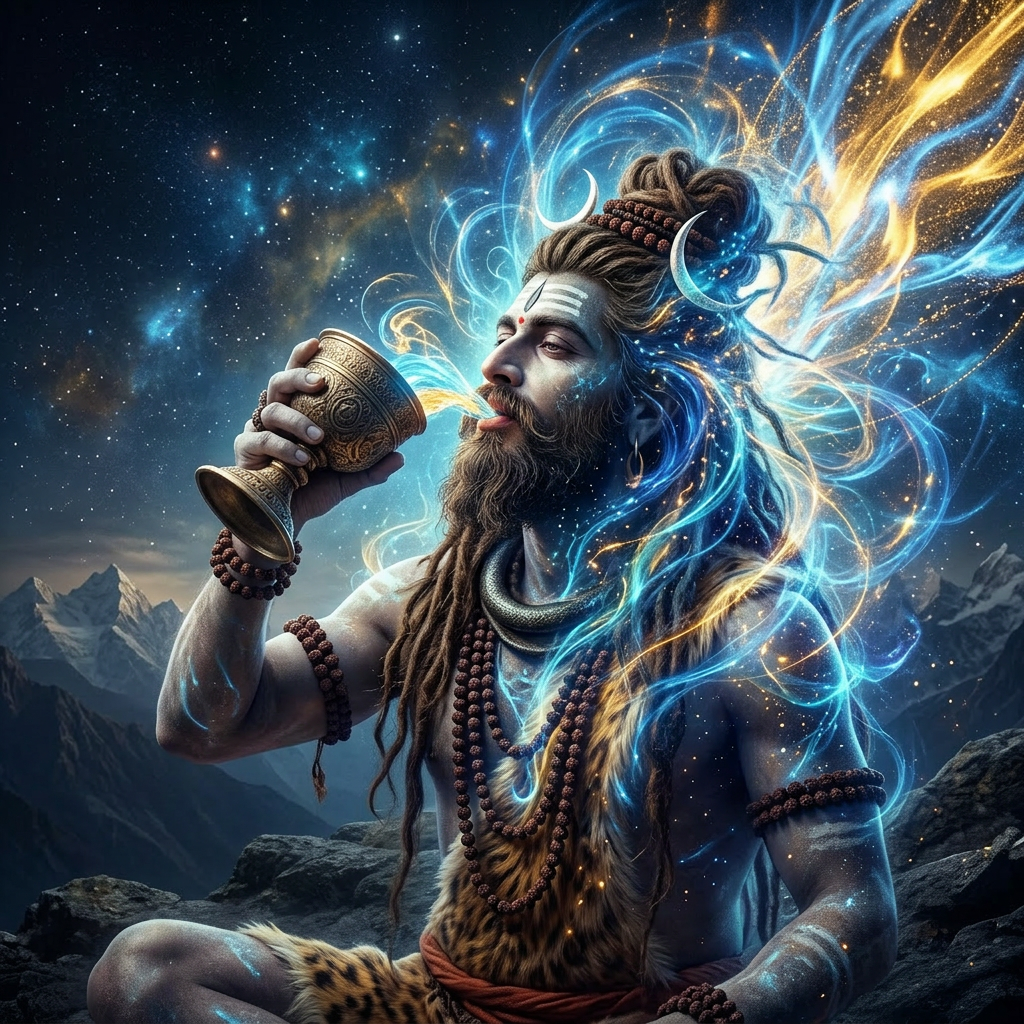
There is in the Rig Veda a divine figure that is perhaps the most directly relevant for understanding what is happening today in the laboratories of Johns Hopkins, Imperial College London, New York University, and dozens of other research centres that are exploring with growing scientific rigour the therapeutic effects of psychedelic substances: Rudra. Not because Rudra would be the god of drugs, which would be a gross simplification. But because Rudra embodies precisely the force that destroys in order to heal, that terrifies in order to liberate, that breaks what obstructs to allow life to circulate again. And this is exactly what contemporary psychedelic medicine does, in its best expressions, for patients suffering from treatment-resistant depression, post-traumatic stress disorder, addiction and anxiety in the face of death.
Let us recall what Rudra is in the Vedic hymns. He is the god who makes one weep, the one whose power is great enough to break what resists, redoubtable enough that the rishis approach him with a caution not found in their relationship with the other great gods. But he is also, and inseparably, the greatest of healers, the one whose hands carry the remedies of the mountains and forests, the one whose pharmacopoeia surpasses that of all other gods. These two dimensions are not contradictory in Vedic thought. They are constitutive of the same reality: profound healing requires a power that resembles destruction from the outside. It is not gentle. It is not comfortable. It strikes down what blocks before liberating what wants to live.
Contemporary psychedelic medicine has rediscovered this truth through the path of rigorous clinical research, without knowing Rudra and without having sought to confirm anything Vedic. Studies on psilocybin in the treatment of major treatment-resistant depression show that patients often pass through intense and difficult experiences during the therapeutic session before reaching what researchers call the opening experience: a dissolution of the habitual defences of the ego, a confrontation with painful psychic materials long avoided, an encounter with aspects of oneself that had been buried under layers of protection. This passage through difficulty, this moment when Rudra makes one weep before healing arrives, is often predictive of the best therapeutic outcomes. The most difficult sessions are frequently those that produce the most profound transformations.
This clinical observation is of remarkable coherence with the Vedic vision of Rudra. In the hymns, one does not ask Rudra to be gentle from the outset. One asks him to direct his power with wisdom, not to strike blindly, to distinguish what deserves to be destroyed from what deserves to be preserved. This is exactly what contemporary therapeutic protocols seek to do with psychedelics: to create a framework in which the power of the substance can operate with the precision of a surgeon rather than the brutality of a storm. The trained therapist is the rishi who accompanies the experience of Rudra, who maintains the sacred framework within which the liberating destruction can occur safely and productively.
Psychic traumas are perhaps the most direct manifestation of what Rudra heals in contemporary psychology. A trauma is precisely an obstruction: something painful that could not be digested and integrated, that has become encysted in the psyche, that blocks the normal circulation of psychic and emotional life. Conventional therapies work slowly and patiently to undo this obstruction, layer by layer, in the safety of a stable therapeutic relationship. MDMA-assisted therapy, which has obtained remarkable results in the treatment of post-traumatic stress disorder, functions differently: it temporarily creates a state in which the habitual defences relax sufficiently for the traumatic material to be approached without triggering the panic response that made it inaccessible in conventional therapy. It is Rudra who lowers the walls, who allows what was locked away to emerge, who creates the space in which healing can finally take place.
The connection between Rudra and soma, which we mentioned in the article on the discreet but real role of Shiva, takes on its full importance here. Both are associated with mountains, wild spaces, a power that surpasses ordinary understanding. Both require a ritualised context for their effects to be beneficial rather than devastating. And both work according to the same logic: dissolving what obstructs to let flow what wants to flow. In contemporary psychedelic medicine practice, this logic is operationalised under the name of set and setting, the state of mind and the framework, which Michael Pollan and the Johns Hopkins researchers have shown to be determining factors for the quality and direction of the experience. A psychedelic taken without framework, without preparation, without intention, is a Rudra without ritual: a power that can liberate but can equally devastate.
There is in the contemporary rise of psychedelic medicine something that deserves to be named clearly: it is a return to Rudra after centuries of exclusion. Modern psychiatry, dominated by the pharmacological paradigm of antidepressants and anxiolytics, has sought for decades to treat psychic suffering by attenuating symptoms, by reducing pain, by making existence more bearable without necessarily transforming what made it unbearable. It is a medicine of the Ashvins, the gentle and benevolent healer gods, effective at relieving but limited in its capacity to transform in depth. Psychedelic medicine is a medicine of Rudra: it does not seek to attenuate suffering but to traverse what produces it, to go to the root of the obstruction to undo it rather than circumvent it.
This return to Rudra in contemporary medicine is not without tensions and resistances. Medical institutions, regulatory agencies, pharmaceutical companies whose economic model rests on medications taken daily rather than on treatments in a few sessions: all these forces oppose real and understandable resistance to the rise of psychedelic medicine. These are contemporary forms of Vritra, not malevolent but obstructive, keeping closed doors that clinical research is striving to open. The fact that the American FDA has granted breakthrough therapy status to psilocybin for treatment-resistant depression and to MDMA for PTSD says that something is changing, that the thunderbolt of Indra is beginning to work, that the retained waters are finding their way.
The Vedic vision of Rudra also offers something important about the training of the therapists who accompany psychedelic sessions. In the hymns, the remedies of Rudra are not accessible to just anyone. They require a knowledge of the plants of the mountains and forests, a familiarity with the forces one is handling, a capacity to accompany without interfering. This is exactly what training programmes in psychedelic-assisted therapies seek to develop: therapists who have themselves had the experience of the states they accompany, who know from the inside the topography of the territory where their patients are venturing, who can maintain the sacred framework without directing the experience according to their own projections. It is the figure of the rishi who accompanies the invocation of Rudra: present, attentive, competent, but sufficiently humble to know that the healing does not come from them but from the force they have invoked.
What contemporary psychedelic medicine and the Vedic vision of Rudra have in common, at bottom, is an understanding of healing that runs counter to the ideal of comfort and avoidance of pain that dominates conventional medicine. They both say that certain healings cannot be gentle, that certain obstructions can only be undone with a power that frightens, that the passage through difficulty is sometimes the necessary condition of profound transformation. They say that Rudra, the god who makes one weep, is also the greatest of healers. And that these are the same thing.


Votre commentaire