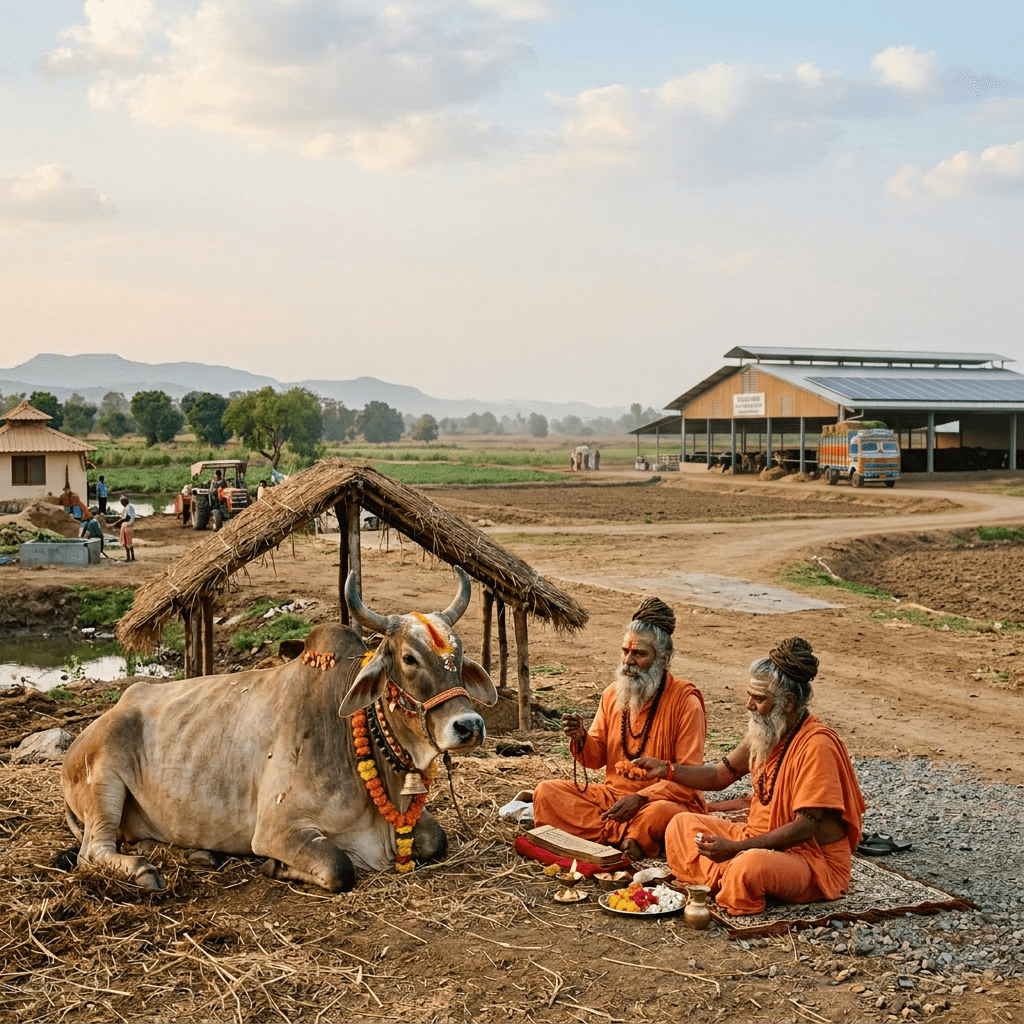
There is in the Rig Veda an animal presence that surpasses all others in density and significance, including the horse of which we spoke in a dedicated article: the cow. She is everywhere in the corpus, from the oldest hymns to the most recent, in forms so multiple and so charged with meaning that it would be impossible to cover them all in a single article. But what makes the Vedic cow particularly interesting for our era is precisely the striking contrast between the way this civilisation conceived of her and the way ours treats her. On one side, a goddess, a cosmic symbol, a sacred presence at the heart of the spiritual and material life of an entire civilisation. On the other, a unit of production in an industrial system that has made her one of the most mistreated and most exploited creatures on the planet.
We mentioned in other articles that the word go, which designates the cow in Vedic Sanskrit, is also the word that designates the ray of light, the divine word, the sky, the earth and water. This polysemy is not an accident of language. It reflects a vision of the world in which the concrete cow and the divine light are manifestations of the same fundamental principle. It is not that the Vedic Indians confused the cow and the light. It is that they perceived in the cow something that ordinary eyes do not see: a vital force, a generosity, a way of being that corresponded to what the hymns described when they spoke of the Light of Brahman.
This perception was not a poetic fancy. It had a concrete and daily foundation. The cow nourished. She gave the milk that fed families, the clarified butter that fuelled the sacrificial fire, the milk that was mixed with soma in the sacrifice. She was generosity incarnate: she gave without asking in return, she nourished unconditionally, she offered life without calculation. In a civilisation whose highest spiritual value was precisely the offering without guaranteed return, the gift without calculation, unconditional generosity, the cow was a living model of this virtue. One did not need a philosophical treatise to understand what generosity is. It sufficed to observe the cow.
The hymns to the cow in the Rig Veda are not catalogues of her practical uses. They are celebrations of a presence. The cow is described in them as the mother, as the source of abundance, as the guardian of the hearth, as the animal whose presence in a community is the sign of its spiritual as much as its material prosperity. In certain hymns, the cows are Lights, rays of the sun having taken animal form, manifestations of Brahman rendered accessible to ordinary perception. This divinisation does not prevent the concrete and daily relationship with the animal. On the contrary, it deepens it: to treat a cow with care and respect is to honour a divine presence in its most accessible and most intimate form.
The economic value of the cow in Vedic civilisation was considerable and well documented in the hymns. She served as a standard of exchange, a unit for measuring wealth. Soma was exchanged for a cow at its full value, which says something about the level of that value. Gifts made to priests after the great sacrifices often included cows. Requests to the gods frequently included prosperity measured in cows. But this economic value was never separated from spiritual value. A cow was not simply an abstract unit of value, like gold in later economic systems. She was a living presence, whose value came precisely from what she was: a generous, nourishing, sacred being.
What the Vedic tradition says about the cow has implications that go well beyond the question of Hinduism and the sacred cow in contemporary India. It says something about the fundamental relationship between a civilisation and the animals that feed it, and about what happens when this relationship is reduced to its purely economic dimension. Contemporary industrial farming is perhaps the most brutal illustration of what a civilisation becomes when it loses contact with ṛta, when it allows the collective ego and economic calculation to replace the vision that recognised in the cow a sacred presence deserving respect and care.
The figures of industrial farming are difficult to look at squarely. The cow in an intensive farming system is kept in near-permanent gestation to produce milk in industrial quantities. Her calf is taken from her at birth to prevent it from consuming the milk destined for commercial production. She lives in confined spaces, often without seeing daylight or treading on natural ground. Her productive lifespan is four to five years, after which she is slaughtered. She is no longer an animal. She is a biological machine optimised for the production of proteins and lipids at minimum cost. And this machine, we produce at tens of billions of units per year, in a system that is one of the principal contributors to greenhouse gas emissions, deforestation, water pollution and loss of biodiversity.
It would be naive to pretend that it suffices to reread the Vedic hymns to the cow to resolve this problem. The reasons why industrial farming exists are complex, economic, demographic, political. They do not reduce to a loss of spirituality. But it would be equally naive to pretend that the way in which a civilisation treats the animals that feed it has nothing to do with its worldview, with its fundamental values, with what it recognises or fails to recognise as sacred. The Vedic Indians treated the cow with respect and care because they perceived her as a divine presence. We treat the cow with indifference and brutality because we have reduced our relationship with her to her market value alone. This is not a difference of technology. It is a difference of vision.
Ahimsa, non-violence toward all living beings, which would become one of the fundamental principles of Hinduism and Jainism, finds its oldest roots in this Vedic relationship with the cow and with animals in general. It is not a rule imposed from outside. It is the logical consequence of a vision in which all beings are manifestations of Brahman, in which to harm an animal is to harm an expression of ultimate reality, in which the cow that gives her milk is a divine presence deserving the same consideration as any other divine presence.
The Rig Veda does not tell us how to organise a global food economy for nine billion human beings. It does not claim to answer questions it could not have anticipated. But it tells us something essential and timeless about the nature of the relationship between human consciousness and the living world that feeds it. It tells us that this relationship can be a relationship of recognition, respect and reciprocity, in which what nourishes the body is also what nourishes the soul. And it tells us, by contrast, what we have lost in reducing this relationship to a calculation of costs and benefits: not only the dignity of the animals we raise, but something of our own dignity, something of our capacity to see the sacred in what feeds us.


Votre commentaire