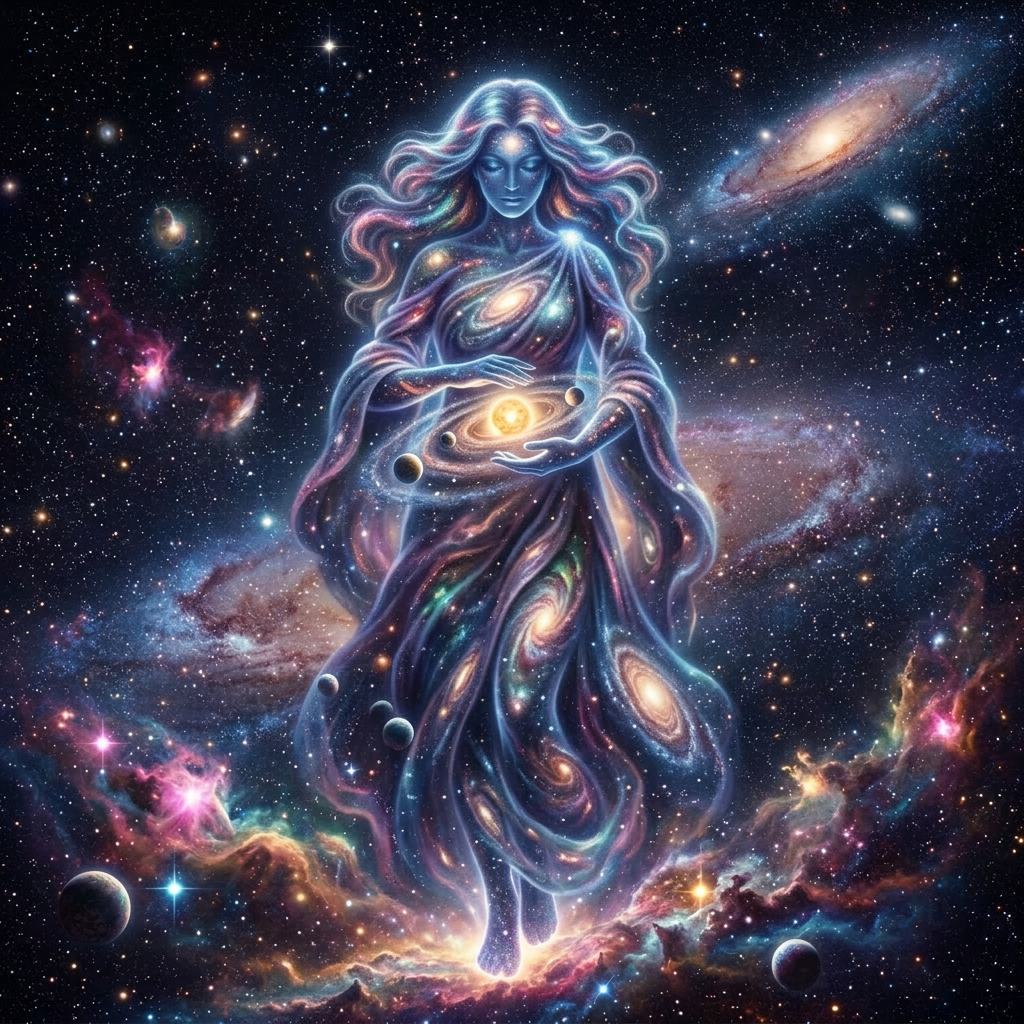
There is in the Rig Veda a divine figure that resists all definitions — that escapes every attempt to grasp it, to circumscribe it, to reduce it to a function or a story. This figure is Aditi. And perhaps it is precisely because she is the infinite itself that any definition betrays her.
Her name says everything — and says nothing. « A-diti » — that which cannot be bound, that which has no limits, that which cannot be contained in any form. In a pantheon where each god has its attributes, its stories, its domains of competence — Aditi is the one who escapes all of that. She is the ground on which everything is drawn. The silence from which all speech is born. The space from which all forms emerge.
What the Hymns Say About Aditi
In the Rig Veda, Aditi is invoked in very diverse contexts — for protection, for liberation from the bonds that imprison us, for health, for prosperity. But what characterizes her in all these contexts is her nature as universal matrix — she is the mother of all the gods, the mother of all beings, the mother of all that exists.
The Adityas — those solar gods who form the heart of the Vedic pantheon — are her sons. Varuṇa, Mitra, Aryaman, Indra, Sūrya — all these major cosmic forces emerge from Aditi. Which means they are partial expressions, limited aspects, of a reality that precedes and surpasses them all.
One hymn of the Rig Veda says — « Aditi is the sky, Aditi is the atmosphere, Aditi is the mother, the father, the son. Aditi is all the gods, Aditi is the five peoples, Aditi is what has been born and what will be born. »
This formulation is vertiginous. Aditi is not one divinity among others — she is the totality. She is simultaneously sky and earth, past and future, gods and humans. She is what contains everything without being contained by anything.
Aditi and Freedom
There is a dimension of Aditi that deserves particular attention — her relationship to freedom and liberation.
In the hymns, Aditi is invoked to be freed from bonds — debts, faults, illnesses, constraints that imprison. And this invocation says something important about her nature. If Aditi is the unlimited, then to approach her is to approach a state where limitations fall away. Where what chains us dissolves into something vaster.
This liberating dimension of Aditi prefigures what will become in the Upanishads the notion of moksha — the final liberation, the dissolution of the limited ego into infinite consciousness. Aditi is already, in the Rig Veda, the symbol of this state — not as a distant and abstract goal, but as a present reality into which one can enter, even momentarily, through ritual practice and awareness.
Aditi and Modern Cosmology
What is remarkable about Aditi is the way this ancient Vedic intuition resonates with some of the most recent discoveries of physics and cosmology.
The quantum vacuum — that state of space which is not empty in the ordinary sense, but which is full of a colossal potential energy from which pairs of particles spontaneously emerge — is a scientific description of something that resembles strangely what the rishis described under the name of Aditi. An indescribable, unlimited ground from which all forms emerge and to which they return.
The expansion of the universe — that cosmological fact that space itself is expanding in all directions, without center, without limit — is another image of Aditi. An infinite that does not define itself in relation to something external because there is nothing external to it.
And consciousness — that mystery that neuroscience struggles to explain from matter alone — finds perhaps in Aditi a more accurate metaphor than in any materialist model. Consciousness as infinite space in which all experiences appear and disappear. Aditi as universal consciousness of which each individual consciousness is a limited and temporary expression.
Aditi and the Mother
A word must be said about the maternal dimension of Aditi — which is as fundamental as her dimension of infinity.
In the hymns, Aditi is the mother par excellence — not only the mother of the Adityas, but the mother of everything. This cosmic maternity is not a sentimental metaphor — it is a deep intuition about the nature of the infinite.
The infinite is not a cold and geometric abstraction. It is fertile — it generates forms, it gives birth to universes, it carries within it the potentiality of everything that can exist. And this creative fertility is what the rishis chose to symbolize through the maternity of Aditi.
The mother who carries the child — who contains it without constraining it, who gives it everything it needs to develop, who releases it when the time comes — is the most accurate image of what the infinite does with the finite. Aditi carries the Adityas as the infinite carries the finite — giving it its substance, allowing it to exist, always remaining greater than it.
What Aditi Teaches Us
Aditi is perhaps the most difficult divinity of the Rig Veda to approach — and the most profound. Because she gives no handhold. One cannot ask her for something precise as one asks Indra for victory or Agni for purification. One can only open to her — open to the idea that what one is infinitely surpasses what one believes oneself to be. That the limits one imposes on oneself — fixed identities, rigid certainties, borders between self and the rest — are provisional constructions in something far vaster.
In a world that is collapsing — that is losing its certainties, its reference points, its structures — Aditi is not a consolation. She is something more radical — an invitation to recognize that the collapse of forms is not the end of everything. That what subsists when forms collapse — the unlimited ground from which they emerge — is Aditi. Is always there. Has never begun and will never end.
This is perhaps the most difficult and most necessary lesson of the Rig Veda for our era.
 Le Rig Veda
Laisser un commentaire