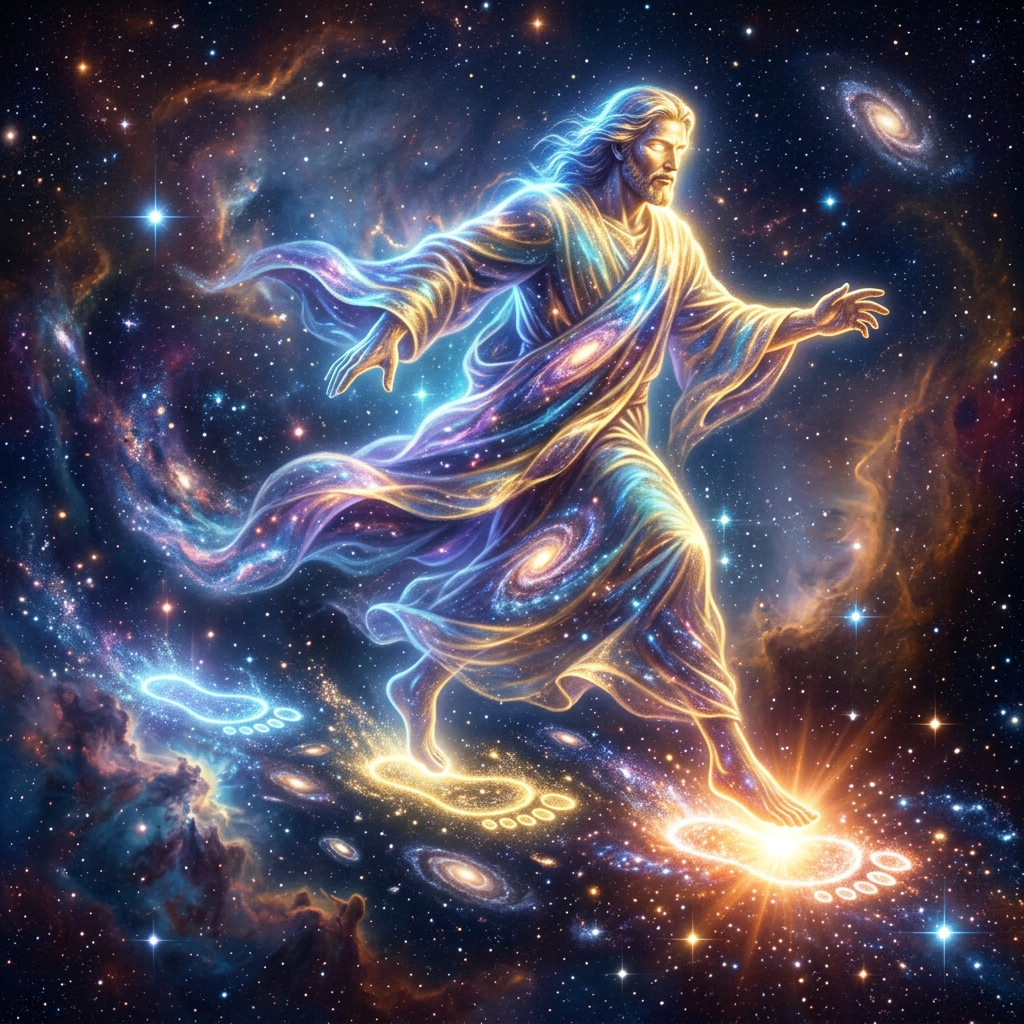
There are in the first mandala of the Rig Veda three consecutive hymns, hymns 1.154, 1.155 and 1.156, that form together one of the most coherent and most profound ensembles in the entire corpus on the nature of knowledge and on the way a consciousness can traverse the levels of reality. Their protagonist is Vishnu, whose name comes from the root vish, meaning to be active, to become active, to act in and for the people. Vishnu is therefore literally the one who is in movement in the world, the one whose activity is constitutive of his nature, the one who cannot be understood from a fixed point because he is himself the movement. And this active and penetrating nature of Vishnu is precisely what his three strides illustrate: a knowledge that does not observe but traverses, that does not instrument but walks.
Hymn 1.154 opens with an announcement that says from the outset that what follows is not ordinary: I shall declare the mighty deeds of Vishnu, the one who measured the terrestrial regions, who sustained the highest regions, taking three great strides, walking with great steps. This is not a request for material goods, not an invocation to obtain victory or prosperity. It is the celebration of an act of knowledge: measuring the terrestrial regions, sustaining the highest regions. These two simultaneous gestures, measuring what is below and sustaining what is above, say something essential about the function of Vishnu in Vedic cosmology: he is the link between the levels, the one whose presence maintains the coherence of the whole.
The second verse adds an image that surprises those familiar with the later version of Vishnu in classical Hinduism: Vishnu is honoured as terrible as a tiger prowling in uninhabited mountains. This Vedic Vishnu is not yet the benevolent and smiling temple god of the later Vaishnava tradition. He still carries within him something wild, something that belongs to undomesticated spaces, to inaccessible heights where the summits meet the Sky. He is a force of nature that traverses territories mortals cannot reach, and whose power is precisely linked to this capacity to circulate where ordinary life cannot go.
The three strides themselves are described in the third verse with a cosmological precision that constitutes in reality a complete cartography of the Vedic universe: Vishnu places his first stride on the Earth, his second stride in the Intermediate World, and his third stride in the highest Sky, where the gods rejoice, where the streams of honey flow. These three levels that we described in other articles are here measured in a single continuous movement: the Earth of our ordinary consciousness, the Intermediate World of expanded states of consciousness where the gods and spirits circulate and where the essential of Vedic spiritual life unfolds, and the supreme Sky of Brahman, the ultimate reality that precedes and contains all particular manifestations.
What is remarkable in this description is what it says about the nature of knowledge. Vishnu does not measure the universe from the outside, from a fixed point from which he projects measuring instruments onto what he wishes to know. He measures the universe by traversing it, by being present within it, by placing his foot in each of its levels. It is an epistemology of walking, a way of knowing through embodied presence in what one wishes to know, that is the exact opposite of modern scientific epistemology. Science asks the researcher to efface themselves, to neutralise their subjectivity, to create a maximum separation between themselves and what they measure. Vishnu does the opposite: he is there, he places his foot, and it is this that constitutes the measurement.
The third stride is the one that mortals cannot see. The first two are accessible, in one way or another: the Earth that everyone treads, the Intermediate World that those who practise the sacrifice and drink soma can traverse in expanded states of consciousness. But the third remains beyond the reach of ordinary perception. And yet the rishis speak of it, invoke it, desire it with a precision that says they know something of it, even if they cannot see it directly. This knowledge from the edge, this knowledge of the invisible from the boundary of the visible, is perhaps the most precious of all that the Rig Veda transmits: not the pretension of seeing what cannot be seen, but the certainty that it exists and the aspiration stretched toward what one senses without being able to grasp it.
Hymn 1.155, which follows immediately and addresses Vishnu and Indra together, adds a fundamental dimension to this vision. One sees the two gods seated at the summit of the mountains after drinking soma. The co-presence of Vishnu and Indra in this hymn says something important that one would not find by reading the two hymns separately: the measurement of the universe and the liberation of vital energy are two aspects of the same movement. One cannot truly traverse the three levels of reality without soma, without that expanded state of consciousness that allows access to the Intermediate World and a glimpse of the Sky. And conversely, soma alone, without the wisdom of Vishnu who knows where he is going and what he is traversing, produces only intoxication without knowledge. The two together produce the cosmic surveyor: the one who knows where he is because he has traversed all the levels of what is.
Hymn 1.156 completes this triptych by adding a generous dimension that is often forgotten in discussions of the three strides: Vishnu enriches the praise. He is not only the one who measures. He is the one who enriches, who nourishes, who gives more than is asked of him. This generosity is inseparable from his quality as measurer: because he knows the universe in all its dimensions, he knows exactly what each thing needs in order to be accomplished. Just measurement produces just generosity. The one who knows only the surface of things can give only from the surface. The one who knows the depths gives from those depths.
What this triptych of hymns tells us about measuring the universe differently is of remarkable coherence. Measuring the universe differently means first recognising that it has three levels and not just one. Modern science measures the first level, the Earth, with extraordinary precision and power. It is beginning to explore the edges of the second level, the Intermediate World, with studies on states of consciousness, the psychology of the depths, and a quantum physics whose paradoxes strangely resemble the Vedic description of this level as a space where ordinary categories relax. But the third level, the supreme Sky, the one that mortals cannot see, remains beyond its reach, not for lack of technology but because of a structural limitation: one cannot measure what is the condition of possibility of all measurement.
Measuring the universe differently also means accepting that certain forms of knowledge cannot be separated from the embodied presence of the one who knows. Vishnu’s three strides cannot be replaced by satellite data or mathematical models, however sophisticated. They require that someone place their foot on each level, be truly present there, breathe the particular air of that space, feel beneath their sole the texture of that level of reality. It is a form of knowledge that the contemplative traditions of all cultures have kept alive, with diverse methods but a common conviction: certain truths cannot be read, cannot be calculated, cannot be deduced. They must be walked.
And measuring the universe differently means finally recovering the link between measurement and generosity that hymn 1.156 expresses with such simplicity. Vishnu enriches the praise. The true knowledge of the structure of the universe does not produce domination or exploitation. It produces generosity, because the one who sees clearly the needs of each level of reality knows how to respond to them with precision and abundance. This is perhaps the most profound critique that Vishnu’s three strides address to our contemporary way of measuring the world: we have developed an extraordinarily precise measurement that has produced an extraordinarily effective exploitation, because we have lost the link between knowledge and generosity that makes Vishnu not merely a surveyor of space, but a god, that is to say an active force in the service of life in all its dimensions.


Votre commentaire