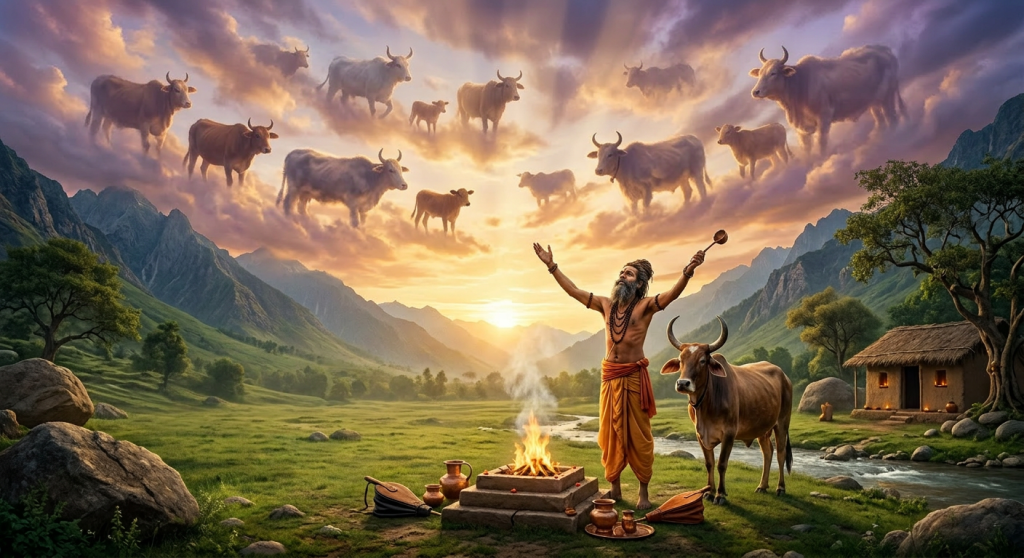
There are in the Rig Veda hundreds of requests addressed to the gods for prosperity. Cattle, horses, sons, gold, good harvests, victory in battles, longevity. These requests have often embarrassed modern commentators who would have preferred sacred texts to confine themselves to spiritual heights and leave material matters aside. They have also given ammunition to those who saw in the Vedic religion a simple utilitarian magic, a system of barter with the gods. Both readings miss the essential, because they ignore what the word artha truly meant for the Vedic Indians, and what this says about the profound difference between their conception of prosperity and the one that dominates our era.
Artha is one of the four purusharthas, the four goals of human life in the Indian tradition: dharma, Truth and duty; artha, prosperity and meaning; kama, desire and pleasure; moksha, liberation. These four goals are not hierarchised in an opposition between the material and the spiritual. They are conceived as the four dimensions of a fully human life, which can only be accomplished if the four are cultivated in a balance that reflects the situation, age and vocation of each person. This holistic vision of human life is radically different from any conception that would oppose material wealth to spiritual purity.
The word artha itself is of remarkable richness. It simultaneously means goal, sense, significance, wealth, resource and utility. These meanings are not accidental homonyms. They say that for the Vedic Indians, material wealth and the meaning of life were inseparable. It is not that money gives meaning to life, which would be a modern and reductive way of reading this association. It is something deeper: the material resources that allow a life to be accomplished in all its dimensions are a form of meaning, they are part of what gives life its direction and its fullness. A life deprived of the resources necessary for its unfolding is a life whose meaning is impeded. And conversely, resources accumulated without direction, without goal, without meaning, are not artha. They are accumulation, something fundamentally different.
In the hymns, these metaphors that are requests for prosperity are always contextualised. One asks for cattle to feed the family and participate in the sacrifice. One asks for horses to travel and defend oneself. One asks for good harvests so that the community is fed. One asks for longevity to have the time to accomplish what a life has to accomplish. These requests are never abstract, never unlimited, never decoupled from a use and a context. One does not ask for wealth in general, as an absolute good to be accumulated indefinitely. One asks for what is needed to live fully and to fulfil one’s responsibilities toward the community and the cosmos.
This distinction between wealth as a resource for an accomplished life and wealth as indefinite accumulation is perhaps the most important that the Vedic vision of artha offers us for understanding our era. We live in economies that have made infinite growth their fundamental objective. Not growth in view of a particular goal, not the increase of available resources to allow more human beings to fully live their four purusharthas. But growth as an end in itself, growth for growth’s sake, that perpetual movement of economic expansion whose interruption economists have long presented as the worst of catastrophes.
Yet infinite growth is a biophysical impossibility on a planet of finite resources. Every biologist, every physicist, every ecologist knows this. A population of bacteria growing exponentially in a Petri dish ends by exhausting its resources and collapsing. An economy growing exponentially on a finite planet ends by exhausting the natural systems that sustain it and collapsing. This is not a catastrophist hypothesis. It is a law of physics. What is surprising is not that we are beginning to see the signs of this exhaustion, but that we have been able for so long to ignore this fundamental impossibility by calling it progress.
The Vedic rishis did not know the laws of thermodynamics, but they knew something equivalent within their own framework of thought: the Truth, the fundamental reality of the world, which says that everything is cyclical, that nothing can grow indefinitely, that accumulation that does not circulate becomes corrupt, that life is maintained through circulation and not through accumulation. Their requests for prosperity were requests for circulation: that the water flow, that the harvests be good, that the animals reproduce, that the fire burn, that the exchanges be just. Not requests for endless accumulation.
The post-Rig Vedic Lakshmi, who would become in Hinduism the goddess of wealth, is at the origin the goddess of benevolent chance, of fortune in the sense of what presents itself at the right moment. She is the daughter of Aditi, the infinite mother, and this lineage says something about the nature of true wealth in the Vedic vision: it is a gift of the infinite, it flows toward those who are in alignment with the Truth, it leaves when one tries to retain it by force or greed. The post-Rig Vedic Lakshmi is not kept. She circulates. And the one who knows how to let her circulate is the one who continues to benefit from her.
This vision of wealth as circulation rather than accumulation has concrete economic implications that contemporary economists are beginning to rediscover under other names. The circular economy, which seeks to eliminate waste by making the output of one process the input of another, intuitively reproduces the Vedic logic of circulation. The economy of the common good, which measures the performance of enterprises not by their profit but by their contribution to collective wellbeing, recovers something of the Vedic vision in which individual prosperity is inseparable from the prosperity of the community. Selective degrowth, which proposes reducing certain destructive economic activities while maintaining or developing those that truly contribute to human wellbeing, intuitively recovers the Vedic distinction between artha, wealth that has meaning and purpose, and directionless accumulation.
What the Vedic request for prosperity tells us, at bottom, is that asking for wealth is not in itself a base or materialistic approach. It is a natural and legitimate approach, on condition that the wealth requested is artha: a wealth that has meaning, that is proportionate to real needs, that is destined to circulate and not to accumulate, that is inscribed within the Truth of the world rather than violating it. An economy founded on artha rather than on infinite growth is not an economy of poverty. It is an economy of sufficiency, of just measure, of wealth that gives meaning to life rather than substituting itself for it. And this is perhaps the most concrete and most urgent contribution that the Vedic vision can make to our era: not an esoteric philosophy about states of consciousness, but an economy of meaning, a way of producing and exchanging that knows what it is seeking and why.


Laisser un commentaire