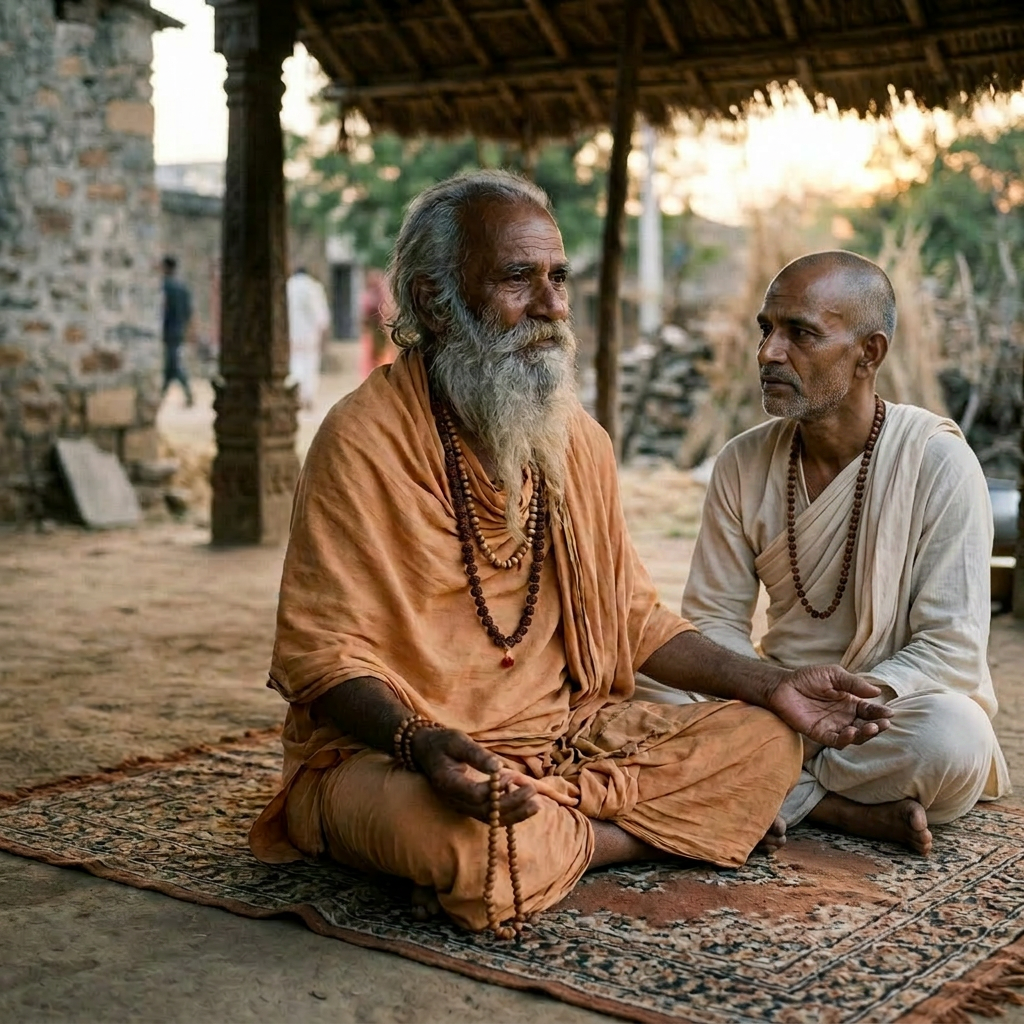
There is a technical word that designates the most fundamental form of Vedic transmission, the one that precedes all others and is their condition: Samhita. This word means literally put together, joined, composed, and it designates at once the text of the Rig Veda in its entirety and the first mode of recitation, the one in which the words are recited with their natural phonetic liaisons, the sandhi, in a continuous flow that is the form closest to what the hymns must have sounded like in the mouths of their original authors. But beyond this technical meaning, the Samhita is something deeper: it is the living memory of a civilisation, carried in human bodies, transmitted from mouth to ear across millennia, surviving everything that history has thrown against it.
We devoted an article to the oral transmission of the Rig Veda and to the extraordinary mnemonic techniques that the Vedic Indians had developed to guarantee the fidelity of this transmission. But we have not yet examined what the survival of this tradition tells us about the nature of oral memory in general, about what it preserves that writing cannot preserve, and about what we are in the process of losing as the great oral traditions of the world go out one after another under the combined pressure of modernisation, the marginalisation of traditional cultures and the death of the last bearers.
Oral memory is not simply a primitive form of archiving, an awkward substitute for writing that civilisations without letters would have used for lack of anything better. It is something fundamentally different from writing, not inferior but other, with its own properties, its own strengths and its own limits. Writing preserves forms. Oral memory preserves life. What writing cannot transmit is the way a text must sound in a human mouth, the rhythm of the breath that accompanies it, the quality of presence and intention that gives it its effectiveness, the relational context between the master who gives and the student who receives. All of this is lost when a text passes from the body to the page.
The Vedic Samhita survived precisely because its transmitters had understood this difference and had developed techniques to preserve not only the forms of the text but the life that animated it. The recitation modes — Pada, Krama, Jata, Ghana and the others — of which we spoke in the article on oral transmission, are ways of knowing the text from the inside, of carrying it in its deep structure rather than in its linear surface, of making it a part of oneself that cannot be forgotten because it is integrated into the way one thinks and perceives. A brahmin who has memorised the Rig Veda in all its recitation modes does not consult the text. He is it, to a certain degree. He carries it within him as a cognitive and spiritual structure that orients everything he does and everything he says.
This way of inhabiting a text rather than consulting it is the most profound and most precious characteristic of oral memory. It produces a relationship to knowledge that is qualitatively different from the relationship that writing, and a fortiori the digital, produces. When one searches for information on the internet, one finds it and uses it, but it does not become a part of oneself. It remains external, consultable, replaceable by another piece of information. When one has memorised a text according to Vedic methods, it becomes part of one’s inner structure, of one’s way of thinking and perceiving. The difference is that between possessing a map and knowing a territory, between having a recipe and knowing how to cook.
The great oral traditions of the world are disappearing at an alarming rate. The ethnolinguists and anthropologists who document these traditions have been sounding the alarm for decades: with every language that dies, with every elder who carries to the grave the corpus of knowledge they bore, something irreplaceable disappears. The oral traditions of the indigenous peoples of Amazonia, Africa, Australia and the Americas carry botanical, ecological, medical, cosmological, philosophical and spiritual knowledge accumulated over millennia of direct observation and lived experience in particular environments. This knowledge is not available in books. It cannot be, because it is inseparable from the living context that gives it its meaning and its effectiveness.
UNESCO estimates that half of the seven thousand languages still spoken in the world are threatened with extinction by the end of the century. With every language that disappears, a unique way of organising perception, thought and relationship with the world goes out. Linguists have shown that languages are not simply different codes for the same ideas. They structure perception differently, they permit distinctions that other languages do not make, they reflect ways of understanding time, space, causality and the relationships between beings that vary from one culture to another in ways that are not always translatable. When a language dies, these distinctions die with it, and the perception they made possible disappears from humanity’s cognitive arsenal.
What the Vedic Samhita achieved where so many other traditions have failed is to cross four thousand years of history without breaking. Invasions, colonisations, changes of religion, political transitions, natural catastrophes: nothing has interrupted the chain of transmission that connects the brahmins who recite the Vedic hymns today to the rishis who composed them six thousand years ago. This extraordinary resilience is not the fruit of chance. It is the result of two factors that combined to create a form of transmission of exceptional robustness. The first is technical: the multiple recitation modes create redundancies that make any alteration immediately detectable. The second is spiritual: the deep conviction of the transmitters that what they carried was of sufficient value to justify the extraordinary investment of an entire lifetime in its preservation.
It is this second factor that is the most difficult to reproduce and the most threatened in the contemporary world. One can digitise the texts, one can record the recitations, one can archive threatened languages in databases. But one cannot digitise the conviction that something is worth transmitting at the cost of an entire life. And without this conviction, oral traditions die even when the texts survive, because a text without a living transmitter is an empty shell, a form without the life that gave it its meaning.
The Vedic tradition itself is confronted with this threat today. UNESCO recognised in 2003 the Vedic recitation as oral and intangible heritage of humanity, but this symbolic recognition has not resolved the concrete problems that threaten the tradition: the diminishing number of families that commit to the transmission, the competition of modern academic and professional training that offers more immediate economic prospects, the growing mismatch between the way of life that traditional Vedic transmission requires and the way of life that Indian modernisation proposes and valorises.
What we lose with the great oral traditions is difficult to quantify precisely, but easy to sense. We lose forms of knowledge that cannot be reduced to information, ways of being in the world that cannot be taught in a classroom, relationships to time, nature and the sacred that cannot be reconstructed from archived texts. And we lose, perhaps above all, the living proof that the human being is capable of carrying within themselves, in their memory and in their flesh, a heritage of consciousness accumulated over generations, and of transmitting it intact to those who come after. The Vedic Samhita is the most extraordinary demonstration of this capacity. Its growing fragility is the most serious warning we could receive about what we are in the process of choosing not to transmit.


Laisser un commentaire