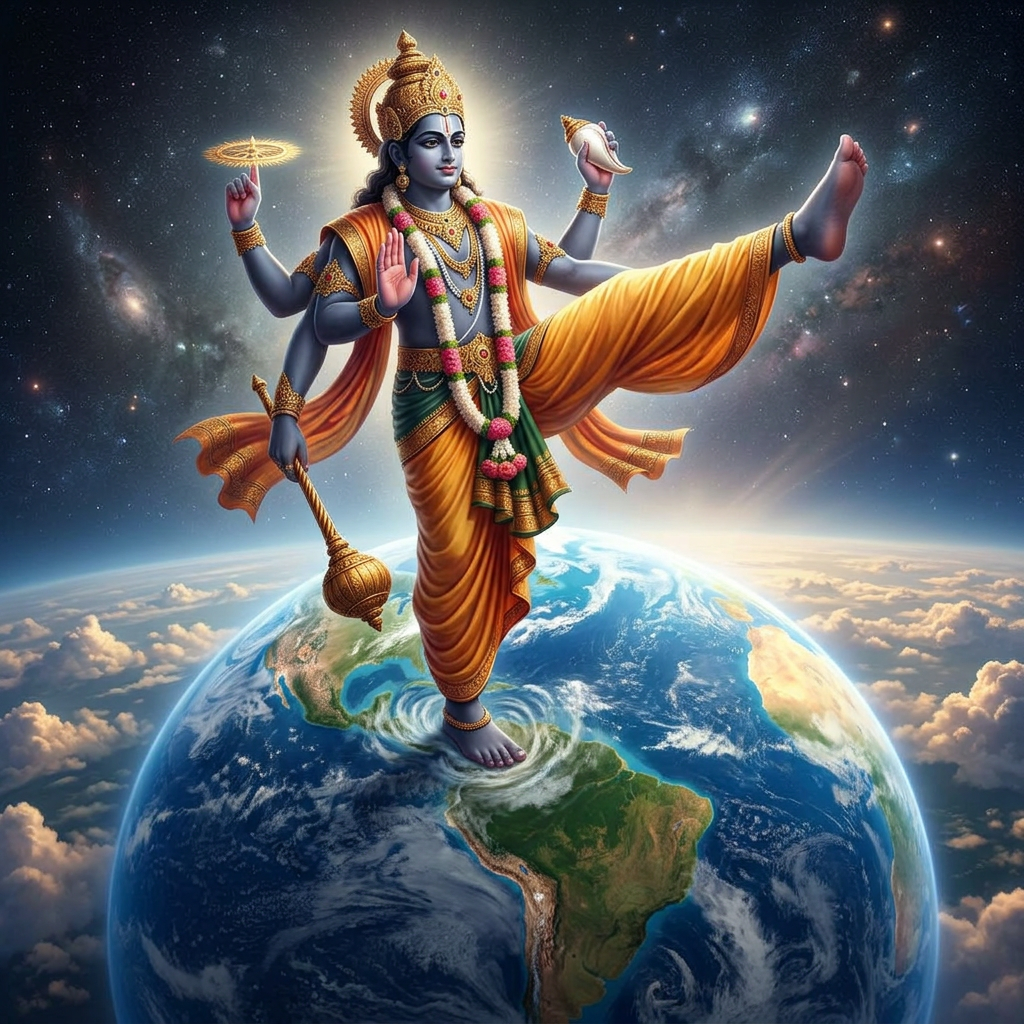
There is in the Rig Veda a figure whose relative discretion contrasts sharply with the cosmic importance it would acquire in the centuries that followed: Vishnu. In the Vedic hymns, Vishnu is not yet the great preserver god of the Trimurti, the maintainer of the world who incarnates in avatars to save humanity from successive crises. He is something both simpler and more mysterious: the one who takes three strides. These three strides that measure the universe are one of the most commented upon, most celebrated and most profound mythological gestures in the entire Indian tradition. And they say something about measurement, about knowledge, about the relationship between the human being and the universe that contains them, that is of striking relevance for an era that measures everything and understands less and less.
The name Vishnu comes from the root vish, to be active, to penetrate, to be present everywhere, to permeate. Vishnu is literally the one who is active, the one whose activity consists in penetrating all space, in being present in every corner of existence. This is not a passive, contemplative presence. It is a dynamic presence, in permanent movement, that maintains the world in functioning through its continuous activity alone. In the hymns, Vishnu is described as the lord of space, the one who has measured the worlds and who guarantees their structure through his knowledge of their dimensions. And this knowledge he acquired through his three strides.
The three strides of Vishnu are described in several hymns of the first mandala, notably hymn 1.154, entirely devoted to this figure. Vishnu places a first stride on the earth, a second stride in the regions of the intermediate world, and a third stride in the highest sky, that summit which mortals cannot see. This third stride is the most important and the most mysterious. It is placed where the gods rejoice, where the sources of honey flow, where ultimate knowledge resides. And it is precisely this stride that human beings cannot see, cannot reach by their own means alone, can only contemplate from afar with an aspiration that is itself a form of knowledge.
The structure of these three strides reproduces exactly the cosmological tripartition that we examined in the article on Earth, the Intermediate World and the Sky. The Earth, the intermediate atmosphere, the supreme Sky: Vishnu measures the three levels of reality in a single continuous gesture, in three strides that say that the universe is a whole whose levels are accessible to the one who knows how to move between them. The measurement of Vishnu is not a quantitative measurement. It is not the measurement of the scientist who assigns numbers to the dimensions of space. It is a qualitative measurement, a way of knowing each level of reality for what it is, of traversing it with the fullness of presence, of understanding its nature and its place in the whole.
What these three strides say about the nature of knowledge is fundamental and deserves to be dwelt upon at length. Vishnu does not measure the universe from the outside, from a fixed point from which he projects his measuring instruments onto what he wishes to know. He measures the universe by traversing it, by being present within it, by placing his strides in each of its levels. It is a knowledge through immersion, through presence, through participation, radically different from the knowledge through distanced observation that modern science has developed as its dominant method. Vishnu does not look at the universe. He walks it.
This distinction between walking a space and measuring it from the outside is at the heart of the difference between the Vedic vision of knowledge and the modern scientific vision. Modern science has produced measuring instruments of extraordinary precision. It can measure the distance of galaxies in light years, the size of quarks in femtometres, the duration of chemical reactions in femtoseconds. It has given humanity a technological mastery of the physical world that is without precedent in history. But it has also created an abyss between the measurer and what is measured, between the knowing subject and the known object, between the human being and the universe they inhabit. Vishnu measures the universe by traversing it because he is part of it. Modern science measures the universe from the outside because it needs this distance to be objective.
The third stride of Vishnu, the one that mortals cannot see, is the most precise image of this limit. There is a level of reality that measuring instruments cannot reach, not because the technology is not yet advanced enough, but because this level is of a fundamentally different nature from the first two. The Earth and the Intermediate World can be measured, observed, instrumentalised. The supreme Sky, Brahman, ultimate reality, cannot be, because it is the condition of possibility of all measurement and measurement cannot seize itself as an object. This is the fundamental limit of all objective knowledge: it cannot know what makes it possible.
Contemporary physicists encounter this limit in an increasingly explicit way. Quantum mechanics has shown that the observer modifies what they observe, that measurement is not a neutral act but an intervention that changes the reality being measured. Cosmology seeks to understand the origins of the universe but runs up against the fact that the physical laws it uses for this understanding are themselves products of this universe and cannot be applied to what precedes its existence. Unified theories of everything, the holy grail of contemporary theoretical physics, seek to measure the universe in its totality but encounter the same limit as the third stride of Vishnu: there is a level where measurement ceases to be possible because the measurer is themselves part of what is being measured.
Vishnu in the hymns is also described as the one who helps Indra in his cosmic battles, as the friend of the devoted, as the one who opens space so that life can unfold within it. This active and benevolent dimension of Vishnu says something about the nature of true knowledge in the Vedic vision: it is not neutral. It is oriented toward life, toward the unfolding of what can grow, toward the protection of what is precious. Vishnu measures the universe not in order to control it but to serve it, to maintain the conditions in which life and consciousness can flourish at all their levels.
This is perhaps the most important lesson that the three strides of Vishnu offer our era. We have developed an extraordinary capacity for measurement, but we have dissociated it from the question of service. We measure the universe, we measure the economy, we measure performances, we measure productivity, we measure happiness on scales of one to ten. But the question that Vishnu poses in his three strides is not how much but where and how. Not what is the size of the universe but what are its levels and how does one traverse them. Not what is the value of this action but does it open space for life or does it close it.
The third stride of Vishnu, the one that mortals cannot see, is perhaps what our civilisation most needs to recover: the awareness that there is a level of reality that cannot be measured, cannot be instrumented, cannot be optimised, but that is nonetheless the most real of all, the one that gives meaning and value to everything else. This level, Vishnu knows because he traverses it. We can know it too, but not with the instruments we have built for the first two levels. It requires a different kind of stride, an inner stride, the stride of a consciousness that opens to what surpasses it. This is what soma gave. This is what meditation seeks. This is what the hymns to Vishnu describe: the ultimate measurement of the universe, placed where mortals cannot see, but which is nonetheless the only measurement that gives the other two their true dimension.
 Le Rig Veda
Laisser un commentaire