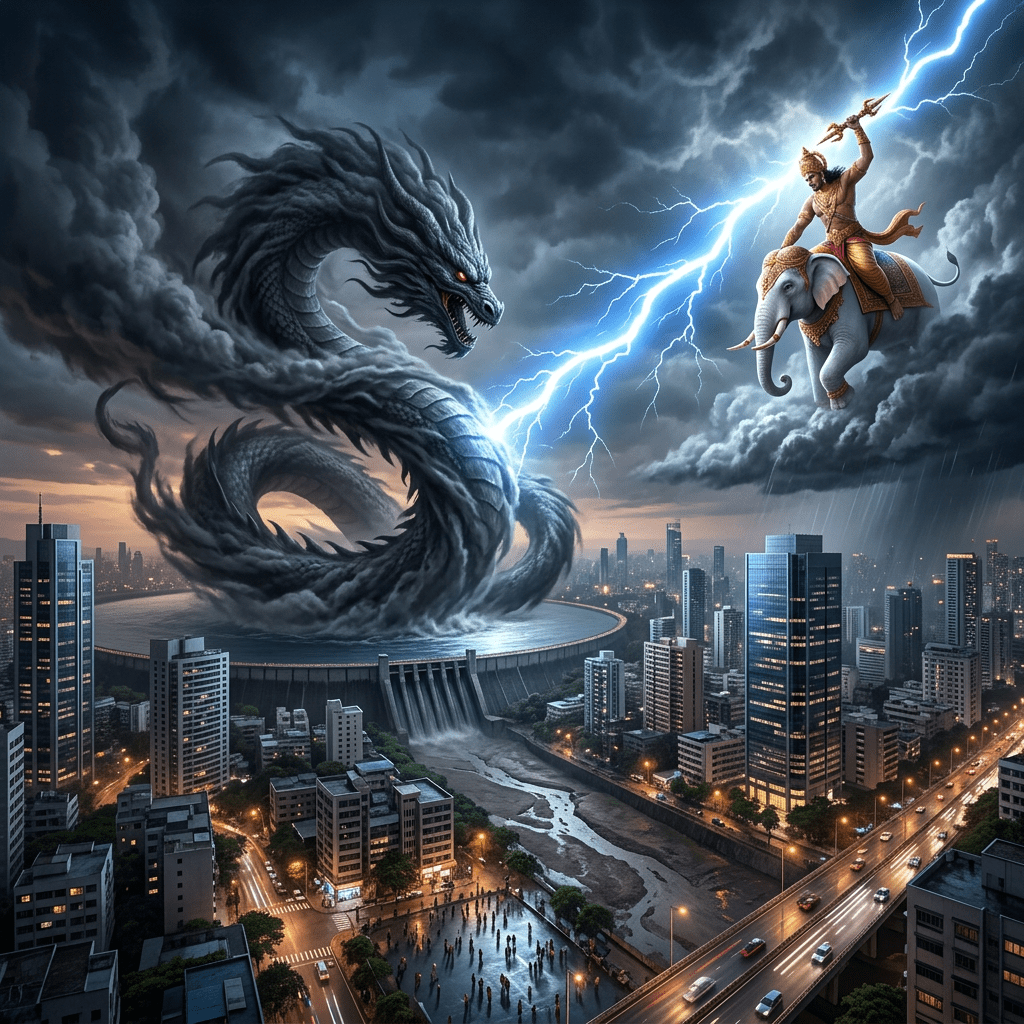
There is in the Rig Veda an enemy that recurs in dozens of hymns with a constancy and an insistence that speak of his fundamental importance: Vritra. We have mentioned him in several articles, from the angle of Indra’s victory, from the angle of the liberation of the waters, from the angle of the ego as inner obstruction. But Vritra deserves an article devoted to him, not because he is a hero, but because understanding precisely what he represents is perhaps one of the most useful keys the Rig Veda offers us for reading our own era.
His name first. Vritra comes from the root vri, to surround, to cover, to envelop, to retain. It is the same root as Varuna, but in an opposite sense: where Varuna surrounds in order to protect and contain within Truth, Vritra surrounds in order to suffocate and retain against the nature of things. Vritra is therefore literally the one who retains, who obstructs, who prevents what should flow from flowing. He is not simply a mythological monster. He is the description of a principle: obstruction as an active force, as organised resistance to the natural movement of life and consciousness.
In the hymns, Vritra holds back the waters. He retains them in the mountains, in the caves, in the depths of the earth. The waters that should descend and fertilise the plains, that should join the rivers and the sea, are blocked by his massive and inert presence. And this retention of the waters is a cosmic catastrophe: without the waters, the earth dries up, the harvests die, life retreats. Vritra does not destroy. He retains. And retention is more destructive than destruction, because it leaves no space even for renewal.
What this image says about the nature of destructive power is of remarkable depth. The forces that do the most damage in human history are not necessarily those that destroy directly. They are often those that retain, that block, that prevent natural transitions from occurring. A dictatorship that resists the democratic movement its own population demands is a Vritra. An industry that blocks energy transitions to protect its immediate profits is a Vritra. An educational system that resists the evolution of knowledge and maintains obsolete paradigms is a Vritra. A collective ego that refuses to recognise that the world has changed and clings to structures that have ceased to serve life is a Vritra. In all these cases, the very structure of the problem is the same: something that should flow is held back by a force that no longer has any reason to be there but that persists through inertia, fear or self-interest.
Indra strikes down Vritra with his thunderbolt, and the waters rush forward. This image of victory is one of the most repeated in the Vedic corpus, and its repetition says something important: victory over Vritra is not definitive. He returns. Each generation must find its Indra and strike down its Vritra. This is not a battle one wins once and for all. It is a structural battle, inherent in the nature of reality, in which the forces of obstruction periodically reconstitute themselves and must be periodically defeated. This repetition of the myth says something honest about the nature of change: it is never secured, it must always be begun again, and vigilance against Vritra is a permanent condition of a living civilisation.
The thunderbolt of Indra, Vajra, is described in the hymns as a weapon fashioned by Tvashtri, the divine craftsman, from the bones of the rishi Dadhîca, whose name itself, he who spreads the curdled milk, speaks of generosity and self-giving to the very end. This mythological precision is of remarkable symbolic depth. The thunderbolt that breaks obstruction is made of the very substance of the sage, of one who has seen the Truth and transmitted it. It is not a material weapon. It is the force of direct knowledge, of unfiltered vision, of the experience of ṛta which, once lived, can no longer tolerate obstruction. When one has seen the Truth, one cannot peacefully coexist with what blocks it. The thunderbolt of Indra is the inevitable consequence of vision. To see clearly is already in the process of striking down Vritra.
There is in the hymns a collective dimension to the battle against Vritra that deserves to be underlined. Indra does not fight alone. He fights with the Maruts, the gods of winds and storms, the unleashed forces of natural energy. He fights with the help of the rishis who recite the hymns, who keep ṛta alive through their speech and their practice. He fights sustained by soma, which gives him the power necessary to break what resists. And he fights for the entire community, so that the liberated waters fertilise the fields of all, not only his own. Victory over Vritra is a common good, and the battle for this victory is a collective responsibility.
This collective dimension is particularly important for understanding the Vritras of our era. The great contemporary obstructions — climate disruption, growing inequalities, the concentration of economic power, resistance to necessary transitions — cannot be overcome by individual heroes. They require exactly what the Vedic vision describes: a coalition of different forces, animated by a shared vision of ṛta, of the flow that must be freed, and ready to use all available forms of energy to break the obstruction. The Maruts are there: the forces of nature running out of control, the social movements accelerating, the technologies rendering old structures obsolete. The rishis are there: those who see clearly and who name what they see, who keep alive the awareness of what should be and is not yet. And the thunderbolt is available: the force of truth seen clearly, which cannot stay silent when it sees obstruction.
What Vritra also tells us about the nature of power is uncomfortable but necessary. The great obstructions are not always the work of consciously malevolent forces. Vritra in the hymns is not a character who deliberately chooses evil. He is a force that obstructs by nature, that retains because that is what he is. The systems that block necessary transitions often function in the same way: they do not choose to be destructive. They follow their own logic, optimise according to their own criteria, and the obstruction they produce is the result not of ill will but of the mismatch between their nature and the needs of the moment. Which makes Vritra all the more difficult to combat: one cannot ask him to understand and change his mind. One can only strike him down.
The death of Vritra in the hymns is followed immediately by an image of total liberation: the waters rush forward, they flow in all directions, they fertilise everything they touch, they join the rivers and the sea in a movement of a power and a joy that the hymns describe with an exuberance that says something about the nature of liberation. It is not a cautious, measured, controlled liberation. It is an overflow, an excess, a superabundance of what had been retained for too long. Blocked transitions, when they finally occur, often resemble this: not a gradual and controlled evolution, but a sudden overflow of what had been compressed. Human history is full of these moments when Vritra falls and the waters rush forward, sometimes with a violence that no one had anticipated.
The Rig Veda does not promise us that Indra will always win. It tells us that the battle is necessary, that the thunderbolt must be wielded, that the waters deserve to be freed. It also tells us that soma, the direct experience of ṛta, is what gives Indra his power: without this experience, without this clear vision of what should be, the thunderbolt has no direction and the battle has no meaning. This is perhaps the most important lesson that Vritra teaches us by contrast: before striking down the outer obstruction, one must have seen clearly enough what this obstruction is preventing from arriving. The waters must first exist in consciousness as a desired reality, as something one knows should flow, before the thunderbolt can find its target.
 Le Rig Veda
Laisser un commentaire