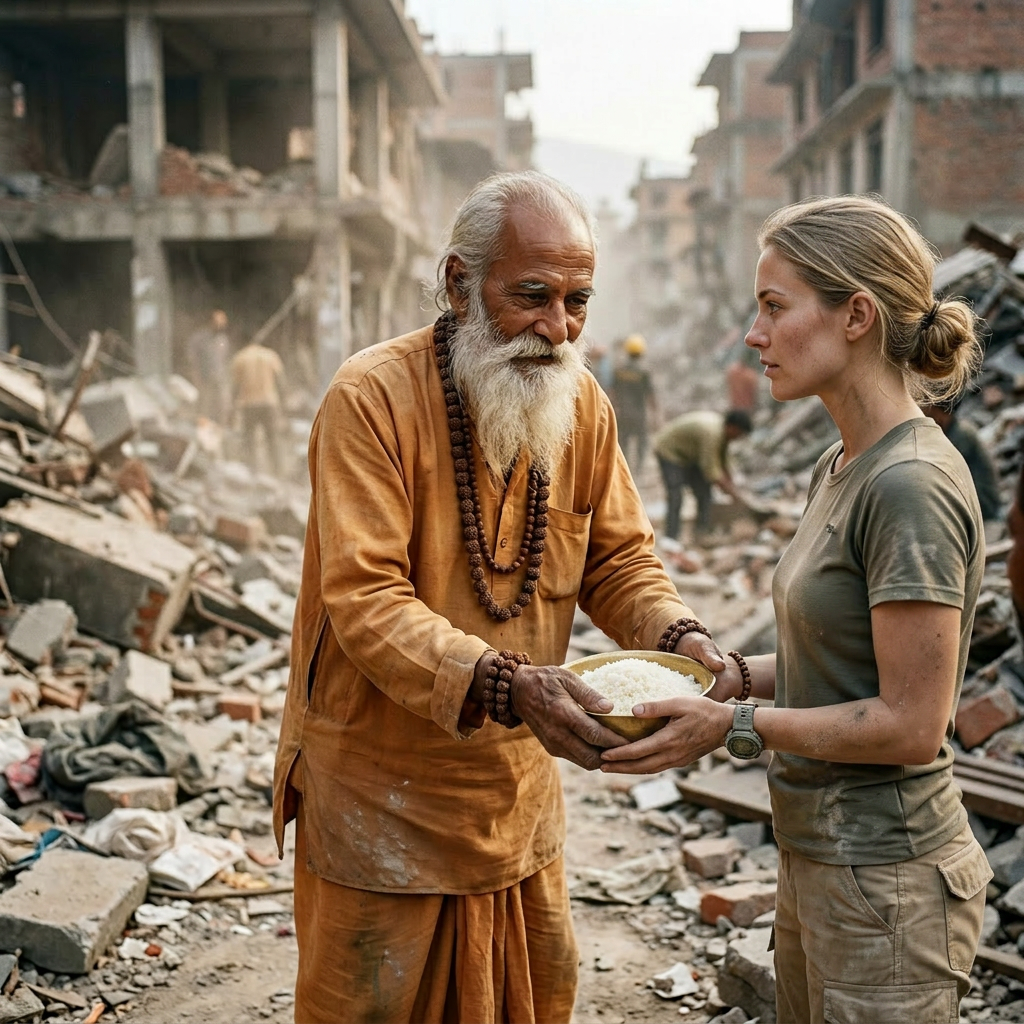
There is in the Rig Veda a word that recurs regularly in the hymns, often translated as honorarium, as gift, as reward offered to the priest after the sacrifice, and whose usual translation almost entirely misses what it actually designates: dakshina. This word comes from the root daksh, meaning to be skilful, to be capable, to be apt. Dakshina is therefore literally that which manifests the capacity to give, that which speaks of the competence of someone who knows how abundance circulates. It is the gift offered after the sacrifice to the priest, to the master, to the one who has rendered service, but it is also much more than that: it is the very principle of generous circulation as the foundation of a healthy economy and a healthy society.
Dakshina is not a payment. The difference between the two is at the heart of this article. A payment is a transaction: I give something because I have received something equivalent, because an explicit or implicit contract requires it of me, because not paying would entail consequences. Dakshina is something else. It is a gift offered freely, generously, in recognition of what one has received, but without contractual obligation, without expectation of return, without calculation of equivalence. It is not I give because I must. It is I give because the abundance I have received deserves to circulate, because retaining what should flow would be to act against ṛta, against the fundamental nature of the world.
This distinction between the gift and the payment is of considerable importance for understanding the difference between the Vedic economy and the market economy that dominates our world. The market economy rests on exchange: I give something equivalent to what I receive, and if the equivalence is not satisfactory to one or other of the parties, the transaction does not take place. It is a system of remarkable effectiveness for allocating resources and coordinating economic activities at scale. But it is also a system with a fundamental limit: it cannot produce generosity. It can produce efficiency, innovation, growth. But generosity — the gift that gives more than it receives in return, the gesture that enriches the one who gives as much as the one who receives — all of this escapes the logic of equivalent exchange.
In Vedic civilisation, dakshina was the oil that kept the social machine running. It circulated in all directions: from the sacrificer to the priest after the yajña, from the master to the student in the form of teaching, from the student to the master in the form of service and gratitude, from the community to the individual in need in the form of hospitality and support, from the individual to the community in the form of participation in the sacrifices and collective celebrations. This circulation was not regulated by contracts, prices or markets. It was regulated by ṛta, by the understanding that abundance is a cosmic force that must circulate to keep the world alive, and that retaining what should flow is a form of Vritra, an obstruction that prevents life from renewing itself.
There are in the Rig Veda hymns that explicitly celebrate the generous giver and that describe with touching precision the qualities of the one who knows how to give. These hymns are not encouragements to charity in the Western sense of the word — appeals to the compassion of wealthy individuals toward destitute ones. They are descriptions of a cosmic principle: the one who gives generously participates in the flow of the universe, he aligns himself with ṛta, he enters a movement that surpasses him and that, in surpassing him, enriches him in a way that selfish accumulation can never produce. The generous gift does not impoverish the one who gives. It connects him to something greater than himself, and this connection is the source of a wealth that gold and cattle cannot measure.
This economic vision is in direct and radical opposition to what we call today the extraction economy. The extractive economy rests on a principle opposite to that of dakshina: to take more than one gives, to extract value from the system without restoring the equivalent, to accumulate at the expense of circularity. It is the principle of industries that exploit natural resources without paying their real cost, of companies that maximise their profits by externalising environmental and social costs, of financial systems that create abstract wealth without creating concrete value. It is the principle of Vritra applied to the economy: retention, obstruction, accumulation that prevents the flow.
The consequences of this extractive economy are visible everywhere: ecosystems impoverished by decades of extraction without restitution, communities disintegrated by decades of competition without solidarity, growing inequalities that result from unlimited accumulation in the hands of a few while the flow of dakshina, the generous circulation of abundance, runs dry for the majority. This is not only an economic problem. It is a problem of ṛta. It is the manifestation at the scale of an entire civilisation of a worldview in which accumulation is a virtue and generosity a weakness.
There is in contemporary economic theory a current that is rediscovering something that resembles dakshina, without knowing the name: the gift economy, whose foundations Marcel Mauss laid in his celebrated Essay on the Gift, and that economists such as Lewis Hyde and Charles Eisenstein have developed more recently. These works show that in many human societies, circular giving, generosity without calculation of equivalence, has produced forms of social cohesion, collective creation and individual satisfaction that the market economy cannot reproduce. This is not an accident. It is because the logic of the gift corresponds to something fundamental in human nature and in the nature of reality, something that the Vedic rishis had named dakshina and elevated to the rank of a cosmic principle.
Dakshina in the civilisation of the 7 Rivers was not only an economic practice. It was a spiritual practice. To give generously was to exercise oneself in the dissolution of the ego, in the liberation from attachment to possessions, in the trust that what flows toward others returns in another form, that generosity is an investment in cosmic circulation rather than a loss. It was, in miniature, the same gesture as the yajña: to offer something precious in the fire of the relationship, without guarantee of return, trusting in the nature of the flow.
What dakshina tells us about our era is at once uncomfortable and liberating. Uncomfortable, because it says that the extractive economy in which we live is a form of violence against ṛta, against the fundamental nature of the world, and that its consequences — ecological, social, psychological — are exactly what one should expect from a prolonged obstruction of the cosmic flow. Liberating, because it also says that the alternative exists, that it functioned for two thousand years in a civilisation that left us texts of extraordinary beauty and depth, and that it is accessible to each of us in every gesture of uncalculated generosity, in every gift offered without expectation of return, in every act that chooses circulation over accumulation. Dakshina is not an economic theory. It is a way of being in the world. And it begins with a gesture as simple as giving without counting the cost.
 Le Rig Veda
Laisser un commentaire