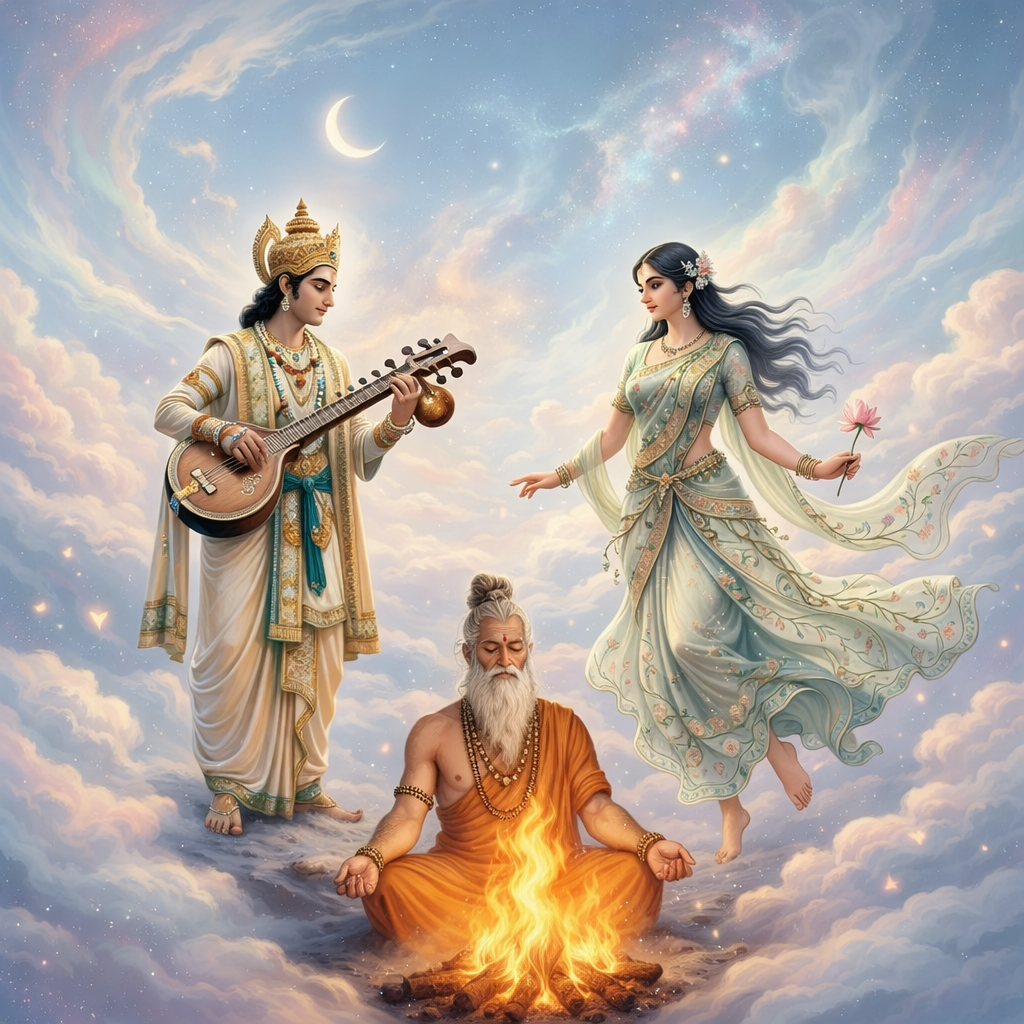
There is in the Rig Veda a category of beings that belong neither entirely to the world of the gods nor entirely to the world of human beings, and whose presence in the hymns is discreet but charged with a particular significance: the Gandharvas. They are spirit musicians, beings of the intermediate world whose nature is intimately linked to music, to song, to the beauty of sonic forms. They are the guardians of soma in certain hymns, the lovers of the Apsaras, those celestial nymphs who dance in the spaces of the intermediate world. But beyond their role in Vedic mythology, they represent something essential about the nature of art and its function in spiritual and human life.
The Gandharva is first of all a being of the in-between. He lives in the intermediate world, that space between Earth and Sky that we described as the space of states of consciousness between the ordinary and Brahman. This is not a geographical location. It is a description of the nature of what he represents: music, like the intermediate world, is between worlds. It is not the raw reality of material life, with its constraints, its pains and its necessities. Nor is it the pure experience of Brahman, which is beyond all form and all expression. It is between the two: a form that points toward the formless, a sound that says the unsayable, a beauty that opens a window onto something that ordinary words cannot reach.
In the hymns, the Gandharvas are often associated with soma, of which they are said to be the guardians or dispensers. This association is not fortuitous. It says something essential about the relationship between music and expanded states of consciousness in Vedic thought. Music, like soma, produces states of consciousness that are not ordinary states. It temporarily dissolves certain of the resistances that the ego maintains permanently, it allows something vaster to enter consciousness, it creates an inner space that resembles, in its quality, what soma created in a more direct and more intense way. The Gandharvas are the guardians of this property of music, the beings who know the secret of the sound that transforms.
Vedic music itself, through the Samans, the ritual melodies of the sacrifice that the udgâtri sang during the yajña, was precisely designed to produce effects on the consciousness of the participants. We spoke of this in the article on the priests of the sacrifice: the Samans were not aesthetic ornaments added to the sacrifice to make it more pleasant. They were tools for the transformation of consciousness, sonic structures whose form, rhythm and tonality acted directly on the inner state of the participants, creating the conditions in which the experience of Brahman became more accessible. The Gandharvas are the mythological figures of this knowledge: the beings who know how music can open doors that ordinary speech cannot open.
In the traditions that would follow Vedism, the Gandharvas would become divine musicians, masters of the performing arts, teachers of the arts to human beings. The classical Indian tradition of music, song and dance often attributes to them the origin of the highest artistic forms. This mythological lineage says something important: in the Indian vision, art is not a human invention. It is a revelation, something that descends from the intermediate world to the human world through beings who are its guardians and transmitters. The artist who receives a melody as a revelation, who says that his music came to him from elsewhere, that his poem was dictated to him, that his dance imposed itself on him without his consciously constructing it: this artist describes an experience that the Vedic tradition recognised and named. He was in contact with the Gandharvas. He was receiving what the intermediate world had to give.
What all of this says about the nature of art deserves to be examined in our contemporary context, because we live in an era that has a profoundly contradictory relationship with art. On one side, art is everywhere: permanently broadcast, accessible at any moment on any medium, produced in industrial quantities. On the other, genuine art, the kind that transforms, that opens consciousnesses, that puts one in contact with something beyond the ordinary, is increasingly rare, increasingly marginalised, increasingly difficult to distinguish within the continuous flow of cultural production.
This contradiction is explained, from the Vedic perspective, by the same dynamic that explains all the other losses we have documented in these articles: the domination of the ego and the loss of contact with ṛta. Art produced by the ego, for the ego, in view of recognition and success, can be technically brilliant, emotionally effective, commercially successful. But it cannot do what the Gandharvas did: open a window onto the intermediate world, create a space in consciousness where something greater can enter. This is only possible when the artist is sufficiently available, sufficiently freed from their own egotistic constructions, to receive rather than to produce.
What the Vedic tradition calls inspiration, and which we examined from the angle of Îla in another article, is precisely this contact with the Gandharvas. It is the moment when the artist ceases to be the author and becomes the channel, when the melody arrives of itself, when the words write themselves without effort, when the dance imposes itself with a necessity that exceeds conscious will. These moments exist in every artistic tradition and in every culture. They are recognised as moments of grace, moments of genuine creation, the ones that produce the works that endure and that touch. The Vedic tradition gave them a name and an address: they were the Gandharvas, inhabitants of the intermediate world, guardians of the sonic soma.
There is a phrase that circulates in the world of contemporary music, attributed to different musicians depending on the version, but whose content says something very Vedic: music already exists, musicians only find it. This formulation, which may seem modest or mystical depending on who hears it, is in fact a precise description of the experience of the Gandharvas in the current context. The music that already exists is that of the intermediate world, the music that the Gandharvas guard and dispense. The musicians who find it are those who have learned to open themselves sufficiently to receive what this world has to give.
What the Gandharvas represent for our era is perhaps this: in a world where the ordinary means of access to Brahman — soma, collective sacrifice, a community united in a common spiritual practice — are no longer available to the great majority of people, art remains one of the most direct and most universally available means of access to the intermediate world. A great piece of music, a great poem, a great dance, a film that touches something deep: all these arts, when they truly function, when they are not merely entertainment or egotistic performances, open the same door that the Gandharvas opened in Vedic civilisation. They create a space in consciousness where the ordinary defences of the ego relax, where something vaster can enter, where the boundary between self and the rest of the world begins to blur.
This is why art, the real kind, is a last refuge. Not a refuge in the sense of an escape or a consolation. A refuge in the Vedic sense of the word: a sacred space, an intermediate space, a space where the ordinary is suspended and where something essential can reveal itself. The Gandharvas are still there, in every melody that arrives from one knows not where, in every line that writes itself, in every note that says what words cannot say. They do not need us to believe in them. They just need us to be sufficiently silent to hear them.
 Le Rig Veda
Laisser un commentaire