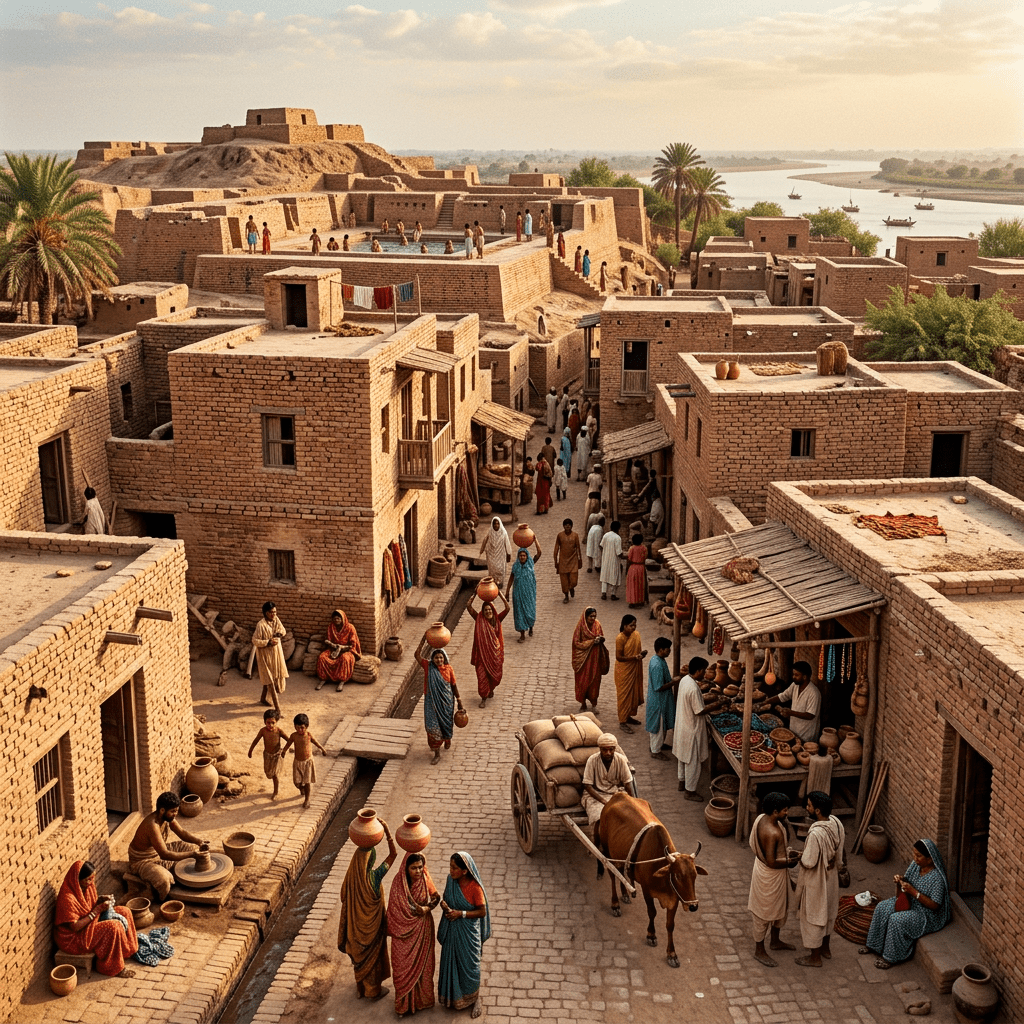
There is something profoundly revealing in the way a civilisation builds its houses. Not only in the techniques it employs, in the materials it chooses, in the way it arranges spaces. But in what these choices say about its values, about its conception of human dignity, about the way it thinks the relationship between the individual and the community, between body and spirit, between the private and the public. The civilisation of the 7 Rivers, the Sapta Sindhu, built its houses and cities in a way that says all of this with a clarity and a coherence that continue to surprise and challenge the archaeologists and historians who study it.
Fired brick is the first remarkable fact. In a world where most contemporary civilisations built with unfired brick, sun-dried, subject to erosion and collapse, the builders of the Indus-Sarasvati civilisation systematically used fired brick, far more solid and far more durable. This choice says something about their relationship with time: one does not build in fired brick for a single generation. One builds for centuries. There is in this choice an awareness of duration, a will to transmit to those who come after an environment as solid and as functional as the one received from those who came before. It is a form of intergenerational responsibility inscribed in the very matter of the walls.
The proportions of the bricks are standardised across the entire territory. In a civilisation that extended across more than a million square kilometres, the bricks of Harappa have the same proportions as those of Mohenjo-daro, as those of Rakhi Garhi, as those of dozens of other sites hundreds of kilometres apart from one another. This standardisation is not the result of a centralised bureaucracy imposing its norms by force. No trace of such a central power has been found. It is something more interesting and more mysterious: a collective agreement on forms, a common way of seeing and doing that had spread across the entire territory without visible coercion. It is ṛta at work in stone, the common Truth manifesting in a common way of building.
Individual houses are of remarkable consistency in their design. Every house, whatever its size, had its own washroom. This is not an insignificant detail. In most ancient cities, bodily hygiene was a luxury reserved for elites. In Mohenjo-daro and in the other great cities of the Indus civilisation, it was a recognised necessity for all. The washroom was connected to an elaborate drainage system that ran beneath the streets, carrying wastewater out of the city. This drainage system is one of the most sophisticated in the entire ancient world, comparable to what Rome would not develop until two thousand years later. It says something essential about the way this civilisation conceived of the common good: the collective management of wastewater is not a question of individual comfort. It is a question of public health, of respect for the environment, and of a vision in which the cleanliness of the city is the responsibility of all and the right of each.
Some houses had dry toilets, also connected to the drainage system. This is an innovation that existed virtually nowhere else in the world at this period, and it says something about the level of technical and conceptual sophistication of this civilisation. Dry toilets presuppose an understanding of the links between hygiene and health, between waste management and disease prevention, that is of striking modernity for an era in which most of the world’s populations lived in conditions we would today describe as insanitary.
The organisation of the streets is another revelation. The cities of the Indus-Sarasvati civilisation were built according to an orthogonal plan, with wide main streets and narrower secondary streets opening off them perpendicularly. This grid plan is not simply a technical solution to the problem of circulation. It is a vision of urban space as something rational, plannable, organisable according to coherent principles applicable to the entire city. The main streets were wide enough to allow the passage of loaded carts. The intersections were organised to facilitate movement. All of this speaks of an attention to the practical needs of inhabitants, a way of conceiving public space as a functional space in service of all.
The craftsmanship of this civilisation was of remarkable quality and diversity. The ceramics found at the sites are abundant, well fired, often decorated with geometric patterns and animals of a precision and a fineness that speak of highly skilled craftsmen. The objects in bronze and copper, the jewellery in gold, silver and semi-precious stones, the engraved seals: all of this testifies to a technical mastery that few civilisations of the era could match. The seals in particular are fascinating. These are small objects in steatite, square or rectangular, engraved with animals, human figures and signs that probably constitute a form of writing not yet deciphered. They probably served to mark merchandise in the context of trade, which speaks of an organised economy, regular exchanges, a way of guaranteeing the origin and quality of what was sold.
The organisation of artisanal production is another interesting dimension of this civilisation. Craftsmen’s workshops seem to have been collectively organised, grouped by trade in particular zones of the city. This was not the individual and isolated artisanal production of the craftsman working alone in his workshop. It was a more collective organisation, in which craftsmen of the same trade worked together, probably shared resources and techniques, and produced objects of relatively homogeneous quality. This collective organisation of artisanal production is consistent with the broader organisation of society, in which the communal dimension took precedence over the individual dimension.
There is in the urbanism of the Indus-Sarasvati civilisation an absence that is as telling as all the presences: the absence of wealthy districts clearly separated from poor ones. In the great cities of Mesopotamia, Egypt, Greece and Rome, spatial segregation according to wealth and social status is visible in the archaeology: the great palaces and fine houses on one side, the slums and insanitary housing on the other. In the cities of the Indus-Sarasvati, this segregation is far less marked. There were larger houses and smaller houses, which speaks of inequalities of wealth. But the smaller houses still had their washrooms, their access to the drainage system, their connection to public space. The difference in size did not imply a difference in fundamental dignity.
The public granaries deserve particular mention, because they perhaps embody better than any other element the social philosophy of this civilisation. Built outside the cities, on raised platforms that protected them from moisture, accessible from the river to facilitate loading and unloading, they were not private storehouses accumulating the wealth of a sovereign or an elite. They were collective resources, intended to guarantee the food security of the entire population in the event of poor harvests or shortage. It is a form of social security before the term existed, made possible not by a redistributive bureaucracy but by a vision of the world in which abundance is naturally shared because ṛta, fundamental Truth, does not recognise the distinction between what is mine and what is yours.
What the urbanism and craftsmanship of the Sapta Sindhu tell us, in the end, is that a spiritually advanced civilisation is not necessarily one that turns away from the material world to devote itself to inner life alone. The civilisation of the 7 Rivers demonstrated the opposite: that spiritual depth can manifest in the quality of fired brick, in the sophistication of a drainage system, in the standardisation of proportions, in the attention paid to the washroom of the most modest house. The sacred was not separated from the everyday. It was in the everyday, in every gesture of construction and creation, in every object made with care and skill, in every street traced in such a way as to serve best those who were going to live there.
 Le Rig Veda
Laisser un commentaire