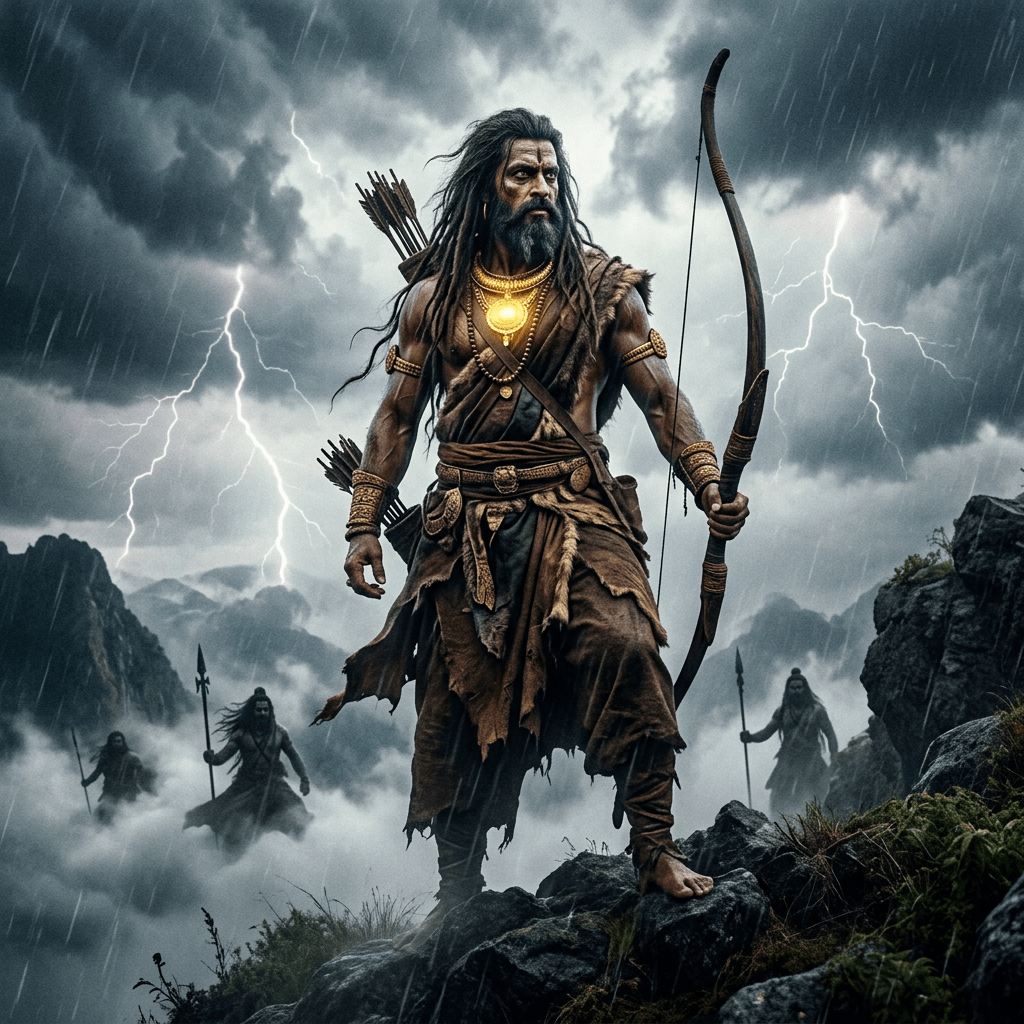
We devoted an article to Rudra from the angle of healing and raw power, exploring the paradoxical coexistence in him of terrifying force and curative compassion. But there is another dimension of Rudra in the Rig Veda that deserves to be examined in its own right, and which is perhaps the most instructive of all: his discretion. Rudra is present in relatively few hymns compared to the great gods of the Vedic pantheon. Indra dominates the corpus. Agni opens it. Soma fills the entire ninth mandala. But Rudra is there in the background, invoked with caution, honoured with respect, and yet running through the entire tradition like an underground presence that cannot be dispensed with. This discretion is itself a teaching.
In the oldest mandalas, Rudra is invoked less often than one might expect given the importance that tradition would later accord him. The hymns devoted to him in the second mandala, notably hymns 1.114 and 2.33, have a particular tonality found nowhere else in the corpus. He is addressed with a deference that contains something unusual in the Vedic hymns: a sharp awareness of his uncontrollable power, a way of approaching him as one approaches an immense natural force in the hope that it will spare you rather than in the certainty that it will favour you. It is not the warm familiarity of the hymns to Agni, nor the confident enthusiasm of the hymns to Indra. It is something more measured, more watchful, more respectful in the deepest sense of the word.
This particular posture of the rishis before Rudra says something essential about what he represents in Vedic cosmology. The other great gods are, to a large degree, forces that can be invoked and directed, with whom one can enter into a relationship of reciprocity: one offers them soma and hymns, they grant their gifts in return. This relationship of reciprocity is at the heart of the functioning of the Vedic sacrifice. But Rudra does not quite work this way. One does not really negotiate with Rudra. One asks him to remain benevolent, which implicitly supposes that he may not be. One asks him to direct his power elsewhere, which supposes that this power exists independently of the sacrifice and does not depend on it to manifest. Rudra is there whether one invokes him or not. His force is not granted to him by the ritual. It is constitutive of him.
This independence from ritual is one of the most distinctive characteristics of Rudra in the Rig Veda, and one of the most important for understanding what he will become. In the tradition that follows, in the Upanishads and in Shaivism, this independence will deepen until it becomes the defining trait of Shiva: the god who has no need of sacrifice, who lives outside cities and temples, in forests and cremation grounds, who carries on himself the signs of everything that escapes the social and ritual order. The Shiva of late Shaivism is a god of the margin, of excess, of everything that overflows categories and conventions. This royal marginality is already present in embryonic form in the Rudra of the Rig Veda, in his way of existing outside the sacrificial system while being included within it.
The connection between Rudra and the Maruts, his sons, is another dimension of his discreet but real presence in the Vedic corpus. The Maruts are omnipresent in the hymns, far more so than their father. They are Indra’s companions, the gods of storms, the unleashed forces of natural energy. And they carry within them something of Rudra’s nature: that ambivalence between destruction and renewal, that power which overturns and clears rather than building and accumulating. When the Maruts blow, trees fall, dust rises, clouds gather and rain falls. It is Rudra at the atmospheric scale, the same logic of liberating destruction operating now in the physical cosmos.
There is in the hymns to Rudra a request that recurs insistently and that is of remarkable therapeutic precision: the request for his remedies. The rishis ask him for his thousand remedies, his pharmacopoeias of the mountains and forests, his knowledge of the plants that heal. This insistence on the medical dimension of Rudra is not separable from his destructive dimension. The same hands hold the thunderbolt and the medicinal herbs. And in Vedic thought, this has a profound meaning: whoever truly knows destruction also knows healing, because genuine healing is a form of destruction — the destruction of what obstructs, what blocks, what prevents vital force from circulating. The surgeon who operates destroys tissue in order to free what was blocked. Rudra is the great cosmic surgeon.
This medical dimension of Rudra is also a shamanic dimension. We noted in the previous article that Rudra is the god of wild spaces, of forests, of mountains, of zones that civilisation has not domesticated. And it is in these spaces that the healing plants grow, including soma itself. There is a deep connection, which the texts do not fully spell out but which the context clearly suggests, between Rudra and the shamanic practices that precede and underlie Vedism. The shaman who enters altered states of consciousness to travel in the intermediate world and bring back therapeutic knowledge, the shaman who knows where the plants grow and how to use them, the shaman who is not bound by ordinary social conventions because his function obliges him to circulate between worlds: this is Rudra, in human form. And the fact that Rudra is the father of the Maruts, the winds, says something about the nature of the shamanic journey: it is made in the wind, in the breath, in that invisible movement that carries with it seeds and scents and presences from everywhere.
The transformation of Rudra into Shiva over the centuries is one of the most fascinating evolutions in all of Indian tradition, and it says something important about the way a tradition can integrate its own margins rather than repressing them. In classical Vedism, Rudra is on the margin: powerful, respected, feared, but not at the centre. With the Upanishads and the development of Shaivism, what was on the margin becomes central. Shiva becomes one of the most important gods in all of Hinduism, and the aspects of his nature that might have seemed most difficult to integrate — destruction, death, the dance in cremation grounds, the association with demons and spirits — become precisely what makes him the most universal of gods, the one with whom all those on the margin, the ascetics, the yogis, the outcasts, the seekers of the absolute, can identify.
This movement from centre to margin and from margin to centre is perhaps the deepest lesson that Rudra offers us. In the Rig Veda, he is discreet because the civilisation that produced this text still functioned on the basis of the direct experience of Brahman, of ṛta lived rather than merely named. In this context, Rudra had no need to be in the foreground. His power was recognised, honoured, kept at a respectful distance. But when soma disappeared, when the sacrifice emptied itself of its direct content, when institutional religion replaced lived spirituality, Rudra stepped out of his margin. The force that destroys in order to liberate, that cannot be domesticated by ritual, that exists independently of social and sacerdotal approval, began to take up more space. Not by chance. By necessity. Because when the ordinary paths toward Brahman are blocked, the extraordinary paths, those of Rudra, become the only ones that remain open.
 Le Rig Veda
Laisser un commentaire