Étiquette : Vedic civilization
-
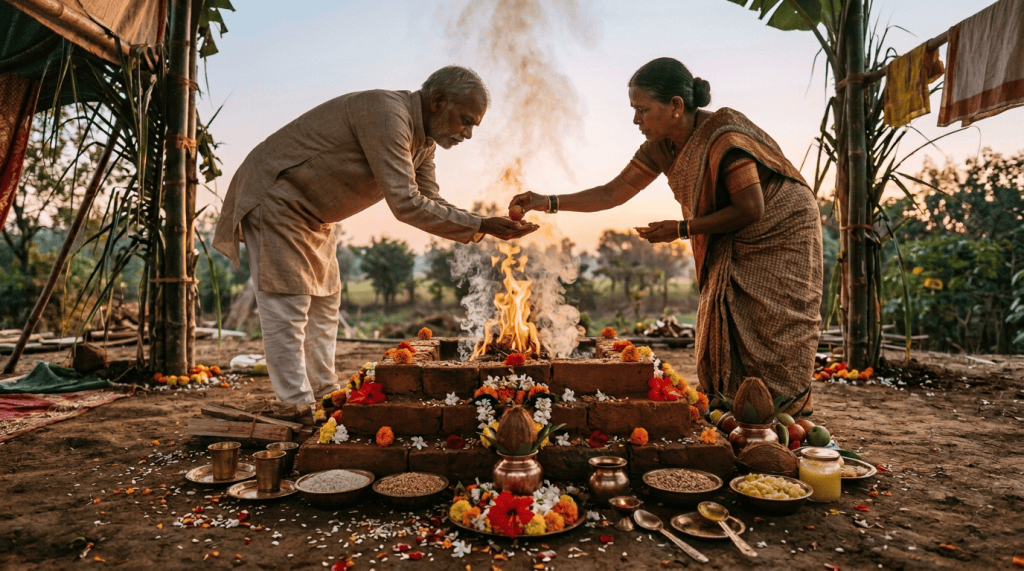
THE SACRIFICE AND THE CULTURE OF GIVING
In the Rig Veda, the chief is the one who gives the most. Hymns 10.107 and 10.117 define an economy of giving and redistribution 4,000 years old.
-

SARASVATĪ — THE RIVER, THE SACRED WORD AND KNOWLEDGE
Sarasvatī is the only deified river of the Rig Veda — « best of mothers, best of rivers, best of goddesses. » A close reading of the lost river and the divine word.
-

MITRA — FRIENDSHIP DEIFIED
Mitra is friendship deified in the Rig Veda — the force that unites peoples, reconciles men, maintains alliances. A close reading of hymns 3.59 and 5.65-72.
-

THE ASHVAMEDHA — THE HORSE SACRIFICE AND POLITICAL POWER IN THE RIG VEDA
n the Rig Veda, the Ashvamedha is not an instrument of conquest — it is an act of total redistribution. A close reading of hymns 1.162 and 1.163.
-

PŪṢAN — TRAVEL AND HERDS DEIFIED
Pūṣan is travel deified — guardian of paths, protector of herds, gruel-eater with a goat chariot. A close reading in Hervé Le Bévillon’s translation
-

ARYAMAN — NOBILITY OF THE PATH DEIFIED
Aryaman is nobility of action deified — the principle that clears paths, unites strangers, presides over marriages. A close reading in Hervé Le Bévillon’s translation
-

PARJANYA: THE GOD OF RAIN AND FECUNDITY
Parjanya is the celestial bull who fertilizes the Earth through rain. A close reading of hymns 5.83 and 7.101-103 in Hervé Le Bévillon’s translation
-

HOSPITALITY AS A SACRED VALUE IN THE RIG VEDA
The Rig Veda devotes an entire hymn to generosity. Agni is « the guest of the house. » A decipherment of a value that was a cosmic law.
-

THE WOMEN RISHIS: GHOṢĀ, LOPĀMUDRĀ, APĀLĀ….
Thirteen women composed hymns in the Rig Veda. A close reading of three of them — Lopāmudrā, Apālā, Ghoṣā — in Hervé Le Bévillon’s translation
-

ALPHA AND OMEGA OF THE RIG VEDA: AGNI AND UNION
From the first hymn to the last, the Rig Veda speaks of Agni and union. A unique decipherment of the Vedic civilization’s spiritual arc.

