In the Vedic pantheon, some gods are philosophical abstractions — Varuṇa, guardian of the ṛta, or Brahman, cosmic principle. Others are internalised forces of nature — Agni, the fire that illuminates; Vāyu, the wind that vivifies. And then there is Parjanya.
Parjanya is concrete. Parjanya is the thunder that rolls before the storm. The rain that falls on dry earth. The seed that germinates in soil that has just drunk. He is fecundity itself, in its most immediate, most physical, most vital form.
For an agricultural civilization rooted in the Indus-Sarasvatī plain — whose prosperity depended on the abundance of monsoon rains and the floods of the seven rivers — Parjanya was not just another god. He was the guarantor of survival.
The bull who roars in the clouds
Three hymns of the Rig Veda are entirely devoted to him: 5.83, 7.101 and 7.102. A fourth — 7.103 — is indirectly related, through one of the most unusual and most beautiful hymns in the entire text: the hymn to the frogs.
Hymn 5.83, composed by the rishi Atri Bhauma, is the most complete portrait of Parjanya. In my translation:
5.83.1 — Address the powerful one with these hymns, with these homages to Parjanya, so that he may come. The Bull, roaring, who fertilizes abundantly, gives his semen as an embryo into the plants.
5.83.2 — He breaks the trees and kills the demons; all creation is terrified by the great killer, and those who are blameless are spared by this powerful one, when Parjanya, howling, kills those who do evil.
5.83.3 — Like a coachman giving suffering to his Horses with his whip, he creates the messengers bringing rain. From afar rise the roarings of the tiger, when Parjanya creates the clouds charged with rain.
5.83.4 — The winds blow, the lightning flies, the plants grow, the Sky swells, drinking water appears to all creation, when Parjanya helps the Earth with his seed.
The central metaphor is that of the sexual union between Sky and Earth. Parjanya is the celestial bull who « gives his semen as an embryo into the plants. » The rain is his seed. The earth is the womb that receives and germinates it. This image is not decorative. It expresses the deep nature of the god: Parjanya is the cosmic fertilizing force that unites Sky and Earth in the founding act of all life.
5.83.9 — When, O Parjanya, thundering and roaring, you strike those who do evil, the universe rejoices, as does all that is on Earth.
5.83.10 — You made the rain fall. Now hold it back! The rainbows carry suffering across for those who seize them. You engendered the plants for nourishment, and you have understood what comes from the thoughts of creation.
The rainbow appears here as the sign of reconciliation after the storm — already. Parjanya is violent in the storm, generous in the rain, and wise in withdrawal. A god of just climatic measure.
The frogs announce Parjanya
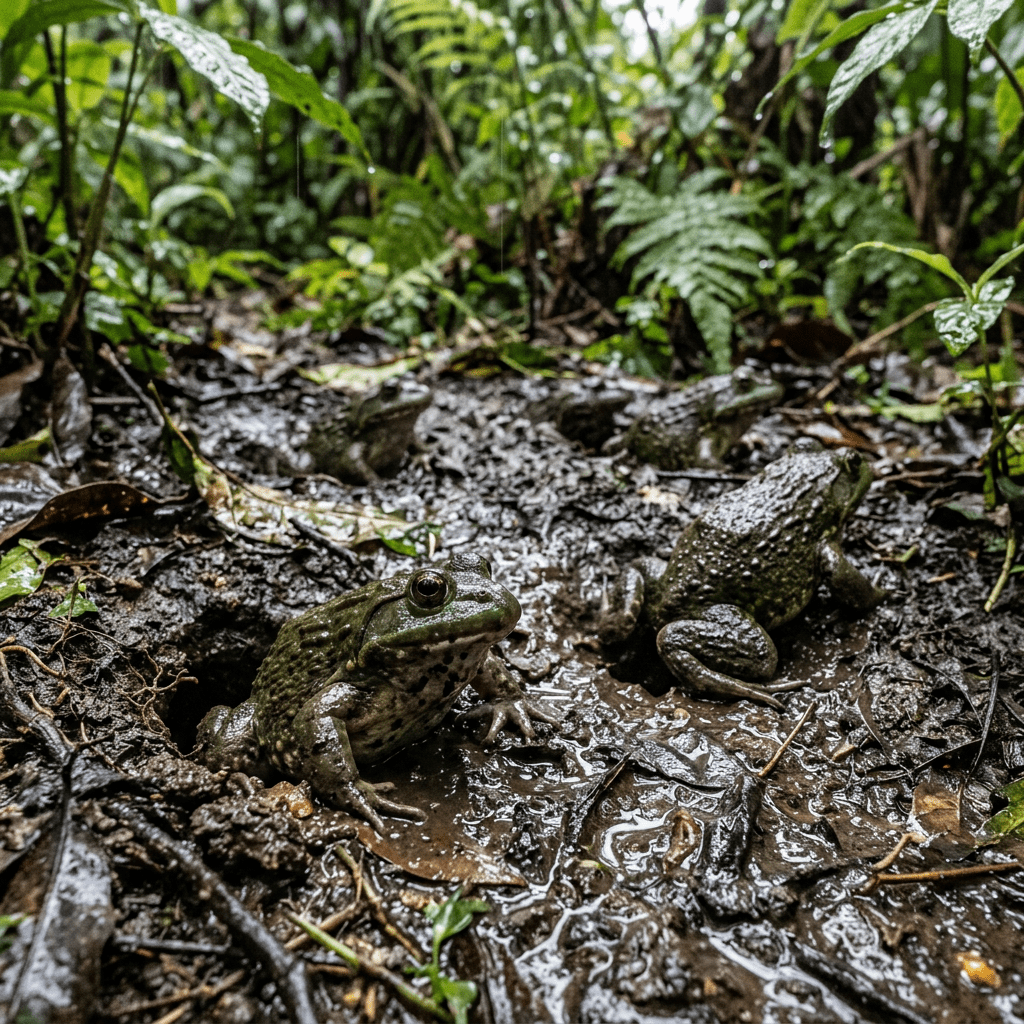
Hymn 7.103 is a gem of Vedic humour. It describes the frogs emerging from their annual torpor at the first song of the monsoon — after a year of sleep in dry mud — and breaking into joyful croaking. The rishi Vasiṣṭha compares them to the brahmins reciting their hymns:
7.103.1 — After sleeping for a year, the brahmins have lived their rule. The frogs have excited Parjanya, so that he would show them kindness.
7.103.7 — Like brahmins who speak when they are near the jar, in the soma prepared through the night, make the round of this day of the year that begins the rainy season when it appears, O Frogs.
7.103.10 — The lowing of the Cow has given, the bleating of the goat has given, the spotted one has given, the yellowish one has given. The frogs have given hundreds of Cows.
This is a hymn to the joy of rain returned — and, behind the metaphor of the frogs, a hymn to the cyclicity of nature: after drought, fecundity. After silence, song. After apparent death, resurrection.
Parjanya as inner force
True to the double reading that characterises all Vedic spirituality, Parjanya is not only the god of external rain. He is also, inwardly, the fertilising force — what in us makes thoughts, impulses and creations germinate.
Hymn 7.101, attributed to Vasiṣṭha, states this with remarkable precision:
7.101.2 — He who makes plants grow, who makes waters flow, the powerful god who created people who go in all directions — he will sustain the three ingredients that fall, a Light three times favourably protective for us.
7.101.3 — According to his desire, he becomes a barren Cow or he quickly generates a body. The mother takes the juice of the father; by this, the father makes the son grow.
And hymn 7.102, brief and luminous in Gāyatrī metre:
7.102.1 — Sing for the son of the Sky, for Parjanya, for the generous one. Let him go to our pasture.
7.102.2 — Parjanya creates the germ of plants, of Cows, of Horses, of men.
One verse, three words — plants, Cows, men — to say that Parjanya is the source of all fecundity, vegetable, animal, human. There is no hierarchy between these three realms. The same rain makes the wheat germinate and the child be born.
Parjanya and the 7 Rivers context
In The Civilization of the 7 Rivers, I underline the crucial importance of water in this civilization. For northwestern India, the monsoon is not just one season among others. It is the major cosmological event of the year. Without monsoon, no harvest. Without harvest, no trade. Without trade, no civilization.
The cities of the Indus-Sarasvatī had developed hydraulic infrastructure unmatched for their time: cisterns, wells, irrigation canals, sewage systems. In some cities like Mohenjo-Daro, tradition holds that during the monsoon, when the plain was flooded, boats were needed to move between the lower and upper town.
It is in this context that Parjanya is a central god — not because rain was rare, but because it was everything. And when it failed, around 2200 BCE, during the great drought that weakened the Sarasvatī, the world of the 7 Rivers began its slow decline.
Parjanya absent — and civilization departs with him.
https://www.rigveda.blog/parjanya-god-rain-fecundity-rig-veda


Votre commentaire