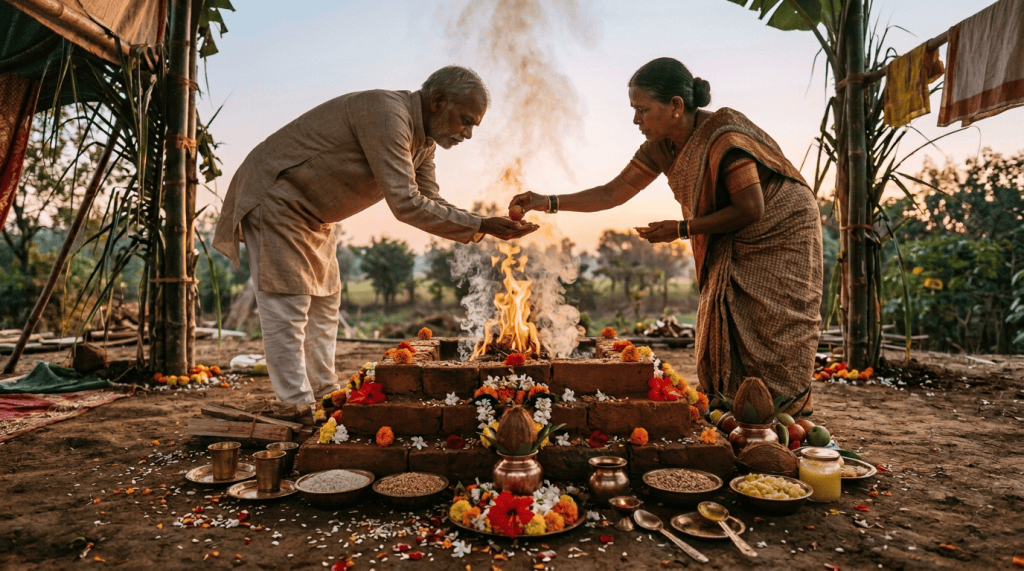
In the introduction to my translation of the Rig Veda, I formulate something essential about the nature of the Vedic sacrifice: the entire life of the civilization revolved around the sacrifice. It was of considerable importance. And the public sacrifices organized by the « householders » could last from one day to a year — they consumed up to an entire year’s income of the sacrificer.
An entire year of income. Offered. Redistributed. Dispersed into the celebration, the music, the alms, the gifts to the priests.
This is not squandering. It is economic policy — the oldest redistribution policy that humanity has documented.
The sacrifice as redistribution
To understand what the Vedic sacrifice represented economically, one must imagine it in its concrete reality. In my introduction, I describe it: a ceremony with long-haired and bearded priests reciting hymns before three or more fires. Music, snake charmers, dancers. A feast lasting days. Animals sacrificed and eaten collectively. Soma drunk by all participants.
And above all: gifts. The dakṣiṇā — the gift made to the priest and the assembly — was the cornerstone of the public sacrifice. Without generous giving, the sacrifice had no value. The wealth of the sacrificer was measured not by what he kept, but by what he gave.
Hymn 10.107 of the Rig Veda, titled « To the Gifts, » is one of the most explicit texts in the Rig Veda on this economy of giving. It is also called the hymn to Dakṣiṇā — and Dakṣiṇā is a divinity, literally: the ritual gift deified.
10.107.1 — Their great generosity has manifested. All the living have been freed from the Darkness. The great Light given by the Fathers has come. The gifts have become visible.
10.107.5 — The one rich in gifts is the first to be called. It is the village chief who walks in front. I think he is the master of men, of peoples, since he is the first who makes gifts.
Notice this verse: the village chief is not the one who has the most — it is the one who gives the most. The legitimacy of power is measured by generosity, not by accumulation. The king of gifts is the first — the chief.
10.107.8 — The generous do not die, nor do they go to failure. The generous are not killed and surely do not fail, since all obtain the Sky and the Earth, since these gifts are offered to them.
The gift protects. It protects not because it buys divine favour, but because it creates a network of reciprocity — the one who gives builds allies, friends, protectors. Generosity is a policy of survival as much as a spiritual virtue.
Hymn 10.117: generosity as cosmic law
If hymn 10.107 is the ritual hymn of giving, hymn 10.117 is its philosophical counterpart — the hymn to generosity as a universal principle. Its rishi, Bhikṣu Āṅgirasa, whose very name means « the beggar, » says what nobody else in the Rig Veda dares to formulate as directly:
10.117.1 — In truth, the gods did not give hunger as an anger that kills; even the well-nourished eventually die. And also, the Wealth of the one who gives is not exhausted, and the one who does not give finds no one to help them.
10.117.2 — The one who has food, when a weak and miserable person approaches, wanting to eat, closes their mind — even if they have known each other for a long time — will find no one to help them.
10.117.5 — The stronger should give to the one who suffers. They should look along the road, for Wealth turns like the wheels of a chariot, and goes from one to another.
10.117.6 — The fool finds their food in vain. I tell the truth. It is simply a weapon for them. They do not prosper like Aryaman, nor as a friend. The one who eats alone has only harm.
« Wealth turns like the wheels of a chariot, and goes from one to another. » — this image is one of the most beautiful in the Rig Veda. Wealth is not made to accumulate. It is made to circulate — as the wheels of the chariot turn, as the rivers flow toward the sea.
And « the one who eats alone has only harm » — a brutal, direct formulation. No condescension, no moral softening. Economic selfishness is an error — not only moral, but practical. The one who does not share ends up alone. And solitude, in a civilization that depends on cooperation to survive, is a catastrophe.
The common assembly: hymn 10.191
The public sacrifice was not only an occasion for redistributing material wealth. It was the central social institution — the place where the community gathered, made decisions, reconfirmed its bonds.
The last hymn of the Rig Veda — 10.191, composed by Saṃvanana Āṅgirasa — is the hymn of unity. And in this hymn, something extraordinary is formulated:
10.191.2 — Come together. Speak together. Know through your minds, since the ancient gods know the portion and venerate it.
10.191.3 — Common is the mantra, common is the assembly, common is their thought through their mind. I declare to you what unites us and that I practise the sacrifice.
10.191.4 — Common is our desire. Common are our hearts. May your thought be common so that you are truly together.
Three times the word « common » in two verses. The sacrifice creates the common — not uniformity, but the shared thing. The common mantra that everyone recites together. The common assembly where everyone is present. The common thought that is born from collective deliberation.
This is the oldest definition of participatory democracy that humanity possesses.
What the sacrifice says to our time
The Vedic culture of giving is not naive altruism. It is a precise understanding of the dynamics of human societies: wealth that circulates is fertile, wealth that accumulates is sterile.
Our contemporary societies have produced the exact opposite of what hymn 10.107 prescribes: fiscal and economic systems reward accumulation and penalize redistribution. The one who gives the most is not « the first to be called » — they are often seen as a fool.
And yet contemporary economic studies on happiness — Kahneman, Dunn, Norton — consistently show that pro-social spending (giving to others, contributing to the community) produces more subjective well-being than spending on oneself. The wheel turns, four thousand years after the rishi Bhikṣu Āṅgirasa, and says the same thing.
10.117.5 — Wealth turns like the wheels of a chariot, and goes from one to another.
 Le Rig Veda
Laisser un commentaire