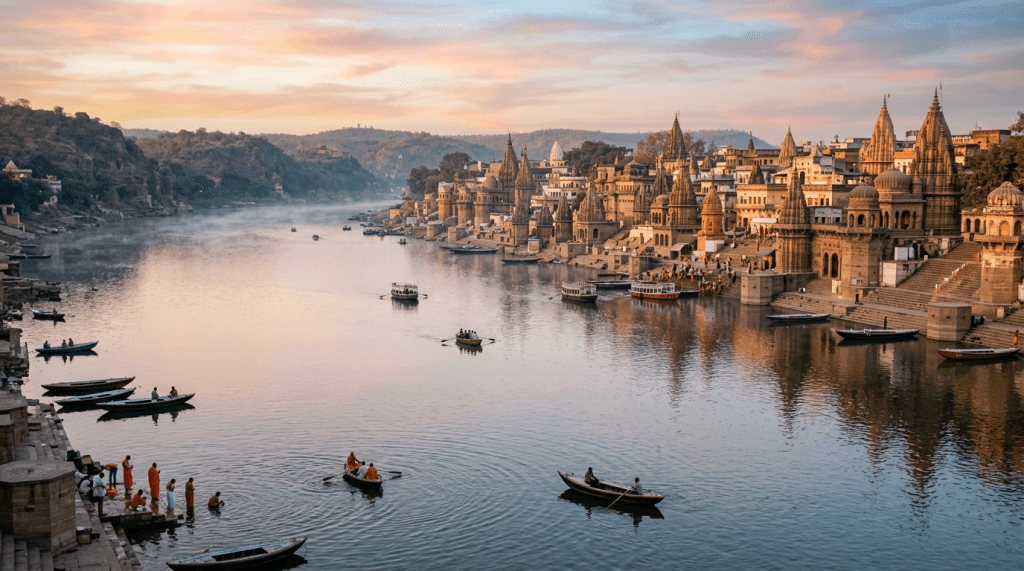
There is only one river in the Rig Veda that is also a goddess — a goddess in her own right, invoked in hymns entirely devoted to her, celebrated as « best of mothers, best of rivers, best of goddesses. » That river is the Sarasvatī.
But the Sarasvatī is not only a river. In the double reading that characterizes all Vedic spirituality, she is also the divine word, the flow of knowledge, the Enlightenment that runs like pure water toward the ocean of the Brahman.
In the glossary of The Civilization of the 7 Rivers, her definition is precise: Sarasvatī: « similar to a lake. » It is the famous river, deified, where the first cities were located. It illuminates all meditations, it is the flow of the divine word which illuminates all thoughts.
The physical river: the greatest of its time
Before being a goddess, Sarasvatī was an extraordinary geographical reality. In The Civilization of the 7 Rivers, I describe her precisely: she formerly bore the Vedic name of Sarasvatī and is known today as the Ghaggar (in India) or Hakra (in Pakistan). At the time of the composition of the oldest mandalas, she was a majestic river descending from the Himalayas, crossing the plains of Punjab and Rajasthan, and flowing into the Arabian Sea.
Her banks bore some of the greatest cities of the 7 Rivers civilization — Rakhigarhi, Kalibangan, Ganweriwala, Banawali. The civilization itself is sometimes called the « Indus-Sarasvatī civilization » precisely because the Sarasvatī was at least as important as the Indus in the geographical organization of this ensemble.
The rishi Vasiṣṭha, in hymn 7.95, describes her in all her power:
7.95.1 — She springs forth, surging, refreshing, that Sarasvatī who wears a purifying metallic armour. She goes like a hasty chariot, surpassing all the waters of other rivers.
7.95.2 — Alone among rivers, Sarasvatī shows herself brilliant. She goes from the mountains to the ocean. She has understood the Riches of the Earth and of the living. She has milked the flow of clarified butter for Nāhuṣa.
« Surpassing all the waters of other rivers » — Sarasvatī was not one river among others. She was the first. And her journey « from the mountains to the ocean » confirms what modern geologists have reconstructed: a river of several thousand kilometres, fed by Himalayan glaciers, crossing the plains of the north-western subcontinent.
Hymn 7.96 of Vasiṣṭha invokes her with particular tenderness:
7.96.1 — I sing the divine word: she is the broadest of rivers. Glorify Sarasvatī, O Vasiṣṭha, with good hymns and, with praises, the Sky and the Earth.
7.96.2 — Since, by your powerful Light, the Pūrus live on your two banks, awaken us, you the protector, the friend of the Maruts. Stimulate the splendour of gifts.
The lost river: what modern science confirms
Sarasvatī dried up around 1900 BCE — a date that is, in The Civilization of the 7 Rivers, one of the key dates of this civilization’s chronology. All specialists agree on this point.
The identification of the Ghaggar-Hakra river with the Vedic Sarasvatī is supported by converging hydrological, geological and archaeological data. In 1893, geologist C. F. Oldham was one of the first to propose this identification in a founding article. In 1980, a team from ISRO (Indian Space Research Organisation) published satellite remote sensing results showing dried-up riverbeds corresponding exactly to the descriptions in the Rig Veda.
Michel Danino, in his reference work The Lost River: On the Trail of the Sarasvatī — which I recommend in The Civilization of the 7 Rivers as « excellent » — assembled decades of geological, hydrological, archaeological and satellite research on this identification. His conclusion is unambiguous: the Ghaggar-Hakra is indeed the ancient Sarasvatī, and her drying up around 1900 BCE — probably caused by Himalayan earthquakes that diverted her tributaries toward other watersheds — played a decisive role in the decline of the 7 Rivers civilization.
Sarasvatī is not a myth. She is a disappeared river that geology and satellites have rediscovered.
The goddess and the divine word
But why did this river — and no other — become a goddess in the Rig Veda?
The answer lies in the Vedic double reading. In the glossary of The Civilization of the 7 Rivers: « She illuminates all meditations, she is the flow of the divine word which illuminates all thoughts. » And in the hymns themselves, Sarasvatī is explicitly associated with sacred speech, with knowledge, with the inspiration of the rishis.
The rishi Bharadvāja’s hymn 6.61 gives her fullest portrait:
6.61.7 — And this Sarasvatī, of golden course, terrible, slaying Vritra, desires good praises.
6.61.9 — Beyond all hatreds, beyond the other sisters, she has extended herself like the Sun extends the day, watching over truth.
6.61.13 — She, the great one among the great, is seen with all her splendours, greater than the others, the most flowing of the waters. Like a chariot made for going far on the great, she must be venerated by observers.
And in hymn 2.41 — perhaps the most celebrated verse the Rig Veda devotes to Sarasvatī:
2.41.16 — Best of mothers, best of Rivers, best of goddesses, O Sarasvatī, we are without glory and desire renown. O Mother, give it to us.
2.41.18 — O Sarasvatī, appreciate this mantra that gives Force. These Gṛtsamadas offer you this flow of Truth, you who are beloved among the gods.
« Best of mothers, best of rivers, best of goddesses » — this triple superlative is unique in the entire Rig Veda. No other entity — not even Indra, not even Agni — receives this triple praise.
Sarasvatī as the flow of speech
The spiritual dimension of Sarasvatī is inseparable from her physical dimension. In the Vedic vocabulary, the words for « river » and for « speech » share a deep kinship: the flow of water and the flow of speech are the same force, in two different manifestations.
When the rishi invokes Sarasvatī to « give the Light of meditations » or to « stimulate the thoughts of the sages, » this is not decorative metaphor. It names a reality of contemplative experience: the just word — the precise mantra, pronounced with adequate consciousness — flows like a river toward its destination, purifying and life-giving.
1.3.10 — Sarasvatī, who purifies us, who sings Force with Energy, favours rich meditation during the sacrifice.
1.3.11 — She brings Luminous Truth and stimulates the thoughts of the sages. Sarasvatī accepts the sacrifice.
1.3.12 — Sarasvatī awakens the great Flow with the Light. She illuminates all thoughts.
This triple verse — in the very first hymns of mandala 1 — immediately establishes the nature of Sarasvatī: she purifies, she stimulates thought, she awakens the great flow of inner Light. This is not the description of an ordinary river. It is the description of a spiritual force.
Sarasvatī and the civilization she bore
There is a deep relationship between the greatness of the physical Sarasvatī and the depth of the spiritual Sarasvatī. In The Civilization of the 7 Rivers, I note that it was on her banks — and those of the Indus and the other rivers — that the most important cities of this civilization were established.
Hymn 3.23.4, in my translation, formulates it magnificently:
3.23.4 — He has installed you in the enclosure of the Earth, in the seat of Ilā, in the Light of days. O Agni, shine richly in Men, in the Dṛṣadvatī and in the waves of the Sarasvatī.
The sacrificial fire burns on the banks of the Sarasvatī. The divine word flows in her waters. The civilization and the river are one.
And when the river dries up — around 1900 BCE — the civilization declines. This is not only a hydraulic catastrophe. It is also, symbolically and perhaps really, the disappearance of the flow that fed the sacred word and collective knowledge.
Sarasvatī ran dry. And with her, something essential was lost.


Votre commentaire