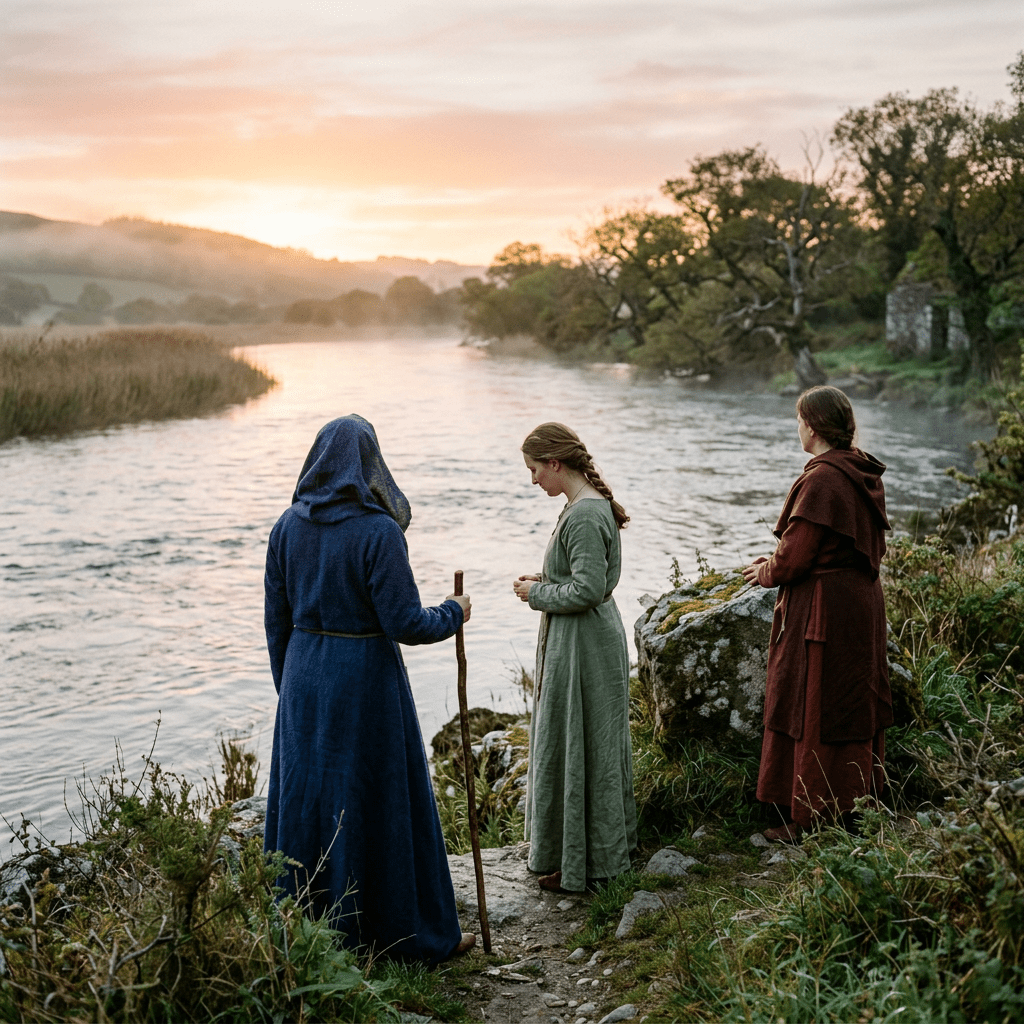
When women composed the sacred hymns
The Rig Veda is a text composed by rishis — seers, poets, sages. And among them, women. Not women evoked, praised or described by men — but women who themselves composed hymns, who themselves had the vision, who themselves transmitted it.
Here is their complete list, as I establish it in The Civilization of the 7 Rivers: Romasā, Lopāmudrā, Apālā, Kadrū, Viśvavārā, Ghoṣā, Juhū, Vāgāmbhṛṇī, Paulomī, Yamī, Indrāṇī, Sāvitrī and Devajāmī. Thirteen women rishis named in the oldest text of humanity. Thirteen women whose words were deemed worthy of transmission, century after century, for over three thousand years.
This simple fact says the essential thing about the civilization of the 7 Rivers: it was not a patriarchal society in the way we understand that word.
Lopāmudrā (RV 1.179): desire as truth
Hymn 1.179 is a unique piece in all ancient literature. It is a dialogue between Lopāmudrā and her husband Agastya — one of the most venerated rishis of the Vedic tradition. And it is the woman who speaks first, and who has the last word.
Lopāmudrā opens the hymn as follows, in my translation:
1 – For many autumns, I have been tired from morning to evening through the Dawns that bring on old age. Old age destroys the beauty of bodies. Let husbands now approach their wives.
2 – The ancients served the Truth. They spoke with the gods. Together, they proclaimed the Laws. They did not fully reach the limit of life. Therefore, let the women unite with their husbands.
This is not a hymn of adoration. Not a prayer. It is a demand. Lopāmudrā tells her ascetic husband, absorbed in his spiritual practices, that desire is legitimate, that the body grows old, that life demands to be lived — and that she, a rishi in her own right, has every right to say so.
Her husband responds, confesses his own desire, concedes. The text closes on Agastya’s admission:
6 – Agastya, desiring children, dug with a spade and engendered the Force. The powerful rishi nourished the two colours, and among the gods, he obtained the Truth.
What is remarkable is that the hymn is attributed jointly to both rishis — Lopāmudrā and Agastya. Wife and husband, co-authors of the same sacred text. This is not condescension. It is parity.
Apālā (RV 8.91): the young woman who finds the soma
Hymn 8.91 is attributed to Apālā ātreyī — a young woman, evidently unmarried, who finds soma in nature and offers it to Indra.
1 – A young girl, going out, found the soma. She said, bringing it home: « I must press you for Indra. I must press you for the powerful one. »
2 – « This little man goes from house to house, shining. Drink what has been pressed by the jaws, accompanied by grain, cake, porridge, and mantras. »
What follows is striking. Apālā asks Indra — the inner force par excellence — for three things: that her father’s hair grow back, that the land become fertile, and that her own desire be fulfilled.
5 – « Indra, make these three highest wishes grow: the head of my papa, the fertile soils, and my little one in my belly. »
7 – « In the hub of the chariot, in the womb of the mother, in the harnesses of the team, O You of a hundred intentions, you have purified Apālā three times and given her a skin as bright as the Sun. »
Apālā is not a submissive figure. She is a woman who negotiates directly with the divine force, who expresses her desires without detour — the fertility of the father, of the earth, and of herself. And it is she, not a priest, who presses the soma. In the civilization of the 7 Rivers, access to the most sacred ritual was not reserved for men.
Ghoṣā (RV 10.39-40): the king’s daughter who sings alone
Ghoṣā Kākṣīvatī is the author of two hymns to the Ashvins — the healing gods, the divine physicians. She identifies herself in the text, which is rare.
6 – It is I who invoked you. Listen to me, O Ashvins, as parents to a son, highly honoured, strengthen me. I am without friend, ignorant, without blood ties, wretched — make me overcome these misfortunes.
And in hymn 10.40:
5 – You circle around us, O Ashvins, Ghoṣā the daughter of a king says: I ask you — be there for me day and night. Would you be as skilled as a coachman for his swift Horse?
Tradition says that Ghoṣā suffered from a chronic illness that had kept her unmarried until an advanced age. Her hymns to the Ashvins — the healers — are said to have earned her both healing and a husband. What matters here is not the anecdote. It is that this woman — ill, isolated, without close family — composed hymns considered powerful enough to enter the Vedic canon. Her very suffering became rishi — seer.
What this changes
In The Civilization of the 7 Rivers, I insist on this point: this civilization could not be macho. Man and woman offered the sacrifice together. Women drank soma like men. They were not relegated to domestic tasks, nor considered secondary. The Rig Veda itself says so, without ambiguity:
5.61.6 – And a woman is more trustworthy than a man, if he does not follow the gods and is selfish.
10.159.2 – I am the Light, I am the leader, I am the powerful decider. My husband, whom I have conquered, must follow my intention by obeying.
These thirteen women rishis are not an anomaly. They are the signature of a civilization that, long before our contemporary debates on equality, had understood that the Truth — the ṛta — has no gender.


Laisser un commentaire