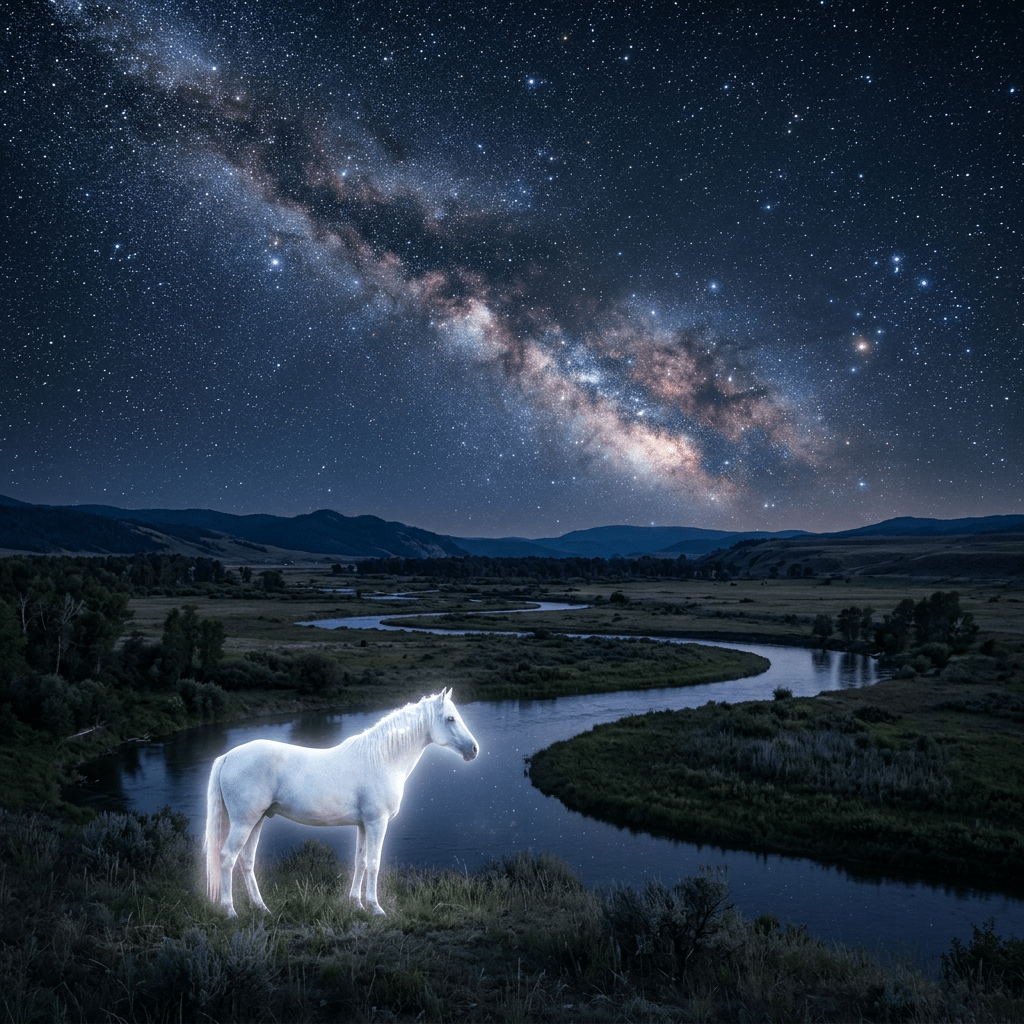
The Ashvamedha — the horse sacrifice — is one of the most complex and most commented rituals of the entire Vedic tradition. In later periods of Indian history, it was appropriated and transformed into an instrument for legitimizing military conquest — a horse released into neighbouring lands, whose course was followed, and whose territory became that of the king. But this is not what hymns 1.162 and 1.163 of the Rig Veda speak of — the only two hymns entirely devoted to this ritual in the oldest text.
In these hymns, there is no conquest. No territory. No king extending his dominion. The horse is not a political instrument in the ordinary sense. He is a cosmic force — and the sacrifice is an act of connection between the human, the animal and the divine.
The horse born of the gods
Hymn 1.163 opens with a celestial genealogy of the horse that immediately establishes the register:
1.163.1 — When you made rise the first neighing born of the Ocean and the Earth, you had the feathers of the eagle and the arms of the deer, O great courser, your birth must be invoked.
1.163.2 — Given by Yama, harnessed by Trita, it is he who was first ridden by Indra. The Gandharva seized his rope, O Vasus, from the Sun you fashioned the Horse.
1.163.3 — You are Yama, you are Aditya, O Horse, you are Trita by the secret rule. Divided, you are at the heart of the soma, they say. Three bonds, in the Sky, bind you.
The original Vedic horse was not born of a mare. He was born of the Ocean and the Earth. He was given by Yama — the first of mortals, lord of the ancestors. He was first ridden by Indra — the inner force par excellence. He is Aditya — son of Aditi, the infinite. He is at the heart of the soma. Three celestial bonds bind him.
Before even being sacrificed, this horse is a cosmic synthesis. He carries within him the forces of Sky, Earth and the intermediate realm. To sacrifice him is to release these forces — to make them available, to redistribute them in the world.
1.163.6 — I recognized you in spirit, yourself, from afar, a flying bird that, from below, crossed the Sky. I saw your head on the easy and dustless paths, like a thirsty bird.
The rishi does not see a draft animal. He sees a being that crosses the Sky like a bird — a force of passage between worlds.
The liturgy of the sacrifice: precision and reverence
Hymn 1.162 is in a very different register — more technical, more ritual, almost surgical in its precision about the unfolding of the sacrifice. And yet every practical detail is wrapped in an intention of protection, respect and connection with the divine.
1.162.1 — Do not look upon us, Mitra, Varuna, Aryaman, Āyu, Indra, Ribhukṣan, the Maruts, when we are about to sing in the assembly the prowesses of the powerful Horse, born of the gods.
The sacrifice begins with a request to the gods not to look on critically — a request for indulgence, almost for complicity. This is not the arrogance of a king imposing his will. It is the humility of a rishi who knows what he is undertaking is immense.
1.162.4 — When the Men lead the Horse around three times at the right moment, it is prepared as an offering leading to the gods. The goat precedes the share of Pūṣan and the gods, the sacrifice is announced.
1.162.5 — Invoker, Officiating Priest, Weaver, Fire-Lighter, Soma-Presser, Sage, and Reciter — with this well-ordered sacrifice, nourish and strengthen us!
Seven sacerdotal functions named — seven types of priests who each contribute to a dimension of the sacrifice. This is not a solitary royal act. It is a collective act, ordered, shared among specialists who each have their precise role.
And then comes something unique in all ancient sacrificial literature: the rishi addresses the horse directly at the moment of its death — with a solicitude that has nothing of cold liturgy about it.
1.162.20 — In dying, do not let your dear soul burn, do not let the axe hurt you in your body, do not let the clumsy and brutal slaughterer miss the members cut up with the knife.
1.162.21 — No, you do not die here, truly you are not hurt, you go to the gods by easy paths.
These verses say something remarkable: the horse is not killed. He is sent — to the gods, by easy paths. The ritual death is a transition, not a destruction. And the rishi addresses the horse with a tenderness that forbids any purely instrumental reading of this sacrifice.
What the sacrifice redistributes
Hymn 1.162 concludes with the purpose of the sacrifice — and it is revealing:
1.162.22 — May this Horse bring us all the Riches, the Cows, the Horses, a virile lineage! Being without blame, may Aditi be surety for us. May the Horse, with our offerings, make us win Power.
The Riches requested are not military. They are Cows — symbol of spiritual and material abundance throughout the Rig Veda. Horses — vitality, energy. A lineage — the continuity of the community. And Power — a term which, in the Vedic double reading, designates above all inner, spiritual force, not domination over others.
In The Civilization of the 7 Rivers, I note that the sacrifices of the masters of the house could last from one day to one year and could swallow up an entire year of the sacrificer’s income. The horse sacrifice — the most costly of all, reserved for the most prosperous masters of the house — was a radical putting into circulation of wealth. The sacrificer did not keep — he gave, he burned, he redistributed.
This is the original political meaning of the Ashvamedha in the Rig Veda: not conquest, but the public demonstration that wealth is not an end in itself, that the Ego of the possessor can be subordinated to something greater. The leader who offers the Ashvamedha does not conquer a territory. He proves he is capable of giving everything.
That is politics as an act of generosity — a concept our world has entirely lost.
https://www.rigveda.blog/ashvamedha-horse-sacrifice-rig-veda-power


Votre commentaire