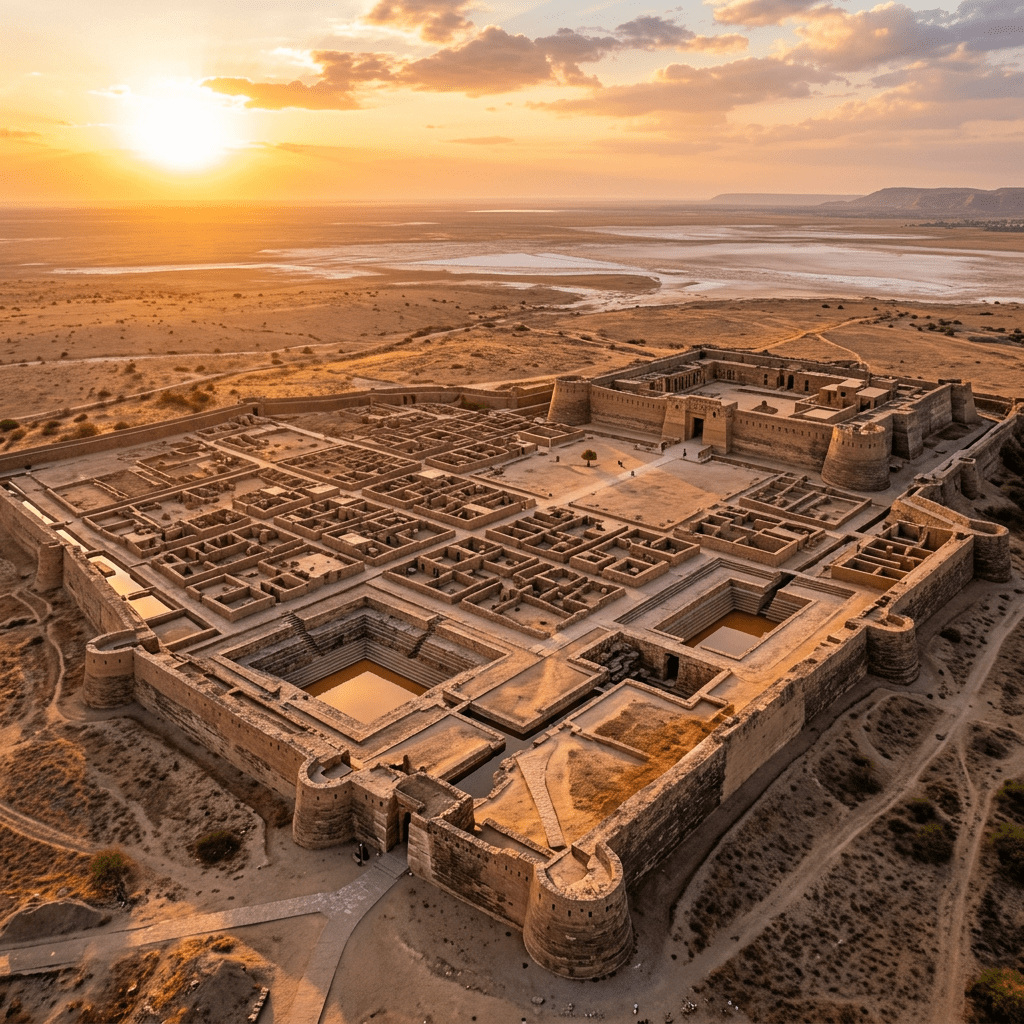
In the northwest of Gujarat, in the Great Rann of Kutch — a vast salt flat that transforms into a shallow sea during the monsoon — lies one of the most extraordinary archaeological sites of the 7 Rivers civilization: Dholavira. Discovered in 1968 and systematically excavated since 1990 by the Archaeological Survey of India, this city reveals aspects of the Indus-Sarasvatī civilization that no other site offers with such clarity.
And it has yielded something absolutely unique in all the excavations of this civilization: a signboard inscription.
Dholavira: the stone city
In The Civilization of the 7 Rivers, I note that the cities of this civilization were built in fired bricks — with the notable exception of Gujarat, where stone replaced brick, notably at Dholavira and Lothal. This regional particularity is not incidental. Gujarat was an exceptional region within the 7 Rivers civilization: not only did it use stone rather than brick, but it survived the general collapse of 1900 BCE for another four to five centuries.
Dholavira is an exceptionally large city — a hundred hectares within the walls, making it one of the largest of the entire civilization. Its plan is remarkably sophisticated: three distinct zones — a fortified citadel on high ground, a middle town, and a lower town — separated by massive walls and monumental gates. An ingenious water reservoir system captures rain and runoff water and distributes it throughout the city — a feat of hydraulic engineering unmatched for its time.
Archaeologists found there the usual hallmarks of the civilization: standardized weights and measures, jewellery in gold, carnelian and lapis lazuli, finely worked pottery, steatite seals. But also, and this is Dholavira’s uniqueness, an object without parallel in the entire archaeology of the Indus.
The inscription panel: ten signs in white wood
In 1990, during excavations of the north gate of the citadel, archaeologists uncovered the remains of a large panel. It had vanished — probably wooden, a perishable material — but the white gyp stone inlays that composed it had remained in place in the ruins. Reconstructed, they reveal ten large signs of the Indus script, arranged from right to left, each approximately 37 centimetres high.
This panel measured about 3 metres long. It was placed above the main gate of the citadel — the place where a civilization that had kings would have put its sovereign’s name, a religious proclamation, a dynastic slogan.
This is not an inscription on a commercial seal meant to travel. Not a text on a utilitarian object. It is a public, monumental text, designed to be read from a distance by all who entered the citadel.
It is the only known example of an inscription signboard in the entire 7 Rivers civilization.
The Indus script: the great mystery
In The Civilization of the 7 Rivers, I devote a section to the mysterious writing of this civilization — and to the many attempts at decipherment that have all, so far, failed.
The steatite seals — thousands discovered on sites, some found as far as Mesopotamia and Bahrain — carry short inscriptions. Too short to allow decipherment. Most contain only four to six signs. Rekha Rao proposed that the seals, worn around the neck, may have served as memory aids for apprentice priests — a system of religious notation. Asko Parpola, the great Finnish specialist in Indus script, concluded after decades of work that it might be an early form of Dravidian language. Iravatham Mahadevan supported the same Dravidian hypothesis. S. R. Rao proposed an alphasyllabic system readable from right to left. Walter Fairservis suggested a logographic proto-writing.
No consensus. The script remains undeciphered.
What makes the Dholavira panel particularly precious — and particularly frustrating — is precisely that it is the longest text in Indus script ever found in a public context. Ten signs. Three metres. A citadel gate. And we still do not know what it says.
Perhaps the name of the city. Perhaps a ritual formula. Perhaps a collective proclamation — analogous to what one might have found at the entrance of a Roman forum, but in a civilization with no sovereign to glorify. The position of the panel — above a monumental gate, in a city without a palace or state temple — suggests something collective: a designation of the place, a protective invocation, a communal principle made public.
What the panel does not say — and what that reveals
This panel is one of the most powerful arguments against the Aryan invasion thesis. If the peoples of the Rig Veda were nomads who came from outside and destroyed this civilization, how can we explain the obvious cultural continuity between the values of the Rig Veda and what we find at Dholavira — the technical sophistication, the absence of glorification of individual power, the communal organization?
The Dholavira panel is the very symbol of this civilization: a public, monumental word, placed at the entrance to the place of power — and of which we still do not know what it says. Perhaps because it says something that our current categories do not yet know how to hear.
When the Indus script is deciphered — if it ever is — the Dholavira panel will be one of the first keys. That day, something essential about the 7 Rivers civilization will be revealed to us.
Until then, these ten white signs on a dark background have been looking at us for four thousand five hundred years. And they keep their secret.
https://www.rigveda.blog/dholavira-inscription-indus-script-signboard


Votre commentaire