There is a god in the Rig Veda who is seldom spoken of, because he is not at the centre of the action — no battles like Indra, no fire like Agni, no cosmic order like Varuna. And yet he is one of the oldest, and perhaps the most universal: Dyaus Pitṛ, the Father-Sky.
His name speaks for itself. Dyaus comes from the Proto-Indo-European root *deiw-, meaning to shine, to blaze. It is the same root that gave Zeus in Greek, Jupiter (Diu-piter, the Luminous Father) in Latin, and Tyr in the Germanic languages. This family of words extends across the entire Indo-European space, from India to Ireland. This is no coincidence — it is a shared memory, a common heritage more than five or six thousand years old.
In the Rig Veda, Dyaus forms an inseparable couple with Pṛthivī, the Earth. Dyaus-Pṛthivī, Sky and Earth: the two Parents of the world. “Heaven and Earth, protect us always from horror, as a child at its parents’ breast” (1.185). That image says everything: the Sky is not an abstraction, he is a Father. And the Earth is not an inert support, she is a Mother.
Elsewhere, the ṛṣi addresses this couple: “The Father and the Mother protect the living… When their Father appears, adorning them with beautiful forms” (1.159). Dyaus is luminous, vast, serene. He does not intervene with great noise. He is there, above everything, like a presence that watches over and protects.
What strikes me is the quietness of this god. In the pantheons that follow — Zeus in Greece, Jupiter in Rome — the Sky-Father became the all-powerful master, the ruler of gods and men, sometimes a jealous and capricious tyrant. In the Rig Veda, Dyaus Pitṛ is more at peace. He is not the authoritarian chief. He is the Father in the deep sense: the one who generates, who protects, who illuminates.
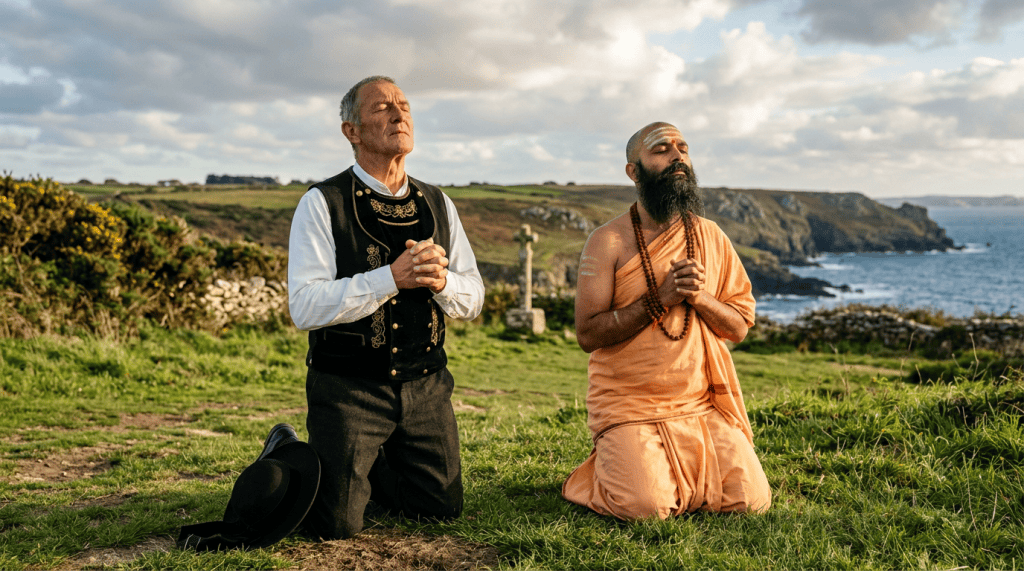
To my mind, there is here a lesson in comparative linguistics that is not always valued at its true worth. When a Breton peasant says doue— god in Breton, doueed in the plural — and a brahmin recites Dyaus, they are pronouncing, six thousand years apart, the same word. And according to S.K. Talageri, advocate of the Out of India Theory, the ancestors of the Celts were the Druhyu, one of the five original Vedic peoples mentioned in the Rig Veda. If that is correct, doue is not merely an Indo-European cousin of Dyaus — it is a direct descendant. The same luminous syllable, carried from the Sarasvatī all the way to the coasts of Brittany. »


Votre commentaire