One of the most striking things when you read the Rig Veda carefully — and after six years of translating it word by word — is the sheer quantity of things you do not find there. Things everyone assumes are present because they belong to the standard image of “ancient Hinduism.” They are not there. Or not yet. The distinction matters.
No temples. No idols.
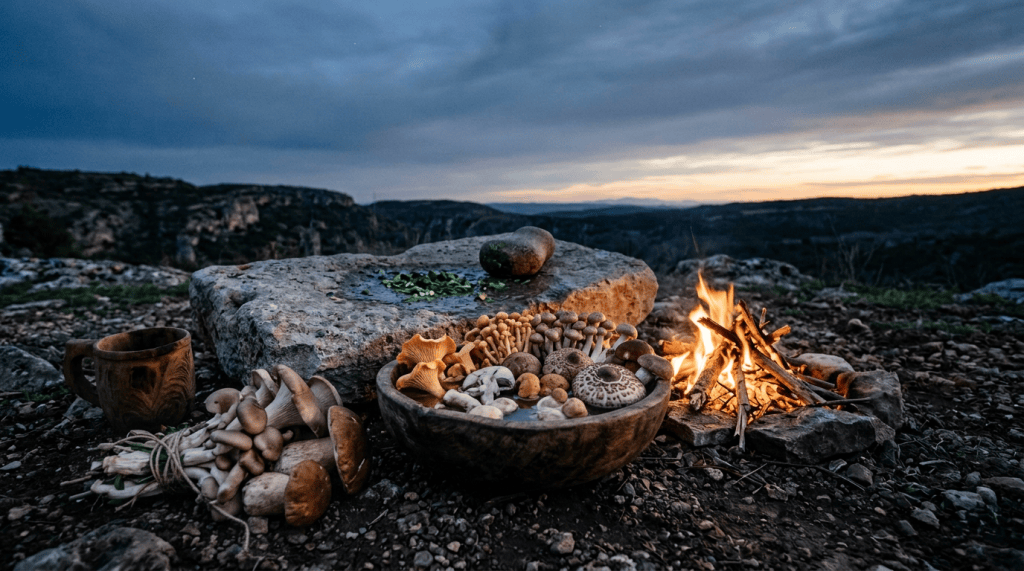
The first nine mandalas of the Rig Veda contain no description of a temple, no mention of a divine statue, no invitation to venerate a sculpted representation of a god. Vedic sacrifices take place in the open air — a fire, a bed of kusha grass, offerings of clarified butter and soma. There is no sacred building. There is no sacred object preserved or displayed.
This is not an omission. It is a coherence. In the Rig Veda, the gods are interior. When you call upon a god to ask for spiritual wealth or immortality, you are calling upon your own inner forces. The gods are symbols. Humanity and nature are not separate. The forces that govern the Universe are the same as those that govern the human being. In this worldview, a temple makes no sense — you do not go into a building to find something that is within you.
The 7 Rivers civilisation — contemporary with the oldest mandalas — confirms this through archaeology: no temple in any of its cities. No prestige idol. No monument to the glory of anyone. It is a remarkable convergence between text and soil.
Varnas: social composition, not hereditary castes
Castes — that word from the Portuguese casta, which rightly makes Westerners flinch — do not appear in the first nine mandalas of the Rig Veda. At most, one finds the word brahman, declined as brahmanah, designating the priests. Never vaishyas, shudras, rajanya.
The varnas appear only in the tenth mandala — the last, the most recent, composed at a time when Vedic society had already evolved, when soma was perhaps beginning to grow scarce. Hymn 10.90 — the Purusha Sūkta — describes society as a body whose different parts correspond to different functions: Brahmins arising from the mouth, warriors from the arms, merchants from the thighs, servants from the feet.
This text must be read for what it is: a description of the functional composition of a society, not a programme of hereditary exclusion. And there is absolutely no mention of untouchables. This notion does not exist in the Rig Veda. It appears nowhere. The jatis — the closed, hereditary castes as they exist today in India — are a much later construction, separated by centuries of social drift from this founding text.
Nothing in the text says these varnas were closed. On the contrary, the first nine mandalas convey an impression of freedom and ease. The only rule visible: perform sacrifices and, therefore, drink soma.
Immortality: present, but differently
The Rig Veda contains many occurrences of the word immortality — amṛta. But care is needed in how you read them. This is not the immortality of the individual soul in the Christian or Buddhist sense. It is a quality the gods possess, which soma can temporarily transmit, and which fusion with Brahman makes accessible. “We have drunk the soma. We have become immortal.” This is not a promise of life after death — it is the description of a state of consciousness.
Vedic immortality is the dissolution of the boundary between the limited self and the unlimited Brahman. Sat-cit-ānanda: being-consciousness-bliss. When that boundary dissolves, death is no longer possible — because there is no longer a separate “self” that could die.
Reincarnation: a late and rare idea
Reincarnation — the transmigration of the soul from one body to another — exists in the Rig Veda only in the tenth mandala, at a time when soma had probably disappeared or nearly so. It is not a pillar of early Vedic thought. It would become one in the Upanishads, then in classical Hinduism. But in the first nine mandalas, this idea is absent.
What is abundantly present, on the other hand, is the idea of continuity — the light returning each morning with Uṣas, the fire rekindled at each sacrifice, the cycle of seasons and waters. A cyclical cosmology, yes. A doctrine of individual transmigration of the soul, no — not yet.
What this absence tells us
What the Rig Veda does not contain tells us as much as what it does. No temples because the divine is interior. No idols because the gods are forces, energies, aspects of Brahman — not characters. No hereditary castes because the only recognised hierarchy is spiritual, and it is accessible to everyone through soma. No reincarnation because the question asked is not “what happens after death?” but “how do we access Reality right now?”
The Rig Veda is a text of immediate experience, not of deferred promise. Perhaps that is what makes it so contemporary — and so misunderstood.
Soma, the path of access to immortality in the hymns → Soma: Plant, Drink, God — What the Hymns of the 9th Mandala Really Say
Varuṇa and the ṛta: Reality beyond māyā → Varuṇa and the ṛta: Truth/Reality Before Morality
The contemporary civilisation — also without temples → Mohenjo-daro: a Million Bricks and Not a Single Palace


Votre commentaire