Soma is everywhere in the Rig Veda. It is pressed, mixed with water and milk, drunk during sacrifices by priests and rulers, celebrated in an entire mandala — the ninth — exclusively devoted to it. It is the only plant-god in the Vedic pantheon. And yet, despite centuries of debate, botanists and Sanskritists cannot agree on its identity. This mystery is itself revealing of something essential in Vedic spirituality.
The Rig Veda gives a botanical description of soma that is remarkably precise in its brevity: amshu — fibre, filament. Never leaves, never seeds, never fruits, never flowers. Across all nine original mandalas — the oldest layer of the text — not a single mention of these elements so fundamental to any plant description. What is pressed is fibres. What is filtered is filaments. This description immediately eliminates all the hypotheses put forward over the centuries: ephedra, wormwood, rhubarb, cannabis. None of these plants corresponds to the total absence of leaves, flowers and seeds in the description.
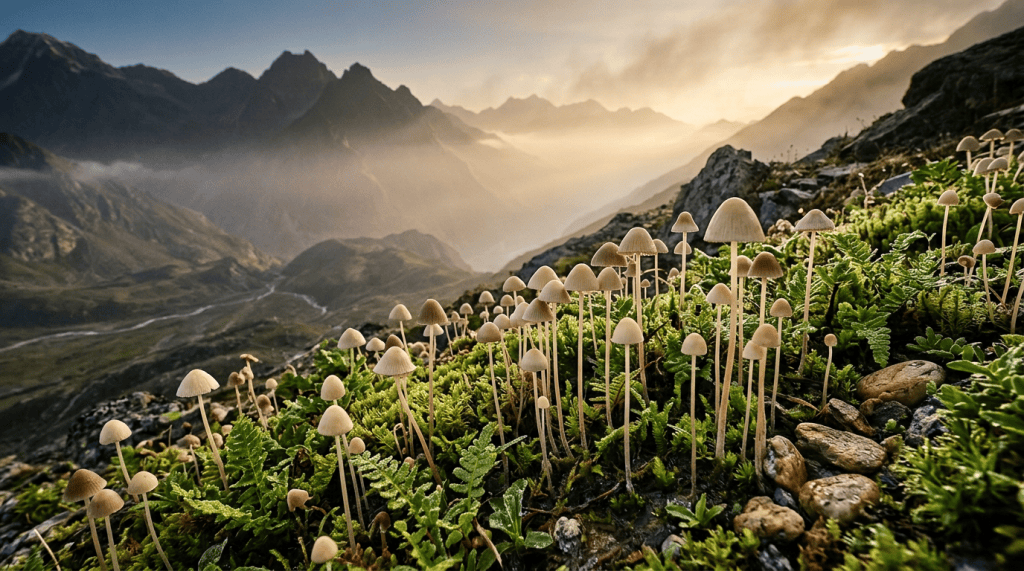
In my view — and I say this clearly because it is my position, not an academic consensus — the soma was psilocybe cubensis, a mushroom containing psilocybin. It is, to my knowledge, the only entheogen that corresponds exactly to the Vedic description: fibre, filament, no leaf, no fruit, no flower, no seed. A mushroom, in its structure, is only mycelium and cap — that is, filaments. The description of soma in the Rig Veda corresponds precisely to the morphology of a mushroom.
The effects of soma as described in the hymns confirm this hypothesis. The texts speak of an expansion of consciousness, of entering into light, of immortality, of union with the divine. “We have drunk the soma. We have become immortal. We have entered the Light, we have found the gods there.” This vocabulary of transcendence, of the dissolution of the ego, of mystical union corresponds precisely to the documented effects of psilocybin-based psychedelics — expansion of consciousness, reduction of the sense of self, experiences of transcendance described as contact with a vaster reality. The work of Griffiths, Carhart-Harris and MacLean, published between 2006 and 2016, provided for the first time rigorous clinical documentation of these effects, confirming what Vedic rishis had been describing for millennia.
The soma plant thus most likely contained a tryptamine — a substance from the same family as the dimethyltryptamine our brain produces naturally. Stanislav Grof, who treated patients with LSD for more than ten years before developing holotropic breathwork, showed that pranayama can trigger similar states of consciousness. This connection between pranayama and altered states of consciousness is the subject of a separate article on this blog.
What is striking is the shortage. Around 2200–2100 BCE, soma disappears. My translation shows this clearly: the tenth mandala, added after this date, has a radically different tone from the first nine. Soma becomes scarce; priests replace it with other plants — ephedra mixed with cannabis, blue lotus — which have entirely different effects. And it is precisely at this time that the caste system appears. This may not be a coincidence: a society whose leaders regularly drank soma could not function like those that followed. Regular expansion of consciousness produces a vision of the world that rigid hierarchical structures cannot sustain.
Today, science is rediscovering what the Vedic rishis knew. Supervised psychedelic therapies are making a remarkable return: the FDA has granted “breakthrough therapy” status to psilocybin for treatment-resistant depression; leading universities — Johns Hopkins, Imperial College London, NYU — are conducting clinical trials on its therapeutic use for addictions, anxiety disorders, and end-of-life distress. Oregon and Colorado have already legalised its supervised therapeutic use. This is not a revolution: it is a return. The Rig Veda tradition has known for millennia what our societies are now rediscovering with the caution of the scientific method.
Soma was not a recreational drug. It was the heart of a collective spiritual practice, consumed within a precise ritual framework, with a clear intention: access to Brahman, to the ultimate reality beyond the individual self. The distinction that contemporary researchers make between supervised therapeutic use and unsupervised use corresponds exactly to the Vedic distinction between the ritual sacrifice with soma — always a structured, communal ceremony — and any consumption outside that context, which the text never mentions in a positive light.


Votre commentaire