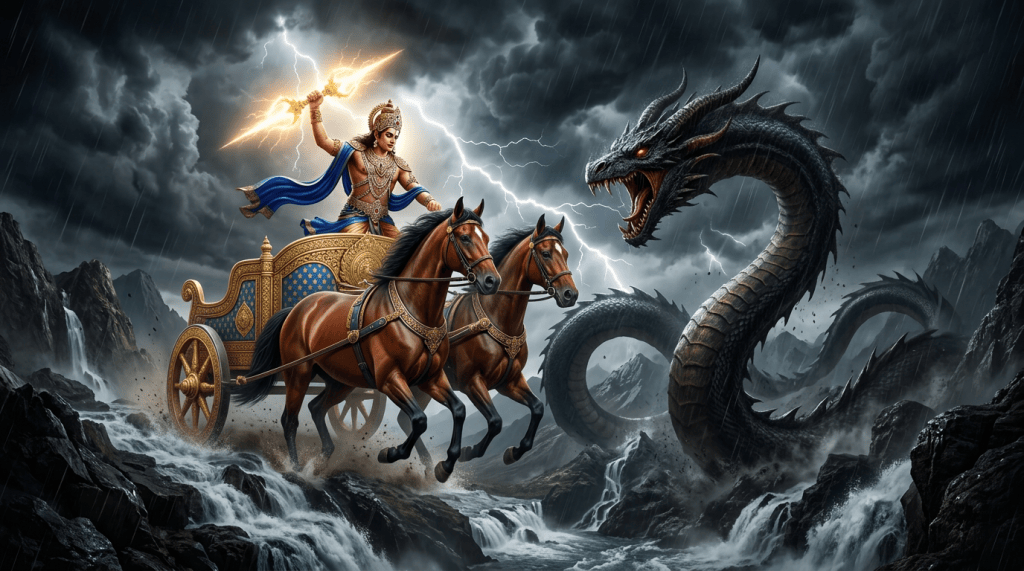
There are hymns in the Rig Veda that seem to have been written yesterday. Hymn 1.32, the great song to Indra the slayer of Vritra, is one of them. Vritra — the cosmic serpent, the one who holds back the waters, the one who blocks life — I find him everywhere in our time. In the conference rooms where oil lobbies negotiate their exemptions. In the public-private partnerships that privatize water. In the trade agreements that protect the profits of fossil fuel corporations. Vritra is still here. He has simply put on a suit.
The hymn begins like this, in my translation: “I tell of the ancient exploits of Indra, which he accomplished with the Thunderbolt. He struck the serpent of the Sky and freed the Waters, he pierced the mountains so that the rivers could flow.” Everything is there, in a single stanza. Vritra blocks the waters — meaning: blocks life, fertility, the natural flow of energy. Indra frees them. It is a myth of cosmic liberation, and it repeats itself in every era under different forms.
Vritra is described in the text as “the darkest”, as “the serpent of the Sky who lay upon the mountain”. He is organized inertia, deliberate stasis, the refusal to let flow what must flow. He “damaged the Rivers” — rivers that, in the Rig Veda, symbolize both physical watercourses and the flows of illumination, vital energy, shared wealth. When Vritra blocks the waters, the entire civilization suffocates. This is not an abstract metaphor: it is a precise description of the mechanism of concentrated power.
What strikes me about this hymn is the description of Vritra himself. “Without feet, without hands, he still provoked Indra.” Without feet, without hands: he does not act directly, he does not fight in the open. He paralyzes, he obstructs, he makes movement impossible. He is not a warrior — he is a system. A system of blockage, capture, and immobilization of flows. Replace the rivers with atmospheric carbon, with solar energy suppressed in standardization committees, with fossil fuel subsidies that strangle renewables at birth: you have Vritra in twenty-first century form.
The hymn says further: “The wives of Dâsa, guarded by the serpent, were besieged, like the Cows by the Panis. The Waters had been placed in a cavern; the killer of Vritra freed them.” In other hymns of the Rig Veda, the Panis are the hoarders — those who hide the light, who accumulate the cows (symbol of light and wealth), who refuse the sacrifice, meaning the act of sharing. I explored their role in the article on Bṛhaspati and the Theft of the Cows by the Paṇis: the Panis and Vritra belong to the same mythological register — that of pathological retention against the natural flow of the world.
Indra carries “the Thunderbolt”. The thunderbolt, in Vedic vocabulary, is the force of sudden rupture, the energy that tears open the clouds and brings the rain. It is also, in the inner reading the Rig Veda proposes, the force of illumination that tears the veil of illusion — Mâyâ. “When you struck, O Indra, the first-born of serpents, and destroyed the Illusion of those who deceive, you gave birth to the Sun, to the Sky, and to the Dawn.” Destroying the illusion of those who deceive — this phrase is of striking precision. The oil lobbies do not merely block climate policies: they manufacture illusion. They fund doubt, commission studies, occupy media space to keep Vritra alive as long as possible.
At the end of the hymn, Indra is proclaimed king “of what is mobile and what is immobile, of what is tethered and what is horned”. This is a formula of total sovereignty over reality. But what interests me is that this sovereignty is exercised after the liberation of the waters — not before. Indra is not a king who reigns over a frozen world. He is a king who has freed the flows and reigns over a living world. Legitimate power, in this Vedic vision, is that which maintains circulation, sharing, movement. Whoever blocks is Vritra, by definition.
This myth seems to me of burning relevance. It is not a matter of believing literally in a cosmic battle between a thunder-wielding god and a celestial serpent. It is a matter of understanding that the cultures which produced the Rig Veda had identified, six thousand years ago, a fundamental mechanism of human power: the power to block natural flows — water, light, energy, knowledge, shared wealth — is the power of Vritra. And that at every epoch, an Indra is needed to break it. On saptasindhuveda.com, I showed that the civilization that produced these hymns was itself organized against Vritra: no palaces, no armies, no ostentatious accumulation — a society structured for the rivers to flow. The notion of dharma in the Rig Veda is the other side of this same struggle: the order of things is flow; transgression is retention.


Votre commentaire