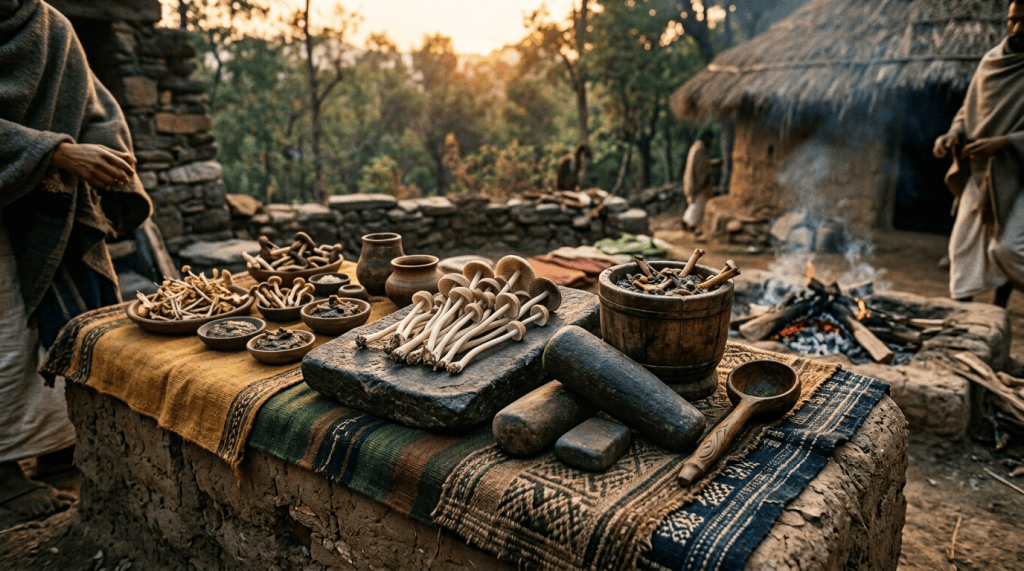
In the Rig Veda, soma is not simply a drink. It is an entheogenic plant — very probably a psilocybe cubensis — whose ritual preparation is itself a sacred act. What I want to explore here is the precise gestures of that ritual, as they appear in the hymns, and what they reveal about the consciousness of those who performed them.
The word soma literally means « that which is pressed. » This deified name refers not only to the plant, but to the entire process: the plant, its juice, and the god that juice embodies. It is this unity between physical gesture and spiritual intention that makes soma something unique in the history of sacred substances.
All of life in Vedic civilization revolved around the sacrifice. The archetypal sacrifice, the Agnistoma — the praise of fire, Light, illumination — took place at least once a year, in spring. Every member of society in a position of responsibility participated and drank soma. This was not a marginal act reserved for a few initiates: it was the central ceremony, the axis around which collective existence was organized. And at the heart of that ceremony lay the preparation of the plant.
In the hymns of Mandala 2, the ritual sequence appears with precision. There is reference to the « three first pressings of the sacrifice » — the trikadrukas — during which the juice was extracted. These three successive pressings correspond to three distinct moments of the sacrifice. « The first juice of the fiber is accompanied by mantras, » the text states (RV 2.13.1). This is not an incidental detail: the mantra is not recited after the preparation, it accompanies it, it is part of it. The sacred word and the gesture of pressing are simultaneous, inseparable.
The pressing stones were the central instruments of this ritual. The plant — whose fibers, or amshu, are the only part ever described in the hymns, never leaves, seeds, flowers or fruit — was crushed between these stones. The juice thus extracted was then filtered through wool, then mixed with water and milk. This dilution was not a weakening: it participated in the balance of the preparation, in the right measure of the experience to follow. For everything to go well, it was essential that the experience be ritualized — that is what I have retained from a key passage in my book.
The integration of mantras throughout the process transformed each gesture into an act of consciousness. The priest who pressed, filtered, and poured was not merely preparing a drink: he was performing an opening. He was inviting the god to descend into the cup, preparing the inner space of those who would drink. RV 2.14 is explicit: « Priests, bring Indra the soma. Pour into the cups the intoxicating juice. Serve it quickly for the mighty Hero who always desires it. » That urgency is not impatience: it is the awareness that the ritual moment is precise, that the window of opening is brief.
The plant contained a tryptamine of the same family as the one we naturally generate in our own brains — dimethyltryptamine. Between half an hour and an hour after ingestion, the effect was at its maximum. The priests knew this. That is why the first mantras were recited during the days preceding the sacrifice, and the last ones as the tryptamine was « rising. » Each verse was a support for meditation. The preparation of soma was only the beginning of a vaster, interior preparation: that of the mind itself.
What I find remarkable in this arrangement is its practical intelligence. Ritualization was not there to mystify the experience: it was there to protect it. It created the framework, the safety, the right intention. It distinguished sacred use from simple consumption. And in that distinction lies, to my mind, all that separates Vedic spirituality from what it would become after soma disappeared — a religion, with its dogmas, its egos, and its violence.
The ninth mandala of the Rig Veda is entirely devoted to deified soma. It is the only mandala dedicated to a single deity. This editorial choice — if one may call it that — on the part of the compilers says something essential: the ritual preparation and consumption of soma were not merely one aspect among others of Vedic spirituality. They were its living heart. The plant and its ritual were the royal path toward what the hymns call immortality — not eternal life in the ordinary sense, but the experience of what, within us, is neither born nor dies.
At the second level of reading, the preparation of soma is a metaphor for interior preparation. Pressing the fibers is extracting the essence of oneself. Filtering through wool is letting fall what is coarse and retaining what is subtle. Mixing with water and milk is integrating purity and nourishment. And the mantras accompanying each gesture — that is conscious intention, without which no transformation is possible.
This precise ritual, this meticulous care given to each stage of preparation, is also what distinguished this civilization from everything surrounding it. For those who want to understand how ego dissolution accompanied by soma transformed individual and collective consciousness, that article is here. And to grasp the role of Bṛhaspati, lord of mantras, in the transmission of this wisdom, I invite you to revisit that text. Finally, for a striking contrast with neighboring civilizations built on war and hierarchy, the 7 Rivers civilization and its commercial hospitality offers compelling insight.


Laisser un commentaire