One of the mythic narratives in the Rig Veda that fascinates me most for its symbolic richness is the theft of the cows by the Paṇis, and the way Bṛhaspati — aided by the Angiras and Indra — splits the mountain open to set them free. It is one of those hymns that demands a double reading: the surface level, and the inner reading, which is the one I propose in my translation.
At the first level, the story is straightforward: demonic misers, the Paṇis, have stolen cows and hidden them inside a mountain cave. The gods send Saramā, the divine bitch, to track them down. Then Indra and Bṛhaspati, together with the Angiras — the forces of Light, children of the gods — split the mountain open through mantra and the power of the sacrifice. The cows are freed.
But in my translation, I consistently read the cow as a symbol of Light. That is what the mini-glossary I built from the text itself says: Cow = Light. The cave is the place where the Light is imprisoned — the mental blockages that prevent the human being from reaching the Brahman. The Paṇis are the spiritual misers, those who perform no sacrifice, who hoard the Light or simply ignore it. This double reading runs through everything I translate — and it applies just as much to the War of the Ten Kings as to the hymns addressed to soma.
Bṛhaspati — whose name means « Lord of the Multitude » or « Lord of the Sacred Word » — is the god of the mantra, the father of all mantras, as hymn RV 2.23 states: « Brihaspati, attentive god, the gods received from you the portion of the sacrifice. Like the Sun, through the great Light, generates its rays, you are the father of all mantras. » He is not a warrior god. He is the god of sacred knowledge, of the right word, of the hymn that opens the inner caves.
What I take from this myth is the power of invocation. Bṛhaspati does not split the mountain with weapons. He splits it with the mantra. Hymn RV 1.62 says it directly: « When Indra and the Angiras desired it, Saramā found a drink for her children. Brihaspati split the mountain, found the Cows. » These are the Angiras — the forces of Light, sons of the gods, those who know the path — who accompany Bṛhaspati. And it is the combination of right desire, the tracker who finds the trail, and the powerful mantra that accomplishes the action.
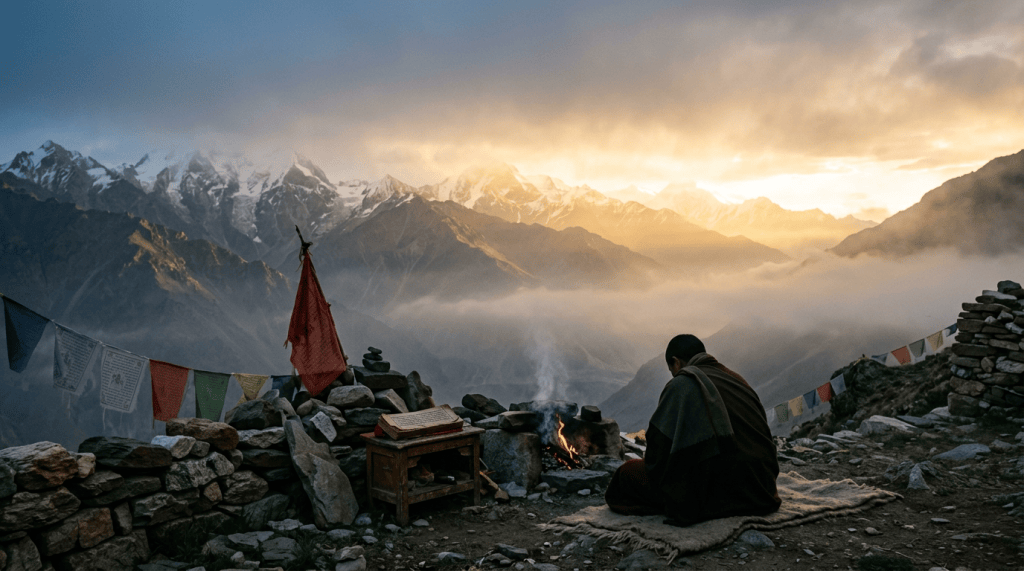
In my reading, this narrative describes the inner experience of the soma sacrifice. Saramā the seeker is intuition, the consciousness that tracks the way toward Light. The mountain is the hardened ego, the mind’s resistance to opening. The split is the moment of illumination — the sudden dissolution of what was standing in the way. And the cows rushing out of the cave into the morning Light: that is the mystical experience itself. I developed this dimension in my article on soma and the dissolution of the ego — the same logic is at work here: soma opens, Bṛhaspati names, and the Light breaks through.
Hymn RV 1.93 says with a clarity I admire: « Agni, Soma, when you magnificently stole from the Paṇis their food and their Cows, you conquered the children of Brisaya, you found the Light. » The Paṇis withholding the cows is ignorance withholding the Light. The gods who split open — that is the sacrifice, the mantra, the Truth that breaks the blockages. This same Truth, this same peaceful force, is what structured the civilization I write about on saptasindhuveda.com: a society without glorification of the ego, without violence, built around the common good.
This is always how I read the Rig Veda: on these two superimposed levels. The physical level of the sacrifice, and the inner level of awakening. Neither is wrong. They are read together.


Laisser un commentaire