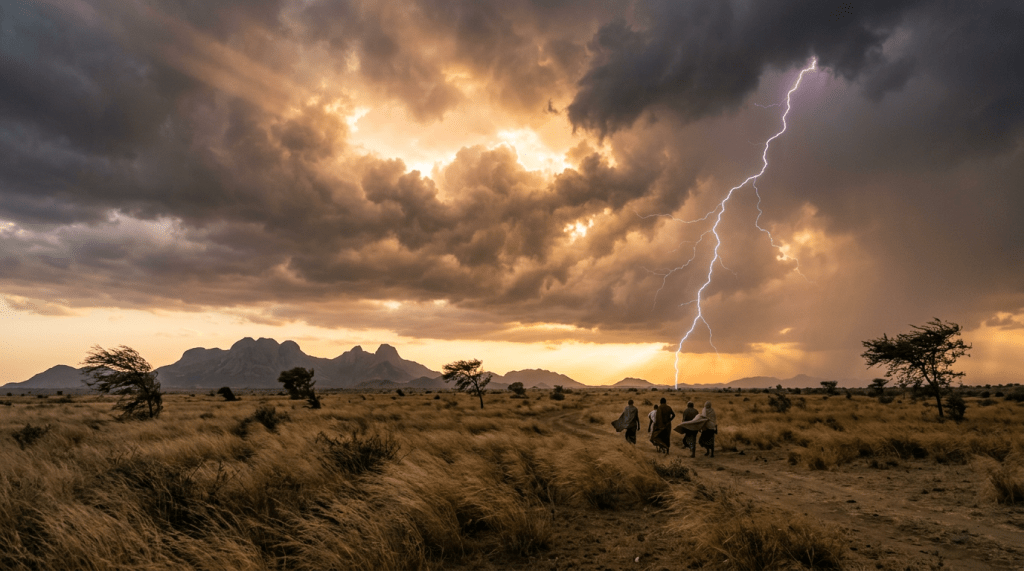
There is no figure in the Vedic pantheon more collective, more impetuous, more radically different from the principle of the solitary and sovereign divinity than the Maruts. They are not a god. They are a troop — and this difference says everything.
In the glossary of The Civilization of the 7 Rivers: « The Maruts: the storm deified. They are forces that can unleash destructive power, but also give rain and fertility. They are associated with the forces of nature in their dynamic and transformative aspect. »
A troop of fierce, roaring young gods who travel together on their blazing chariots, who shake mountains, who make the Earth tremble, who milk the udder of the Sky to bring down rain — and who speak with one voice when they pass.
Sons of Rudra, companions of Indra
The Maruts are the sons of Rudra — the cosmic force of the storm, of necessary destruction, of renewal through violence. And they are the permanent companions of Indra — the inner force that strikes resistance and liberates what was blocked.
This double filiation says something essential: they inherit from their father destructive power, and from their association with Indra a liberating purpose. The storm that devastates and the rain that fertilizes are two faces of the same force.
Hymn 1.64, composed by the rishi Nodhas Gautama, describes them in all their complexity:
1.64.2 — They are born of the Sky, these sublime and vigorous children of Rudra, free from evil and divine, immaculate. They are pure as suns, warriors like storms of terrible form, falling in rain.
1.64.4 — With magnificent ornaments, they adorn themselves with golden chains on their chests and gather in Beauty. On their shoulders are the shining lances. They are born, together, by their inherent power, the Men of the Sky.
1.64.5 — Roaring, giving Force, destroying enemies, they created the winds, the lightning with their Forces. The divine agitated ones milk the udder of the Sky and make the surface of the Earth swell with the juice.
« They milk the udder of the Sky » — rain is the celestial milk. The Maruts are the herdsmen of the cosmos, who extract from the clouds what nourishes the Earth. The violence of the storm is in the service of fecundity.
The troop that speaks together
What characterizes the Maruts uniquely in the entire Vedic pantheon is their collective nature. Never alone. Always as a group. Always acting in concert.
Hymn 1.37, composed by the rishi Kaṇva Ghaura in Gāyatrī metre, says this with unmatched precision:
1.37.6 — Who is the strongest, O Heroes, of those who shake the Sky and the Earth? You shake them like garments.
1.37.7 — At your violent and furious approach, Man stands firm. Hills and mountains flee.
1.37.8 — Under your swift footsteps, the Earth trembles like a clan chief weakened by fear.
1.37.12 — Maruts, you have the Force, shake men, shake the mountains.
1.37.13 — When the Maruts travel, they speak together, everyone hears them.
« When the Maruts travel, they speak together, everyone hears them. » This verse says everything. The Maruts do not whisper. They roar — together, with one voice, that everyone hears. Their power comes precisely from their unity. Separated, they would be ordinary winds. Together, they are the storm that shakes the mountains.
The mandala 5 series: the storm in detail
Mandala 5 offers the most detailed series of hymns on the Maruts — six consecutive hymns (5.54 to 5.59), all composed by the rishi Śyāvāśva Ātreya. Each hymn is a variation on the same force — the storm in its different manifestations.
5.54.3 — The Maruts, men impetuous as the wind, shook the mountains with what is brilliant by its Light and with the stone arrows. Desiring water, in an instant, they are covered with hail with a roaring, violent and very powerful assault.
5.54.8 — The Maruts have chariots drawn by Horses like men conquering villages. They have hospitable water-skins. They swell the clouds. When the powerful ones shine, they flood the Earth with sweet plants.
5.55.5 — You lift the rain from the ocean, O Maruts, you make it rain on the inhabited Earth. Your Cows are not exhausted, O You who perform wonderful acts.
5.55.7 — Neither mountains nor rivers hindered you. Where did you place your observation, O Maruts? And you circulate around the Earth.
« You circulate around the Earth » — the Maruts are not local. They are cosmic. They traverse the entire globe, from mountain to mountain, from ocean to ocean, carrying rain where it is needed.
5.57.4 — The Maruts, impetuous, are like the wind, clothed in rain, all similar in appearance like twins, well-adorned, having tawny Horses and bay Horses, spotless, vigorous, as vast as the Sky in their greatness.
5.58.7 — Even the Earth extended during their journey. As a husband does for an embryo, they implanted their own forces. Yes, they harnessed the winds like Horses under the yoke, they transformed their sweat into rain, the sons of Rudra.
« They transformed their sweat into rain » — the effort of the storm is also a gestation. The rain is the fruit of the violence of the winds, as a child is the fruit of the union of bodies. Destruction and creation are one thing, in two moments of the same movement.
The inner dimension: collective energy as spiritual practice
True to the double reading that characterizes all Vedic spirituality, the Maruts are not only an atmospheric phenomenology. They are also inner forces.
In hymn 1.64.12, the rishi states this explicitly:
1.64.12 — We invoke the lineage of Rudra through a meditation, agile, pure, solid, very effective. The troop of Maruts, energetic, fertilizes the Intermediate World, through the juice of soma, to unite with Beauty.
The Maruts fertilize the « Intermediate World » — that is, the space between Sky and Earth, the psychic space where human consciousness operates. Their collective energy, invoked through soma and meditation, produces in the rishi’s consciousness what the storm produces in the sky: an upheaval that makes way for something more fertile.
What the Maruts reveal about the 7 Rivers civilization
A civilization established in the plains of northwestern India lived under the rule of the monsoons. The wind was not an incidental phenomenon — it was the force that preceded vital rain, that determined whether the year would be abundant or barren.
And the collective nature of the Maruts — never a chief, always a troop — says something about the civilization that created them. Not a king of winds, not a general of storms. A troop that acts in concert, speaks with one voice, shares power and glory equitably.
1.37.13 — When the Maruts travel, they speak together, everyone hears them.
This may be the most accurate image of the 7 Rivers civilization itself: a troop that marches together and speaks with a common voice — without a king, without a palace, without a monument to the glory of any single one.


Votre commentaire