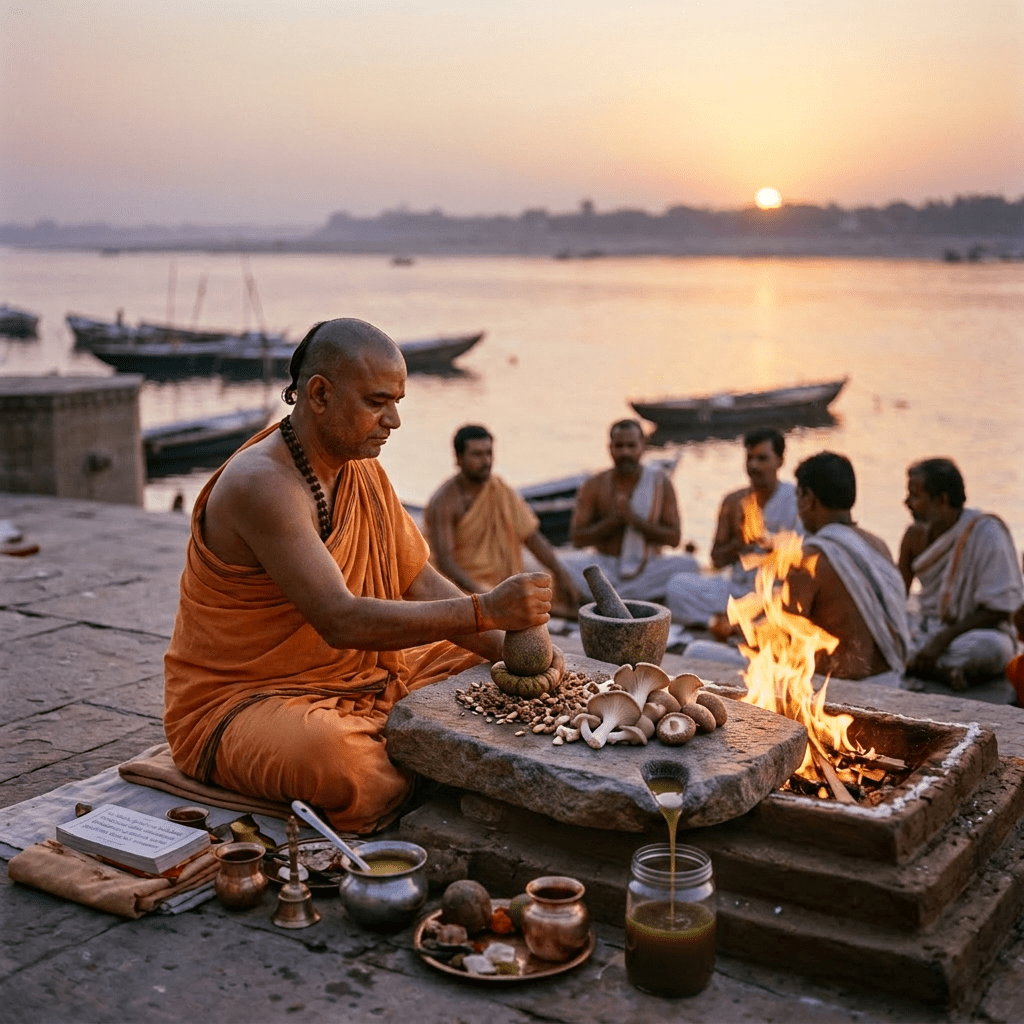
There is a verse in the Rig Veda that sums up six thousand years of human spiritual seeking. It appears in the eighth maṇḍala, hymn 48, verse 3:
We have drunk the soma. We have become immortal. We have entered the Light, and found the gods there.
This is not symbolic poetry. It is not a metaphor. It is the direct testimony of a lived experience, by a rishi of the 7 Rivers civilization, several millennia ago. An experience that this civilization placed at the very centre of its social, spiritual and political life.
What Is the Soma?
Soma is at once a plant, its juice, and a god. In Vedic Sanskrit, the word comes from a root meaning that which is pressed. The plant was crushed, its juice filtered, mixed with water and milk, and drunk during the sacrifices. At the height of the classical Vedic period, soma was worth its weight in gold. It was exchanged for a cow.
The ninth maṇḍala of the Rig Veda is dedicated to it entirely. It is the only maṇḍala consecrated to a single deity. That fact alone tells us how central soma was to this civilization. The whole of social life revolved around the sacrifice, and the most sacred sacrifice was the one at which soma was drunk.
The Mysterious Plant
For centuries, researchers have debated the true identity of this plant. In the hymns, there is never any mention of leaves, seeds, fruits or flowers — only fibres. This rules out the usual candidates, such as ephedra, proposed by some Indologists.
An unexpected archaeological discovery may have provided the answer. In 2009, Russian archaeologists found in Mongolia a tapestry dating from the first century CE, woven in Palestine or Syria and embroidered in the cities of the Indus. The motif depicts priests of Zoroastrianism — the Iranian religion derived directly from Vedism — venerating a mushroom identified as an Indian variety of psilocybe, that is to say, a mushroom containing psilocybin. Zoroastrianism used the same sacred drink as Vedism, called haoma in Persian. Researchers concluded that soma likely contained it too. This matches the descriptions in the hymns perfectly.
The Effects: What the Rishis Said, What Science Says
The soma plants therefore very likely contained a tryptamine from the same family as the one our brains generate naturally: dimethyltryptamine, or DMT. This is not a foreign substance. It is a molecule we produce ourselves, notably during deep meditation, pranayama, or certain dream states.
The psychiatrist Stanislav Grof demonstrated this in a striking way. For over ten years, he treated patients with LSD, obtaining remarkable results. When legal restrictions ended that practice, he developed, with the help of yogis, holotropic breathwork — a technique that, through breath manipulation alone, produces identical states of consciousness. He obtained the same effects.
What the rishis described as the intoxication of soma — and the word intoxication has nothing to do with alcohol, the texts make this explicit — corresponds to what modern neurology calls a mystical-type altered state of consciousness: temporary dissolution of the ego, feeling of unity with the whole, perception of inner light, experience of what the Upanishads call Brahman.
In hymn 2.41.4, the rishi says simply:
Mitra and Varuṇa, this soma juice enables us to reach the Truth.
Truth, in the Rig Veda, is what I translate as Reality or ṛta — the fundamental cosmic order, the deep reality of the universe. Not a religious or dogmatic truth. Reality as it is, beyond the filters of the ego.
A Society Governed by Illumination
What is remarkable — and what academic Rig Veda scholarship tends to sidestep — is the political and social dimension of all this. In this civilization, all those in positions of responsibility drank soma regularly. All the leaders of society participated in the soma sacrifices. Not occasionally, not symbolically. Regularly.
A society in which those in power regularly dissolve their egos in expansive states of consciousness cannot function like our modern societies, built on the competition of egos and the accumulation of power. This is probably one reason why the 7 Rivers civilization had no army, no palace, no absolute king, and lasted fifteen centuries in a remarkably egalitarian organization.
The soma shortage around 2100 BCE, incidentally, coincided with the appearance of the caste system in the tenth maṇḍala — the most recent section of the Rig Veda. This may not be a coincidence. When the substance that dissolved the ego disappeared, the egos came back, bringing hierarchy and power with them.
A Thread That Has Never Broken
Yoga, meditation, pranayama, holotropic breathwork — all of these practices aim at the same state of consciousness that soma made accessible. The paths have changed; the destination has remained the same: to reach that state of being in which the illusion of separation dissolves and something else becomes visible.
When an experienced meditator describes the experience of samādhi, the words are not far from verse 8.48.3: light, unity, dissolution of the boundary between self and the rest. Six thousand years separate the Vedic rishi from the meditator of today. The experience, it seems, has remained the same.
Perhaps that is the true message of the Rig Veda: the state of consciousness that the rishis sought through soma is not beyond reach. It is within us. It has always been within us.
 Le Rig Veda
Laisser un commentaire