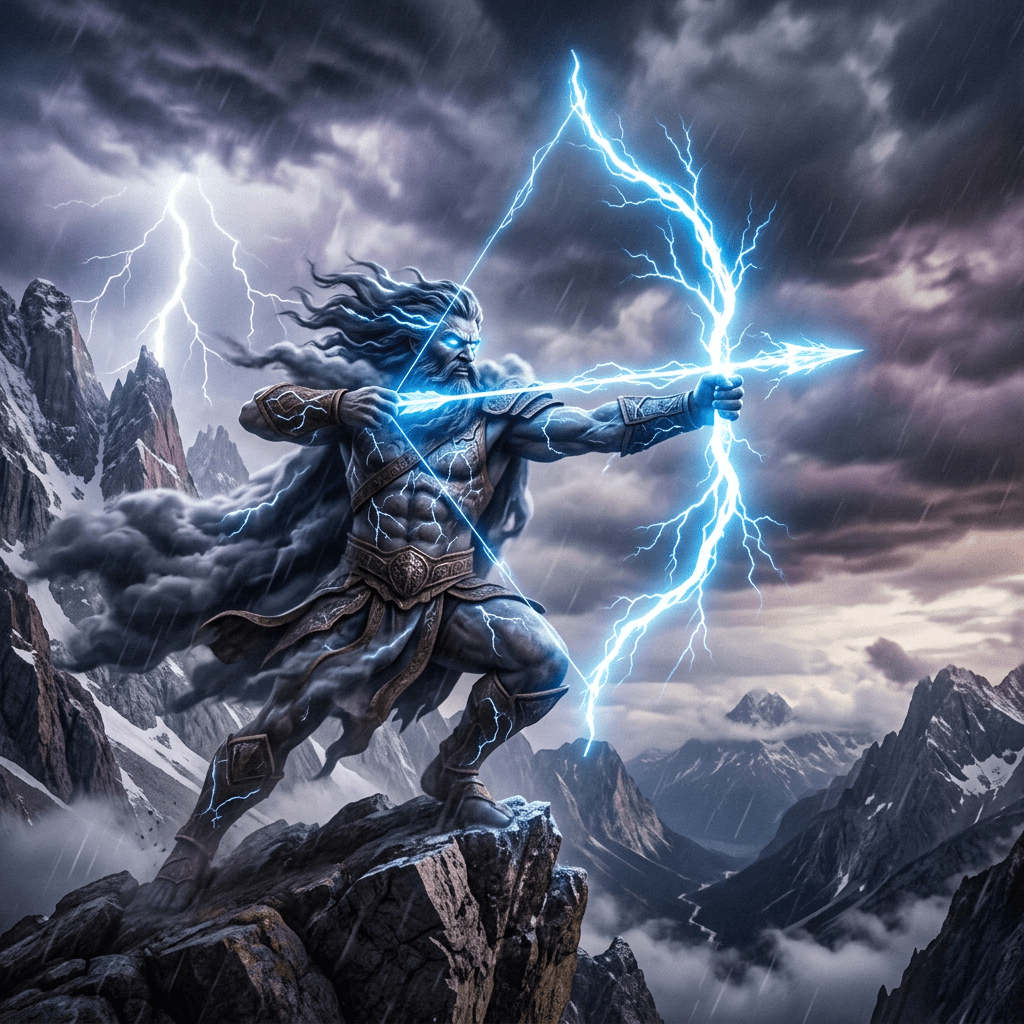
There is in the Rig Veda a god whose mere mention makes the rishis lower their voices. Not out of ordinary respect — but out of a fear mingled with reverence that says something essential about the nature of what they were attempting to name. This god is Rudra. And his relevance for understanding our relationship to natural catastrophes — today, now, in a world that is unraveling — is greater than one might think.
Who Rudra Is in the Hymns
Rudra is difficult to grasp because he refuses simple categories. He is neither simply good nor simply evil. He is not the god of destruction in the sense of a nihilistic force — he is the force that destroys to transform, that strikes to purify, that terrifies to liberate what was blocked.
In the hymns dedicated to him, the rishis approach with remarkable caution. They ask him to direct his lightning elsewhere — toward others, toward distant forests, away from villages and herds. They recognize his power as unavoidable — one does not beseech Rudra not to exist, one asks him to spare what one loves.
His physical attributes in the hymns are eloquent — he carries a bow and arrows each of which can bring illness or death. But his hands also carry the remedies of forests and mountains. He is the greatest of healers and the most formidable of destroyers — simultaneously, inseparably.
This simultaneity is the key. Rudra is not ambivalent in the sense of hesitation between two poles. He is the force in which destruction and healing are two faces of the same reality.
Rudra and Extreme Natural Phenomena
The rishis associated Rudra with storms, lightning, violent winds, epidemics, earthquakes — with all those natural forces that strike without warning, that devastate without distinguishing the deserving from the innocent, that brutally remind us that nature is not at humanity’s service.
This association was not naive. It testified to a deep intuition — that natural catastrophes are not anomalies in an ordinarily ordered world. They are manifestations of a power that is always there, always active, that we forget in periods of calm and that recalls itself to us in moments of crisis.
The sleeping volcano has not ceased to be a volcano. The tectonic fault on which we build our cities has not ceased to be a fault. The river we have dammed has not ceased to carry within it the power of floods. Rudra is always there — in silence as in storm.
What Our Era Has Forgotten — and What Rudra Recalls
Our civilization developed a relationship to the natural world founded on an illusion — that of control. We dammed rivers, stabilized slopes, built on floodplains, populated seismic zones, razed the forests that absorbed rainfall. We acted as if Rudra had been domesticated — as if the wild power of nature could be contained by engineering.
The natural catastrophes of the twenty-first century brutally remind us that this illusion has a cost. The floods in Pakistan in 2022 — a third of the country underwater. The fires in Australia, California, Greece, Canada. The earthquakes in Turkey, Syria, Morocco. The cyclones intensifying as the oceans warm.
These events are not simply natural catastrophes in the sense that they would have existed identically without human intervention. Climate disruption amplifies them, makes them more frequent, displaces them toward zones that were not prepared for them. We did not create Rudra — but we have stoked his anger.
Vulnerability as Truth
There is something Rudra teaches — that the rishis understood and that we have forgotten — which is that vulnerability is a permanent condition of human existence, not a technical problem to be solved.
We are vulnerable. Our bodies are fragile. Our constructions are temporary. Our complex systems have breaking points. The planet on which we live is an active, changing, powerful entity — that was not created for our comfort and that will continue to exist long after our civilization has disappeared.
Recognizing this vulnerability is not pessimism. It is lucidity — and paradoxically, it is the condition of genuine resilience. Societies that recognize their vulnerability adapt better to catastrophes than those that believe in their invulnerability. They build differently, they settle differently, they maintain safety margins that societies confident in their control eliminate in the name of efficiency.
Living with Rudra — What It Implies
The rishis did not ask Rudra to disappear. They asked him to coexist with them — to spare their villages and herds, to direct his power toward wild spaces rather than human spaces. A negotiation, not a domination.
This posture — negotiation with natural forces rather than their domination — is perhaps the most urgent lesson Rudra has to teach us.
Building with natural risks in mind rather than ignoring them. Leaving rivers their natural expansion zones rather than damming them to catastrophe. Maintaining the forests that absorb rainfall and stabilize slopes. Accepting that certain zones are not made for permanent habitation.
These are not surrenders — they are adaptations. A way of living with Rudra rather than pretending he does not exist.
Rudra in a World That Is Unraveling
In a world where climate disruption amplifies natural catastrophes, Rudra becomes an increasingly literal metaphor. The forces we have disturbed — the water cycle, the thermal regulation of the oceans, the stability of ecosystems — now manifest in events of increasing intensity.
This is not divine punishment. But it is a real, documented, measurable consequence — of our way of treating the natural world as an infinitely exploitable resource rather than as a force with which we must coexist.
Rudra strikes. He will strike again. The question is not to stop him — it is to learn to live in a world where his power is real, where our vulnerability is real, and where wisdom consists not in pretending to control the uncontrollable, but in building our human life while taking into account the limits that nature imposes on us.
The rishis knew it. We are relearning it — at our own expense.


Votre commentaire