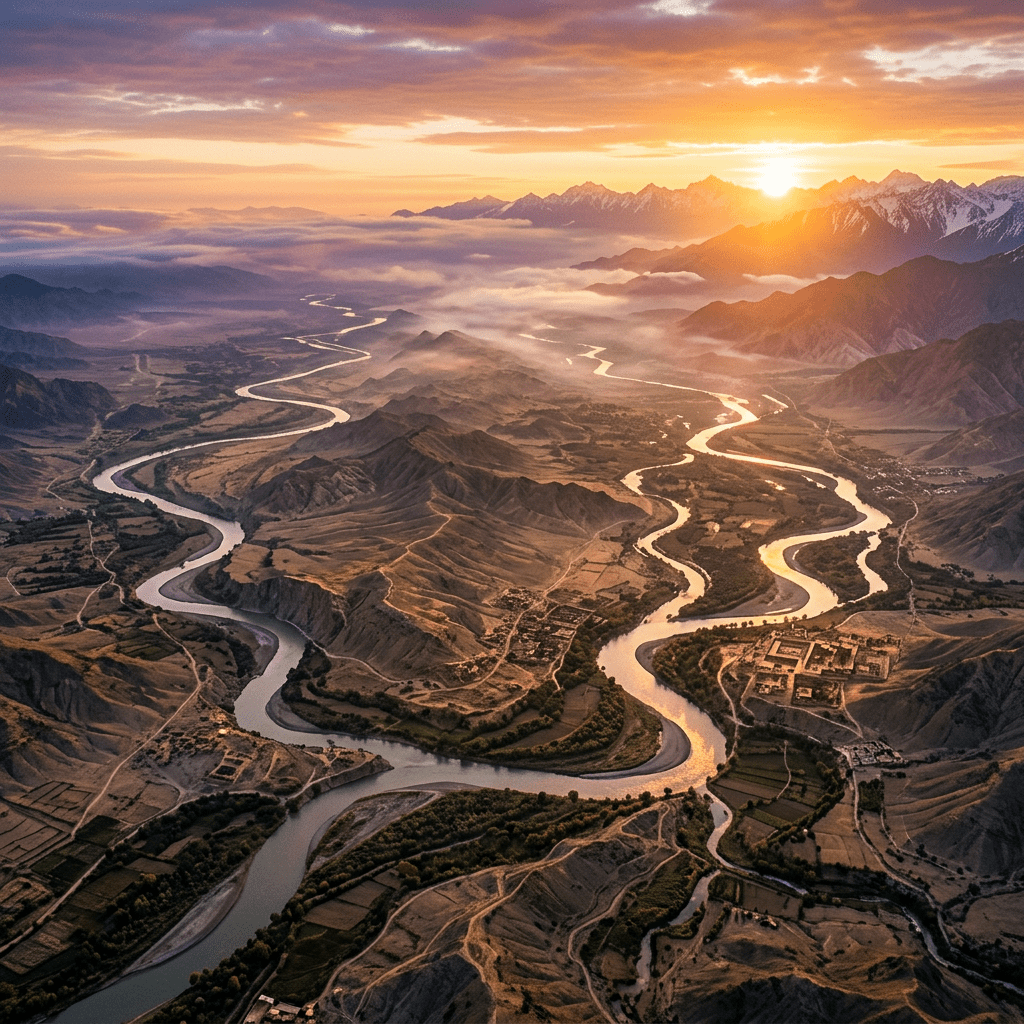
There is a name that recurs in the hymns of the Rig Veda with an insistence that cannot be accidental. Sapta Sindhu — the Seven Rivers. This name is not merely a geographical description. It is an identity, a cosmology, a way of situating oneself in the world. The rishis who composed these hymns defined themselves as the people of the Seven Rivers — those who lived in this irrigated, fertile, living space that the waters made possible.
For a long time, Western historians treated the Indus civilization — also called the Harappan civilization, or the civilization of the 7 Rivers — as a relatively well-documented but poorly understood archaeological curiosity. A civilization without deciphered writing, without readable texts, without an official narrative we can read. A civilization of silence, in a sense.
But recent decades have profoundly renewed our understanding of this civilization — and this renewal deserves to be shared.
The Sacred Geography of the Seven Rivers
In the Rig Veda, the Seven Rivers are invoked as goddesses — Sarasvatî, Sindhu, Vipāś, Śutudrī, Paruṣṇī, Asiknī, Marudvṛdhā. They are the great arteries of life in this territory. Without them, no agriculture, no herds, no cities, no civilization.
Sarasvatî occupied a special place — both physical river and goddess of speech and knowledge. In the oldest hymns, she is described as the most powerful of rivers — « surpassing all other rivers in her strength and greatness. » A river that flowed from the Himalayan glaciers to the Arabian Sea, irrigating an immense plain.
This river has disappeared. Modern geological and satellite studies have confirmed the existence of a major ancient riverbed in the Thar Desert — corresponding precisely to the Vedic Sarasvatî. The disappearance of this river — probably between 2000 and 1900 BCE, due to tectonic changes that diverted its tributaries toward the Ganges and the Indus — played a major role in the decline of the civilization of the 7 Rivers.
This is not legend. This is geology.
What Recent Excavations Reveal
Since the first excavations of Mohenjo-Daro and Harappa in the 1920s, the archaeology of the Indus civilization has never ceased to progress. And what it reveals increasingly contradicts the image of a mysterious and incomprehensible civilization.
The site of Rakhigarhi — intensively excavated since the 2010s — may be the largest city of the entire Indus civilization, larger than Mohenjo-Daro. With an estimated area of more than 350 hectares, it testifies to an urbanization on a scale that few contemporary civilizations could match.
DNA analyses of skeletons found at Rakhigarhi — published in 2019 — have brought valuable information about the population of this civilization. They suggest a population genetically distinct from the Indo-European populations that will arrive later in the region — which complicates simple theories about the relationship between the Indus civilization and Vedic culture.
Studies of irrigation systems reveal remarkable sophistication — canals, reservoirs, water management systems that allowed intensive agriculture in a semi-arid environment. A hydraulic engineering that has no equivalent in the world of the time.
The Question of Writing — A Mystery That Persists
The Indus script — those approximately 400 signs engraved on thousands of seals, tablets, objects — remains undeciphered. Despite decades of effort, despite the application of the most advanced computational techniques, despite decipherment attempts by linguists from around the world — the code has not yet opened.
This resistance is frustrating — and fascinating. It says that we do not yet have all the keys to understanding this civilization. That its texts, if texts there were in the sense we understand, remain inaccessible.
Some researchers advance the hypothesis that the Indus script was not used to transcribe a spoken language — but for primarily commercial or administrative use, with signs representing units of measure, categories of goods, identifications of merchants or owners. A functional rather than literary script.
Others maintain that this writing does indeed transcribe a language — and that its decipherment, when it comes, will radically change our understanding of the prehistory of the Indian subcontinent.
The End of the Civilization — and Its Lessons
The decline of the civilization of the 7 Rivers — between approximately 1900 and 1300 BCE — was not brutal. The great cities were not destroyed by conquerors. They were progressively abandoned — populations dispersing toward other regions, toward the Ganges in the east, toward the Deccan in the south.
The causes are multiple and interacting — the disappearance of the Sarasvatî and other watercourses that fed agriculture, climate changes that reduced precipitation, perhaps epidemics, perhaps internal social tensions of which we have no direct trace.
This gradual decline, without violent collapse, without documented military conquest — is itself a lesson. A civilization can disappear not in a brutal cataclysm, but in a slow erosion of the conditions that made it possible. Its inhabitants probably did not know their civilization was disappearing — they were adapting, moving, surviving. It is only by looking back over several centuries that one sees the decline.
This mirror held up to our own era deserves to be looked at.
What the Civilization of the 7 Rivers Still Tells Us
We always return to the same question — what had this civilization understood that we have forgotten?
It had understood that water is the condition of everything. That collective infrastructures — granaries, baths, sanitation systems — deserve more investment than monuments to the powerful. That long-distance trade and standardization of measures create cohesion between distant communities. That diversity — of cultures, crafts, origins — is a strength and not a threat.
And it had perhaps understood something deeper — that civilizations that endure are those that maintain a balance between human development and natural limits. This balance it held for fifteen centuries.
Before the rivers ran dry.
 Le Rig Veda
Laisser un commentaire