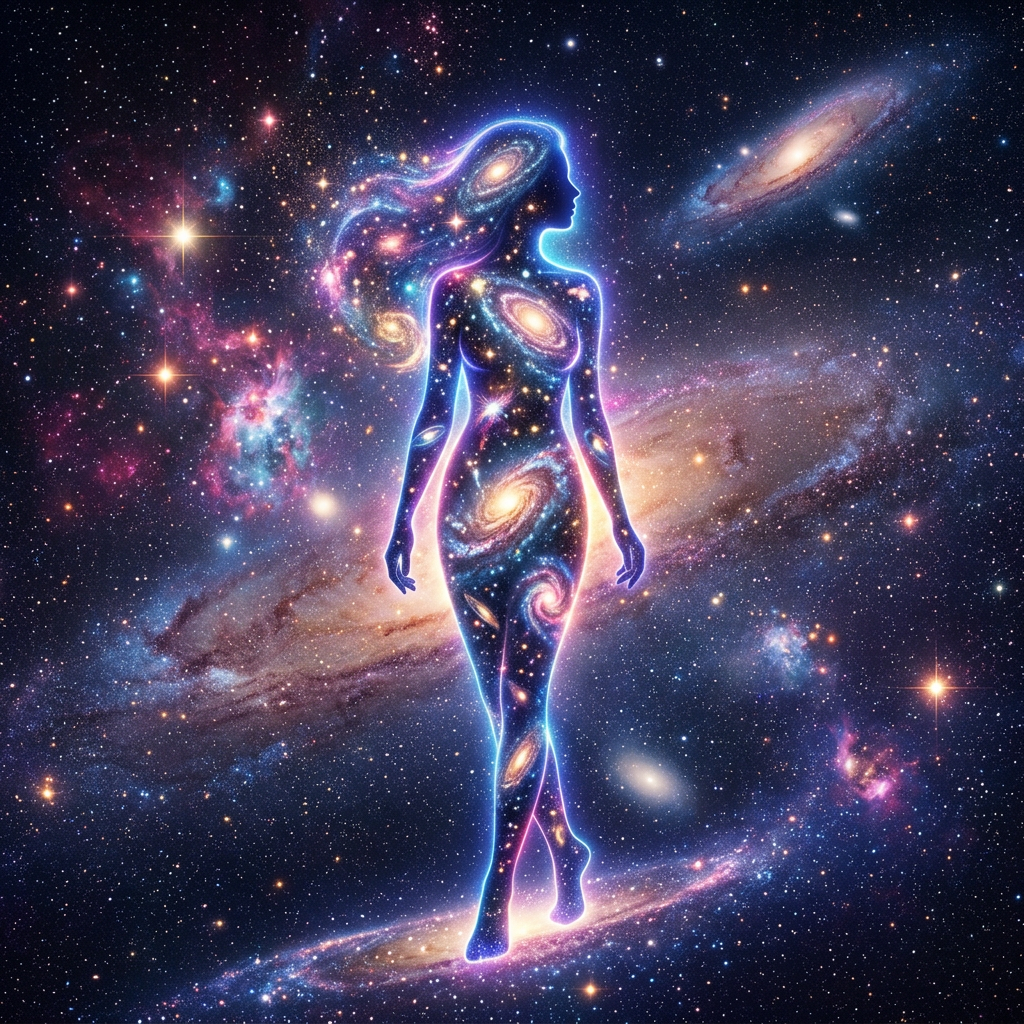
There is in the Rig Veda a divine figure that is perhaps the most difficult to grasp for a Western mind — and perhaps the closest to what contemporary physics attempts to describe. Aditi. The goddess of the infinite, of the unlimited, of that which cannot be contained.
Her name says everything — « a-diti » literally means « that which cannot be bound, » « that which has no limits. » Aditi is the infinite space in which everything that exists takes place. She is the mother of the Adityas — those solar gods of whom Varuna, Mitra, and Indra are part. She is the mother of all gods and all forms of life.
But she is also, and simultaneously, that into which everything returns. The origin and the return. The without-beginning and the without-end.
What Aditi Is in the Hymns
In the Rig Veda, Aditi is invoked in very diverse contexts — for protection, for health, for liberation from the bonds that imprison us. But her fundamental nature is that of an infinite space, a primordial matrix in which all existence takes place.
She is prior to the gods. In certain hymns, the gods themselves are born of Aditi — which makes her something more fundamental than the personalized forces the rishis usually invoke. She is the ground on which everything is drawn. The silence from which music is born. The space from which form emerges.
This conception is remarkably close to what modern cosmology calls the quantum vacuum — that state of space which is not empty in the ordinary sense, but which is on the contrary full of a colossal potential energy, from which pairs of particles spontaneously emerge and annihilate as quickly as they appeared. A void that is not nothing — but which is the condition of everything.
Modern Cosmology and Its Surprises
Twentieth-century physics produced an image of the universe that would have astonished nineteenth-century scientists — and that might have surprised the Vedic rishis rather less.
Einstein’s general relativity showed that space is not a neutral and immobile background on which events unfold. Space is dynamic — it curves, it stretches, it can be created. The Big Bang is not an explosion in space. It is an expansion of space itself.
Quantum mechanics showed that reality at the subatomic scale is fundamentally different from what we observe at our scale. Particles have no defined position before being observed. They exist in states of superposition — multiple states simultaneously — until the moment of measurement. Quantum reality is probabilistic, non-deterministic, strangely dependent on the observer.
And contemporary cosmology revealed that ordinary matter — stars, planets, galaxies, everything we see — represents only 5% of the content of the universe. The remaining 95% is dark matter and dark energy — entities about which we know almost nothing, whose effects we see only gravitationally, and whose nature remains one of the greatest mysteries of science.
Aditi — the unlimited, the unknowable ground of all — finds here a relevance that centuries of Newtonian cosmology had obscured.
The Adityas and the Fundamental Forces
Aditi is the mother of the Adityas — those solar gods who, in the Rig Veda, embody different aspects of the cosmic order. Varuna maintains ṛta, truth and moral order. Mitra presides over contracts and alliances. Aryaman governs paths and customs. Indra is the force of action and victory. Sūrya is the sun itself.
These Adityas can be read as a Vedic intuition of the fundamental forces that structure the universe — those forces that modern physics has identified as gravity, electromagnetism, the strong nuclear force, and the weak nuclear force. Forces that appear distinct, but that theoretical physicists have sought since Einstein to unify in a theory of everything — a theory that would say they are all manifestations of a single fundamental reality.
The same fundamental reality that Aditi embodies — that unique matrix from which all forces and all forms are temporary expressions.
The Question of Consciousness
There is one domain where the convergence between the Vedic vision and contemporary science is particularly striking — the question of consciousness.
In the Vedic vision — and particularly in the Upanishads that extend the Rig Veda — consciousness is not a secondary product of matter. It is fundamental. Brahman — the ultimate reality — is sat-chit-ananda: existence, consciousness, bliss. Consciousness is at the heart of being, not at its periphery.
This vision is radically different from the dominant scientific materialism — which considers consciousness as an epiphenomenon of the brain, a product of neural activity that has no independent existence.
But the difficulties in explaining consciousness from matter alone — what philosopher David Chalmers called the « hard problem of consciousness » — have led some physicists and philosophers to reconsider this position. Theories like panpsychism — the idea that consciousness is a fundamental property of reality, present at all levels of organization — are regaining scientific credibility they had not held for centuries.
Aditi as infinite consciousness — the matrix in which all individual consciousness takes place — may not be so far from certain hypotheses in contemporary theoretical physics.
What the Encounter Between Aditi and Modern Cosmology Tells Us
This encounter is not an attempt to validate religion through science — an exercise always suspect and often dishonest. What the rishis described and what physicists measure are fundamentally different approaches to reality.
But the convergence of intuitions — the universe as dynamic process rather than static backdrop, space as an active participant in reality, the existence of an indescribable ground from which everything emerges and to which everything returns, consciousness as perhaps more fundamental than we thought — this convergence says something.
It says that the rishis, in their meditative observation of the world and in their exploration of states of consciousness, touched something real. Not the same realities as physicists with their particle accelerators. But complementary realities — aspects of existence that science and Vedic wisdom approach by different paths.
Aditi — the unlimited, the mother of all, the ground from which everything emerges — still awaits full understanding. By science as by wisdom.
It may be her very nature to always be beyond what we can say of her.


Votre commentaire