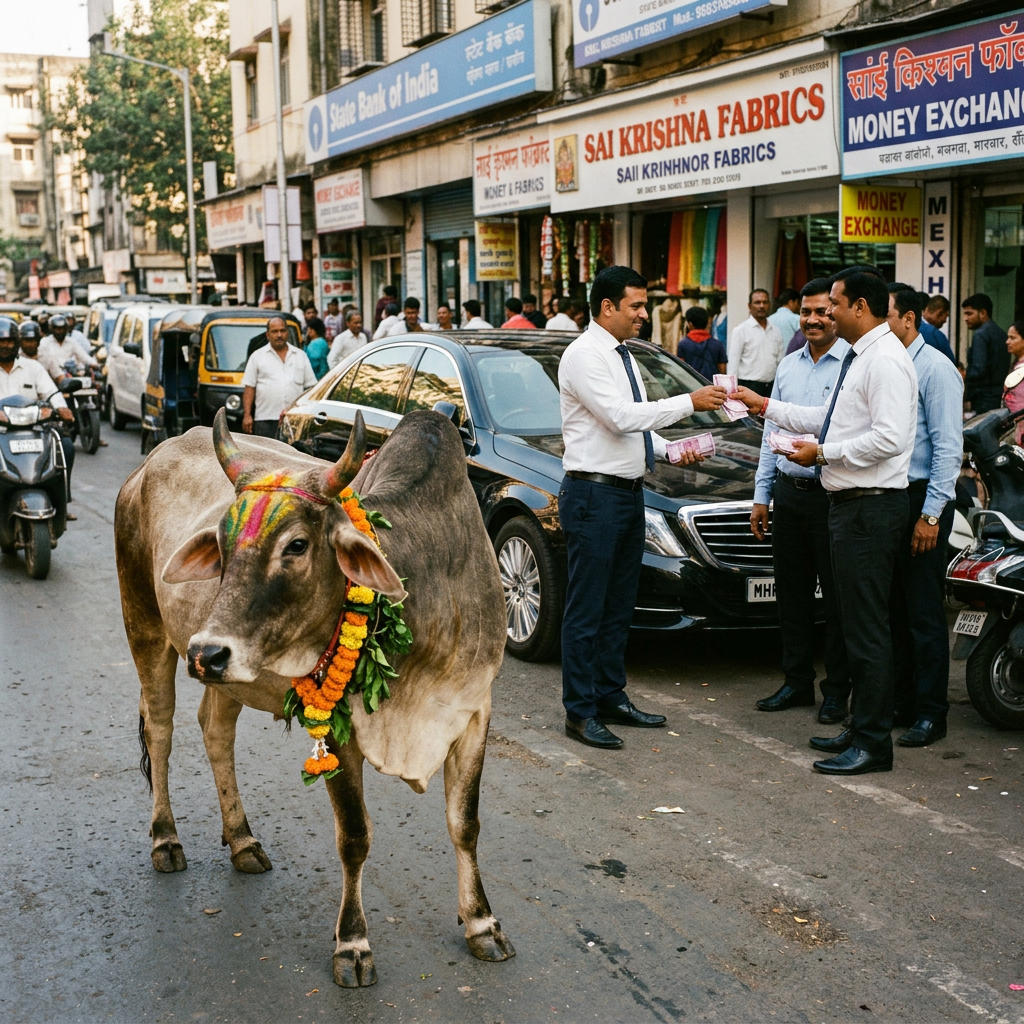
A few years ago, the first news of lab-grown meat provoked reactions ranging from technological enthusiasm to visceral repulsion, passing through philosophical perplexity. Muscle stem cells were taken from a cow, made to proliferate in a bioreactor, and meat was obtained without killing the animal, without methane emissions, without antibiotics, without the industrial farming conditions that make contemporary meat production one of the most destructive activities for the planet and one of the most degrading for animals. The promise was seductive. But something in this promise deserved closer examination, and the Vedic vision of the cow perhaps offers the best angle from which to do so.
We devoted an article to the hymns to the cow, to the way the civilisation of the 7 Rivers conceived of this animal as a divine presence, as a cosmic force manifested in animal form, whose value was inseparable from its living and generous nature. That article posed the fundamental question: what do we lose when we reduce our relationship with the cow to its market value alone? Lab-grown meat poses an even more radical question: what do we gain and what do we lose when we entirely separate the product from the animal, when we preserve the proteins and lipids but eliminate the life that carried them?
The immediate and honest answer is that we gain a great deal on the environmental and ethical level. Conventional beef production is one of the most damaging human activities for the climate: it represents a considerable share of global greenhouse gas emissions, it consumes quantities of water and agricultural land that could directly feed human populations, it generates animal suffering on an industrial scale that is difficult to look at without discomfort. Lab-grown meat, if it delivers on its technological promises, could drastically reduce these impacts. This is not nothing. It is in fact considerable.
But the Vedic vision of the cow invites us to pose a question that technological enthusiasm tends to neglect: is solving the problem of production the same thing as solving the problem of the relationship? Lab-grown meat solves the problem of production: it allows the continued consumption of animal proteins without the environmental and ethical costs of industrial farming. It says nothing, however, about the way we situate ourselves in relation to animals, about what we recognise or fail to recognise in them, about the nature of the bond that unites or separates us from the living world of which we are a part.
In the Vedic vision, the cow was not precious because she produced meat. She was precious because she was a presence, because she embodied a way of being in the world, a generosity and a gentleness that served as model and teaching. The milk she gave had value not only because it nourished bodies, but because it was inscribed within a relationship of reciprocity between the human and the animal: one took care of the cow, gave her grass and water, protected her from predators, and in exchange she gave her milk, her presence, her quiet strength. This relationship of reciprocity was in itself a form of knowledge, a way of learning to receive what the living world offers when one cares for it rather than exploiting it.
Lab-grown meat breaks this relationship of reciprocity at an even deeper level than industrial farming. Industrial farming, however cruel and destructive it may be, maintains at least a relationship, however degraded, between the human and the living animal. The cow exists, suffers, lives, dies. This existence, even mistreated, is a presence that one cannot entirely ignore. Lab-grown meat suppresses this presence. It reduces the cow to a source of initial cells, to a biological starting point of which one no longer has need once the cell lines are established. The cow disappears entirely from the relationship, leaving only her proteins replicated to infinity in a bioreactor. This is the logical culmination of a movement that began with industrial farming: the progressive reduction of the animal to its productive value, until the elimination of the animal itself in favour of its products alone.
There is in this trajectory something that deserves to be named clearly, without for that reason rejecting the real environmental and ethical benefits of lab-grown meat. This something is the deepening of our separation from the living world. Every stage of food modernisation has distanced us a little further from the concrete reality of what nourishes us. The industrial abattoir put death out of sight. Plastic packaging put flesh entirely out of any animal context. Lab-grown meat puts the animal itself out of the equation. The result is a relationship to food that is increasingly abstract, increasingly disconnected from the biological and ecological realities that make it possible.
The Vedic vision of the cow proposes something radically different: not the elimination of the animal from the alimentary relationship, but the transformation of this relationship into something reciprocal, respectful and conscious. The rishis did not ask how to produce animal proteins without cows. They asked how to live with cows in a way that honoured their divine nature. This question, transposed into our era, does not necessarily lead to vegetarianism or to the refusal of all animal consumption. It leads to an interrogation about the quality of the relationship: how can I nourish myself in a way that maintains a real, respectful and reciprocal bond with the living world that feeds me?
This interrogation has concrete answers that already exist and that deserve to be supported. Small-scale peasant farming, in which animals live lives that respect their nature, in which the farmer knows his animals individually, in which death is a conscious act and not an industrial procedure: this is an answer. The drastic reduction of meat consumption, accompanied by increased attention to the provenance and production conditions of what one consumes: this is an answer. The return to agricultural practices that integrate animals into complex agro-ecological systems where they play a functional role rather than a simple productive function: this is an answer.
Lab-grown meat is perhaps inevitable, and its environmental benefits could be sufficiently large to justify its development as a transitional solution. But it should not be presented as the settlement of the question of our relationship with animals and the living world. It resolves a problem of production. It says nothing about the problem of the relationship, and it is this problem, in the Vedic vision, that is the most fundamental.
The sacred cow of the Rig Veda tells us that the real question is not how to produce meat more cleanly and more efficiently. The real question is: how do we wish to inhabit the living world of which we are a part? With what attention, what respect, what reciprocity? And if the answer to this question is sufficiently deep, the technical solutions — whether lab-grown meat or something else — will find their rightful place within a framework that does not allow them to become a new way of dispensing with thinking about what we are doing.


Votre commentaire