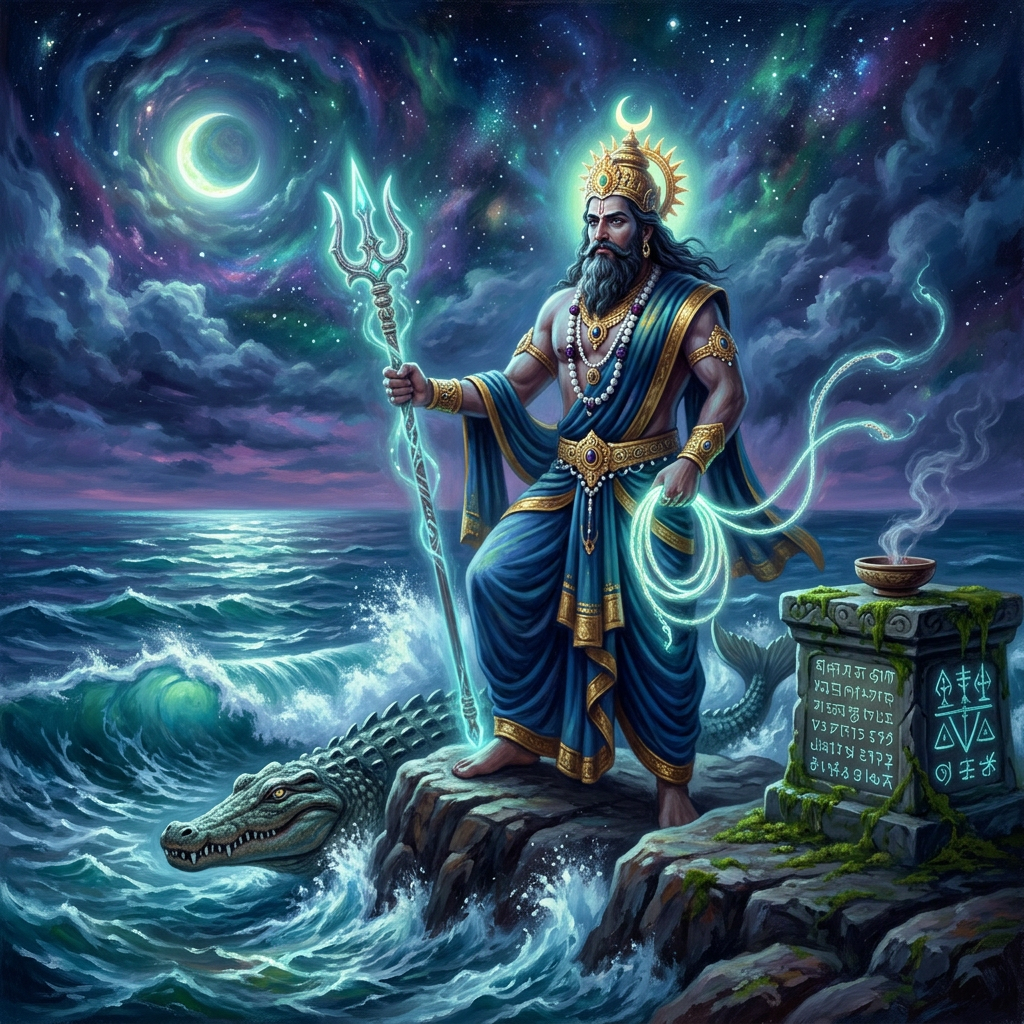
There is in the Vedic pantheon a god who embodies something that our era has almost entirely lost, and whose loss perhaps explains as much as any other factor the disorientation of contemporary societies: Varuna. We have mentioned him in several articles, as guardian of the Truth alongside Mitra, as the omniscient consciousness that sees everything, as the inseparable companion of friendship and contract. But Varuna deserves an article entirely devoted to him, because what he represents — the given word as the foundation of social reality — is of a contemporary relevance and urgency that the hymns devoted to him express with a striking precision and depth.
His name comes from the root vri, to surround, to contain, but in the benevolent and protective sense, unlike Vritra who used the same root to obstruct and suffocate. Varuna surrounds in order to protect, to maintain within the Truth, to hold together what might otherwise disperse. He is the cosmic ocean, the infinite space in which everything exists and which contains everything without ever overflowing. And he is the guarantor of the oath, the one before whom promises are made and who keeps them in force by his omniscient presence alone. Varuna sees everything. Nothing escapes his gaze. And this omnivision is not that of a police god watching for faults in order to punish. It is that of a consciousness that perceives reality as it is, that sees the Truth in every act, in every word, in every intention.
The Vedic oath, called vrata, is much more than a contract in the modern legal sense. A modern contract is an agreement between two parties whose execution is guaranteed by an external legal system: if one of the parties does not honour its commitments, the other can take it to court and obtain reparation by force of law. This mechanism is useful and necessary in a complex society, but it also says something about the nature of trust in that society: it is insufficient to do without coercion. The Vedic vrata is different. It is a promise made before Varuna, a word pledged before the Truth itself. It is not guaranteed by an external system. It is guaranteed by the inner vision of the one who makes the promise, by their awareness that to break one’s word is to violate the fundamental Truth of the world, to rupture one’s alignment with what is real, to separate oneself from Brahman.
The hymns to Varuna in the seventh mandala, those of Vasishtha that we mentioned in the article on the battle of the ten kings, are among the most intimate and most touching in the entire Vedic corpus. They are not triumphant hymns. They are dialogues, confessions, requests for purification. Vasishtha addresses Varuna with a disarming frankness: have I broken my word? Have I said something false, even without knowing it, even without intending to? Is there in me a betrayal I have not seen and that you see? Purify me of my failures to the Truth. This posture of the person who questions their own faithfulness to the given word, who asks to be seen clearly by a consciousness that sees more clearly than their own, is of remarkable psychological and spiritual depth. It is not guilt in the Christian sense. It is something more lucid and more active: the will to see one’s own failings in order to be able to correct them.
The relationship between Varuna and Mitra is fundamental for understanding what the given word meant in Vedic civilisation. Mitra is friendship, the bond between those who know and love each other. Varuna is the Truth that guarantees that this bond is real and not simulated. Together they represent the two inseparable dimensions of every authentic relationship: affection and faithfulness. One can have affection without faithfulness: that is sentimentality, an attachment that does not hold when tested. One can have faithfulness without affection: that is bare contract, a relationship of obligation without warmth or generosity. Mitra and Varuna together is the relationship in its fullness: loved and kept, warm and reliable, affectionate and true.
In the civilisation of the 7 Rivers, this vision of the given word as cosmic reality rather than social convention had concrete and profound consequences for the functioning of society. A community in which all members have a direct and regular experience of the Truth, in which soma and the sacrifice have dissolved the egotistic constructions that produce lying and betrayal, in which Varuna is a real presence and not a theological abstraction, does not need the same mechanisms of coercion as a community in which the given word is only a convention. Faithfulness to one’s word is not there a heroic virtue practised by a few exceptional individuals despite the pressure of circumstances. It is the natural norm of a consciousness aligned with the Truth.
What we have lost with Varuna is difficult to measure precisely but easy to observe in its effects. We live in societies in which lying has become an ordinary communication technique, in which the word of political leaders is systematically suspected of being strategic rather than true, in which commercial contracts run to hundreds of pages because one cannot trust the word alone, in which electoral promises are a rhetorical genre that everyone knows only binds those who believe them. This erosion of the given word is not only a moral problem. It is a problem of social functioning. A society in which the word is worth nothing must replace trust with mechanisms of control, and these mechanisms cost extraordinarily in energy, money and freedom.
There is a concept that economists call transaction cost, meaning the cost of all the verifications, guarantees, contracts, lawyers and enforcement mechanisms necessary to make an economy function in which the agents do not trust each other. These costs are considerable and growing in our contemporary economies. They represent a significant share of global GDP. And they are, from the Vedic perspective, the price paid by societies that have lost Varuna: the price of substituting external coercion for inner faithfulness, of the imposed rule for the kept word.
The legal traditions that followed Vedism, and notably the system of dharma in Hinduism, attempted to preserve something of the function of Varuna in a context where the direct experience of Truth was no longer universally accessible. Dharma, duty, moral law, is a way of codifying externally what Varuna guaranteed internally. But like all external normative systems, it is subject to interpretation, to manipulation, to capture by the interests of the powerful. Varuna cannot be manipulated. He sees what is, not what one claims it to be.
What Varuna ultimately tells us about our era is that the crisis of trust we are living through — in institutions, in leaders, in the media, in experts, in neighbours — is a crisis of Truth. It is the consequence of a civilisation that has progressively lost contact with the fundamental Truth of the world, and that attempts to replace with mechanisms of control what only contact with this Truth can produce: beings whose word is reliable because it is aligned with what is real, commitments that hold because they are made before something greater than immediate interest, communities in which trust is possible because Varuna, in one way or another, is present.


Laisser un commentaire