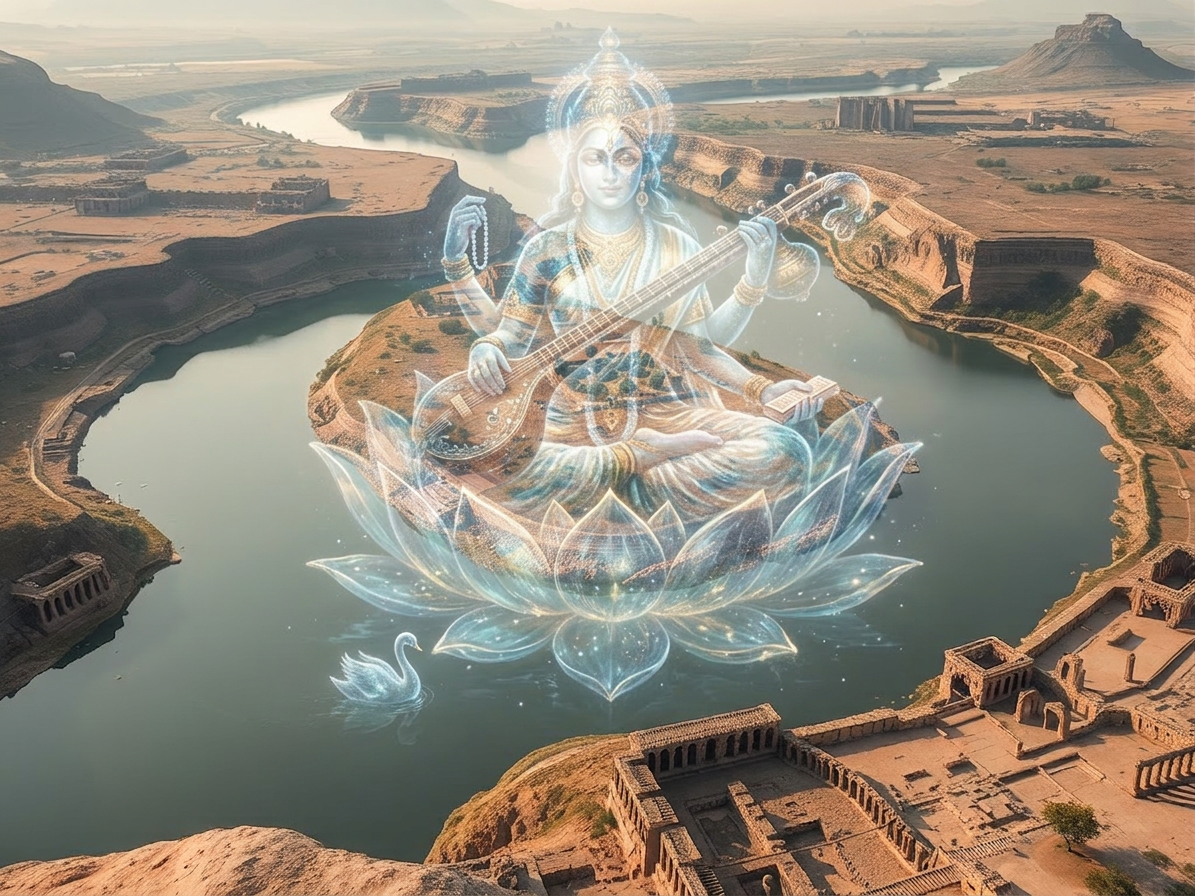
There is in the Rig Veda a divine figure that perhaps embodies better than any other the fundamental vision of this civilisation about the nature of reality: Sarasvati. Not because she would be the most powerful, nor the most celebrated, nor the most dramatic in her manifestations. But because she is the most coherent, the most deeply thought through, the most revealing of what the Vedic rishis had understood about the relationship between the physical world and the spiritual world, between matter and consciousness, between the water that flows and the knowledge that illuminates.
We have spoken of Sarasvati in several previous articles, from the angle of the forgotten goddesses, from the angle of the sacred rivers, from the angle of her drying up and its causes. But Sarasvati deserves an article entirely devoted to her, because what she says about the relationship between water and knowledge is of a depth and an originality that have no equivalent in the other great spiritual traditions of humanity.
Her name, first. Sarasvati comes from saras, which means lake, pond, stagnant water in a first sense, but also flow, current, that which runs. And vati, which means she who possesses, she who is full of. Sarasvati is therefore literally she who is full of flow, she whose flow is her very nature. This is not simply a river name. It is a description of what water is in its most fundamental nature: not water as a chemical compound, H2O, but water as movement, as flow, as that capacity to circulate, to descend, to fill, to nourish, to renew itself permanently. It is this fluid and circulating nature of water that Sarasvati embodies, and it is this same nature that she brings to knowledge when she becomes its goddess.
For Sarasvati is simultaneously and inseparably the river and the goddess of knowledge. This simultaneity is the key to everything. The Western translators who wished to separate the two, who saw in Sarasvati-the-river a physical reality and in Sarasvati-the-goddess a symbolic reality, missed something essential. For the Vedic rishis, there were not two Sarasvatis. There was one, manifested at two different levels of the same reality. The river and knowledge are not two things linked by a metaphor. They are two expressions of the same fundamental principle: flow.
What water does in the physical world, knowledge does in the inner world. Water descends from the mountains to the plain, it irrigates what is dry, it nourishes what could not grow without it, it purifies what it passes through, it connects what was separate, it ends by joining the ocean in which all waters dissolve. Knowledge does exactly the same thing in consciousness: it descends from experience toward understanding, it irrigates the arid zones of ignorance, it nourishes what cannot grow without it, it purifies the perceptions distorted by ego and Maya, it connects what was fragmented in ordinary consciousness, it ends by leading to the experience of Brahman in which all particular knowledge dissolves into ultimate Truth.
This homology between the flow of water and the flow of knowledge is not a poetic invention of the rishis. It is an observation. The rishis who lived on the banks of the Sarasvati, who saw it flowing every day, who depended on it for their lives and their agriculture, who venerated it as a divine presence, also had the direct experience of soma and the sacrifice, those states of consciousness in which knowledge does not present itself as an accumulation of information but as a flow, as something that runs, that arrives, that passes through consciousness without consciousness having to make any effort to produce it. In these states, knowledge resembles water. It is fluid, it flows naturally, it fills empty spaces without effort, it takes the form of what it encounters without losing its own nature.
This is why Sarasvati illuminates meditations, as the text says. Not because she grants information or ideas. But because she brings this quality of flow to consciousness in meditation, this fluidity that allows understanding to arrive without being forced, this openness that lets pass what wants to pass. Meditation in the Vedic tradition is not an effort of concentration. It is a releasing of resistances, a dissolution of obstruction, a way of letting flow what wanted to flow and that the ego was retaining. Sarasvati is the goddess of this releasing, of this dissolution of the inner dams that allows the flow of knowledge to circulate freely.
The three goddesses of speech, Sarasvati, Bharati and Ila, form in the hymns a triad that we mentioned in the article on Ila but that deserves to be examined here from the particular angle of Sarasvati. Bharati is abundant speech, the richness of expression. Ila is precise speech, direct revelation. And Sarasvati is the flow that unites and nourishes them both: without the flow of Sarasvati, the speech of Bharati would be empty of inspiration, and the revelation of Ila would be without the current that carries it. Sarasvati is the water in which the other two are immersed, the fluid force that gives sacred speech its power and its depth.
The Sarasvati of the Rig Veda also says something fundamental about the nature of knowledge itself, about the difference between knowledge as possession and knowledge as flow. In the dominant Western vision since the Enlightenment, knowledge is something one accumulates, possesses, stores and transmits. It is a good, a property, a capital. The more one has of it, the better. And to lose it is a catastrophe. This vision has produced educational systems extraordinarily effective at transmitting information, and extraordinarily ineffective at transmitting wisdom.
The Vedic vision, embodied by Sarasvati, is radically different. Knowledge is not something one possesses. It is something one passes through, or rather something that passes through one when one opens to it. Just as the water of a river cannot be possessed by the banks it flows alongside, knowledge cannot be possessed by the consciousness that receives it. One can welcome it, let it flow, bathe in it and be nourished by it. But one cannot retain it without killing it. Knowledge retained, frozen, transformed into dogma or intellectual property defended by legal walls, is dead knowledge, like the water of a pond with no inlet or outlet that ends by becoming corrupt.
The transformation of Sarasvati after the disappearance of the physical river is one of the most poignant and most instructive evolutions in all of Indian tradition. When the river dried up, the goddess survived, but transformed. She became increasingly the goddess of speech, writing, the arts, knowledge in the intellectual sense of the word. She is represented today with a lute and books. The aquatic dimension, the fluid dimension, the dimension of the living and running flow, progressively faded. The knowledge was kept, the flow was lost. The books were kept, the river was lost.
This loss says something profound about what happened in the Indian tradition after original Vedism, and about what happened in human thought in general: knowledge progressively detached itself from the flow of which it was inseparable, it became a thing rather than a process, a possession rather than an experience, a content rather than a movement. And with this detachment, something of its original nature was lost: that particular quality of knowledge that arrives as a river arrives, naturally, fluidly, filling exactly the spaces that need it, without effort, without resistance, in the grace of the flow that Sarasvati represented when she still ran from the mountains to the sea.


Votre commentaire