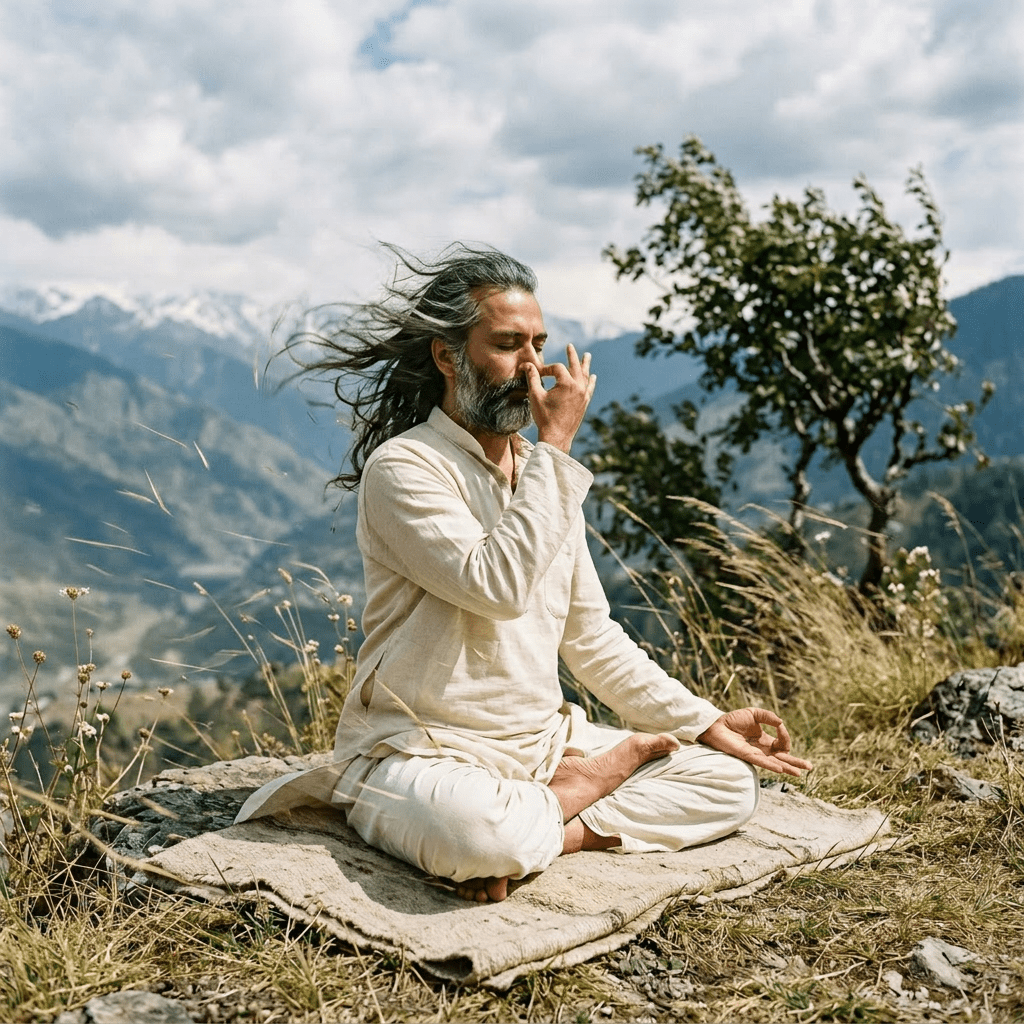
There is in the Rig Veda a hymn to the wind of a beauty and a precision that leaves speechless anyone who has ever truly felt the wind. Not the wind as a meteorological phenomenon that one notes in a smartphone application. The wind as a presence, as a living force, as something that passes through you and that, in passing through you, brings with it something that comes from further than your immediate horizon. The Vedic rishis knew this wind. They had given it a name, Vâyu, and they had elevated it to the rank of the great gods of the Vedic pantheon, not out of animistic naivety, but because they had understood something about the nature of breath and life that our era, with its air conditioning systems and its controlled atmospheres, is in the process of losing.
Vâyu comes from the root vâ, to blow. His name is at once the god and the act, the deity and what it does, inseparably. Vâyu blows. It is his nature, his function, his existence. He cannot stop blowing, exactly as fire cannot stop burning. And in Vedic thought, this impossibility of stopping doing what one does is the sign of divinity: the gods are forces that cannot be interrupted, that cannot decide to stop being what they are. Vâyu is the wind because the wind is what it is, and it will be so as long as the universe exists.
In Vedic cosmology, Vâyu is the master of the intermediate world, that space between Earth and Sky that we described in other articles as the space of states of consciousness between the ordinary and Brahman. This is not an arbitrary association. The wind is by nature an inhabitant of the in-between: it is neither the solid earth on which one walks, nor the immutable sky above one’s head. It is what circulates between the two, what carries something from one place to another, what puts into relationship what was separate. And this is precisely the function of the intermediate world in Vedic spirituality: to connect ordinary consciousness and Brahman, to allow the passage from one to the other, to serve as a space of transition and transformation.
Breath, prâna, is the manifestation of Vâyu within the human body. We spoke of this in the article on the link between fire, breath and consciousness, but it is worth returning here to a particular dimension of this relationship: the fact that breathing is literally to let Vâyu in. Every inhalation is an invitation addressed to the god of the wind, a way of allowing the cosmic force that governs the movement of air in the universe to penetrate your body and bring with it what it carries. And what it carries, according to the Vedic vision, is far more than oxygen. It is prâna, vital force, the energy that animates everything that lives, from the smallest insect to the greatest of elephants, and that circulates in the universe through the wind exactly as blood circulates in the body through the heart.
This vision of breath as a channel of cosmic vital force is at the foundation of all pranayama practices, which we now know date back at least to the era of the Indus-Sarasvati civilisation. When a yogi practises pranayama, he is not simply doing breathing exercises to improve his lung capacity. He enters into a conscious and deliberate relationship with Vâyu, he opens his body and consciousness to the cosmic force that the god of the wind represents, he uses breath to modify his state of consciousness in the same way that wind modifies the landscape it passes through: by setting it in motion, by dispersing what had stagnated, by bringing something new where there was something old.
Contemporary research on the effects of breathing on consciousness and health confirms what the rishis knew from the inside. Breathing is the only autonomous process of the body that we can consciously control. The heart beats, the lungs filter, the liver detoxifies: none of these processes responds directly to our will. But breathing does. And because it is at the interface between the conscious and the unconscious, between the voluntary and the automatic, it is also at the interface between the ordinary state of consciousness and expanded states of consciousness. To modify it is to modify the state of consciousness. It is to access Vâyu, the intermediate world, that space between Earth and Sky where the boundaries between self and the rest of the world begin to relax.
Vâyu is also, in the hymns, the messenger par excellence. Before Agni, before the other gods, it is Vâyu who is invoked first in certain hymns, because he is the closest, the most immediate, the most present. Agni is there, in the hearth, but he must be lit. Vâyu is there at every instant, in every breath, in every breeze that stirs the leaves and in every storm that uproots the trees. His presence requires no ritual. It is given with life itself. And perhaps this is why he is invoked first: because he is the evidence, the most immediate and most inescapable presence of the divine in daily life.
Which brings us to the question that the title of this article poses with an irony worth pausing over: what happens when one lives in a world of air conditioning? The question is not rhetorical. It is a serious question about what we are doing to our relationship with wind, with breath, with Vâyu, when we spend the greater part of our time in artificially regulated atmospheres, at constant temperature, at controlled humidity, in air that has been filtered, deodorised, stripped of everything that the natural wind carries with it.
Air conditioning is one of the most widespread and most admired inventions of modernity. It has made it possible to inhabit regions of the world that would otherwise be barely liveable, it has saved lives by reducing mortality linked to heatwaves, it has made possible working environments where productivity is no longer subject to meteorological variations. All of this is real and deserves to be acknowledged. But there is a cost, less visible and less measured, that the Vedic vision of Vâyu perhaps allows us to identify: the cost of the rupture with the real wind, with the living breath of the planet, with that presence of Vâyu in our daily atmosphere.
The natural wind is unpredictable. It changes direction and intensity. It brings smells, pollens, temperatures that vary throughout the day and the season. It creates different micro-environments depending on whether one is in shade or in sun, at altitude or in a valley, near water or on dry ground. This variability is not an inconvenience. It is information. It is the world signalling itself to our senses, telling us where we are, what season it is, in what relationship with the environment that surrounds us. Air conditioning eliminates this information. It replaces the living wind with a dead, constant, predictable atmosphere that says nothing about the outside world and that progressively cuts those who inhabit artificial atmospheres off from the sensory dialogue with the planet on which they depend.
There is a simple practice that the Vedic rishis would have had no need to be recommended because it was their ordinary condition of existence, and that our era must rediscover as a deliberate practice: to go outside and breathe the wind. Not the filtered air of a carefully maintained urban park. The real wind, in its variability, in its unpredictability, with everything it brings and everything it carries away. To let Vâyu in. To let the cosmic force of breath do its work in consciousness, bringing to it that movement, that putting into relationship with something greater than the closed and controlled space in which we spend the greater part of our days.
This is not a romantic nostalgia for an idealised pre-industrial past. It is the recognition of a reality that atmospheric physics, biology and contemporary neuroscience are increasingly confirming: the wind, the breath, the living air of the planet are not only necessary for biological survival. They are necessary for something more difficult to measure but no less real: the health of consciousness, the maintenance of the link between the human being and the world of which it is a part, the capacity to remain in relationship with Vâyu, with the god of wind and breath who reigns over the intermediate world and whose presence in our breathing is the simplest and most directly available condition of our openness to Brahman.


Votre commentaire