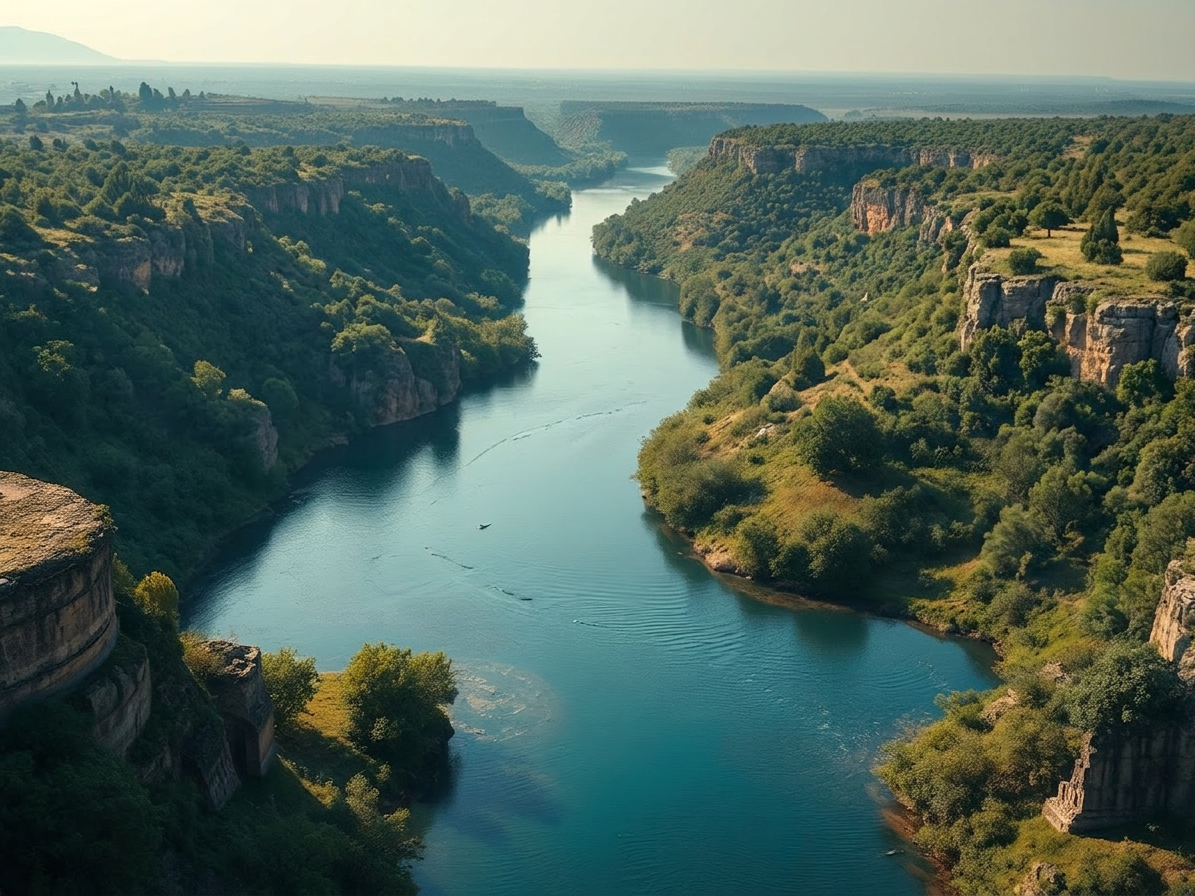
There is in the Rig Veda a way of speaking about rivers that resembles nothing that the other great traditions of Antiquity produced. The Egyptians revered the Nile, the Mesopotamians the waters of the Euphrates and the Tigris, the Greeks had their river gods. But nowhere else does the river occupy in religious and spiritual thought the place it occupies in the Vedic corpus. It is not simply a deification of nature, not simply the recognition of agricultural dependence on seasonal floods. It is something deeper, more articulated, more philosophically coherent: rivers as models of consciousness itself, as living images of what consciousness does when it functions according to its own nature.
To understand why rivers occupy this particular place, one must return to the geography of Vedic civilisation. Between 4000 and 1900 BCE, across that territory stretching from the Ganges to the Indus, all of life was organised around rivers. Not only agriculture and water supply, but social, spiritual and symbolic life. The great cities were on the banks of rivers. The sacrifices took place near water. The rishis lived in hermitages on the banks of rivers. Physical geography and spiritual geography overlapped exactly, because in the Vedic vision they were the same geography. A river was not on one side and Brahman on the other. The river was a way in which Brahman manifested.
The Sarasvati is the most fully developed and most instructive case. We have mentioned her in several articles, but her symbolic importance deserves to be examined more precisely here. She is simultaneously the most powerful physical river of the Vedic territory and the goddess most directly associated with speech, knowledge and enlightenment. This simultaneity is not a poetic metaphor. It is an ontological assertion: the river and knowledge are the same thing, manifested at two different levels of reality. What makes the river flow, what makes water descend from the mountains toward the sea, is the same principle as what makes knowledge illuminate consciousness. It is ṛta, the Truth, manifesting as a flow of water in the physical world and as a flow of understanding in the inner world.
This homology between the river and consciousness is at the heart of the symbolism of rivers in the Rig Veda, and it operates at several levels simultaneously. The first level is the most direct: just as a river flows without effort toward the sea, awakened consciousness flows without effort toward Brahman. The natural movement of water is downward, toward the sea, toward the universal ocean of which Varuna is the deity. There is no effort in this movement, no will, no decision. Water descends because it is its nature. In the same way, awakened consciousness, freed from the obstruction of ego and Maya, moves naturally toward Brahman. It is not a choice. It is its nature, revealed when the obstructions are lifted.
The second level is that of purification. Rivers purify what they flow through. They dissolve impurities, carry them away, transform them in their current. This physical property of water is the same as the spiritual property of awakened consciousness: it dissolves egotistic constructions, fears, ignorances, habits of perception that veil reality. Hymn 10.9 invokes the waters as purifiers of everything that obstructs, and this invocation is at once a request for physical purification, a request for inner purification, and a recognition that the two are the same process seen from two different levels.
The third level is that of confluence. Rivers meet. Tributaries flow into great rivers, great rivers flow into the ocean. This movement of convergence is the Vedic image par excellence of what happens in consciousness as it approaches Brahman: the different dimensions of being, the different faculties, the different layers of consciousness come together, converge, dissolve into something greater than themselves. Hymn 10.75, the hymn to the Indus, which lists the rivers in the order of their confluence, is also a description of this inner process of convergence toward the Absolute.
The fourth level is that of the source. All rivers have a source in the mountains, in the Himalayan glaciers, in the heights inaccessible to ordinary life. And all converge toward the ocean. This movement from source to flow, from flow to sea, is the Vedic image of the cycle of consciousness: born from Brahman, manifested as an individual in the world, returning to Brahman. The mountains from which the rivers come are in Vedic cosmology particularly sacred places, zones of contact between the ordinary world and the Sky, between individual consciousness and Brahman. Rudra lives there. Soma grows there. It is from these heights that the waters descend to fertilise the plains, exactly as it is from the experience of Brahman that wisdom descends to fertilise daily life.
The seven rivers, sapta sindhu, that give their name to the civilisation, are a cosmological image as much as a geographical one. The number seven is not arbitrary in Vedic thought. It appears everywhere: the seven musical notes, the seven colours of the rainbow, the seven chakras in later traditions, the seven levels of consciousness in certain cosmologies. The seven rivers are the seven flows through which Truth, ṛta, irrigates the world. Each of them corresponds to an aspect of this irrigation: force, purity, knowledge, love, life, transformation and dissolution into the infinite. This cosmology of the seven rivers is not explicitly developed in the Rig Veda in this way, but it is implicit in the way the rivers are invoked and deified, in the attributes associated with them, in the way they are described as participating together in the same function of nourishing and illuminating the world.
There is also in the symbolism of Vedic rivers a temporal dimension that deserves attention. Rivers are not static. They have a history, a memory, a way of inscribing in their course the memory of all the flows that preceded them. The waters that flow today flowed yesterday and will flow tomorrow. They carry within them the continuity of the current, the persistence of movement through changes of form. This temporal dimension of the river is the Vedic image of the tradition itself: a flow that crosses time, that carries within it the wisdom of past generations, that continues to flow even as the individuals who compose it change. The oral transmission of the Rig Veda is itself a river, a flow of words that descends from the original rishis to subsequent generations, carrying within it something that does not change despite the passage of time.
The death of the Sarasvati, which we examined in a dedicated article, takes on an additional dimension in this symbolic context. When the river dries up, it is not only a material axis of life that disappears. It is a model of consciousness that fades from the visible landscape. The river that flows without effort toward the sea is no longer there to remind every day those who live on its banks that awakened consciousness flows in the same way toward Brahman. The living and daily model is lost. What remained was the memory of the river, preserved in the hymns and in the figure of the goddess Sarasvati, but a memory is not the river itself. It is perhaps for this reason that the Upanishads, composed after the disappearance of the Sarasvati, seek so intensely to reconstruct through philosophy and meditation what the river made visible and accessible by its simple presence.
The rivers of the Rig Veda teach us something that our era has lost and is only beginning to measure the absence of: nature does not merely nourish our bodies. It also nourishes our consciousnesses, offering them living models, concrete and dynamic images of what inner life can be when it functions according to its deep nature. A river that flows is a teaching about how to live. A river that dries up is a spiritual catastrophe as much as an ecological one. The rishis knew this. And the millions of Indians who still bathe in the Ganges despite its growing pollution know it still, in a way perhaps less articulated but no less real.
 Le Rig Veda
Laisser un commentaire