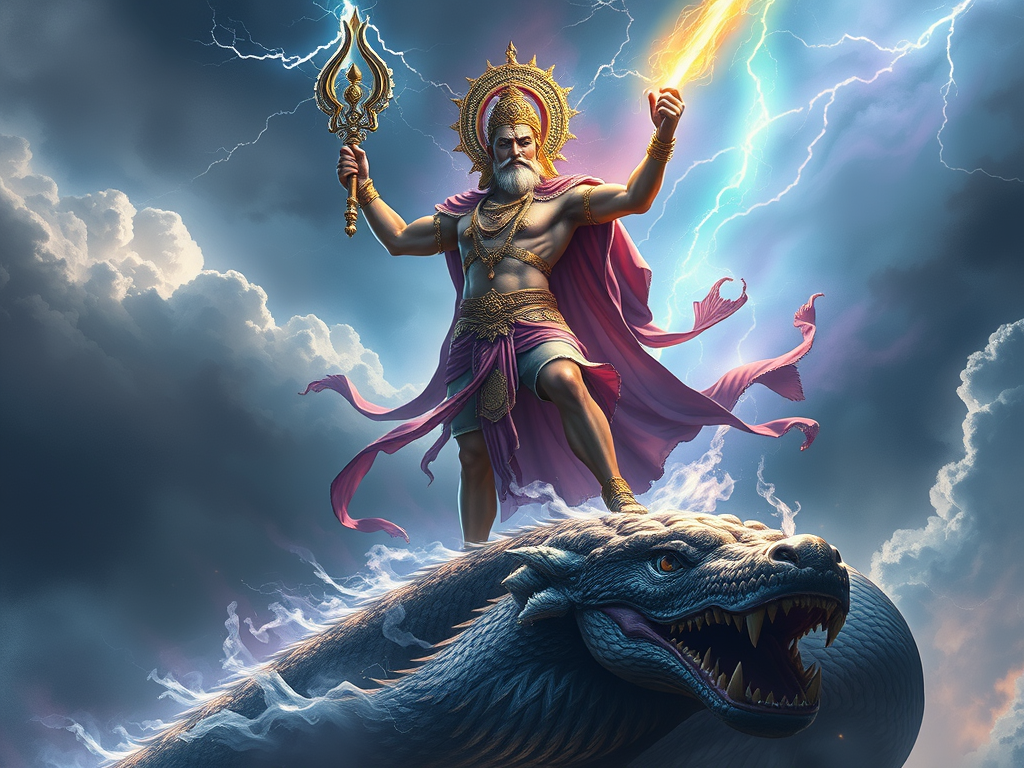
There is in the Rig Veda a narrative that recurs in dozens of different forms, in dozens of hymns belonging to different mandalas and different eras, with an insistence that speaks of its fundamental importance: the combat of Indra against Vritra. Indra, armed with his thunderbolt, strikes down the dragon Vritra who was holding the waters captive, and the waters are freed, flow at last, fertilise the earth, give life. This narrative has been interpreted in a thousand ways: as a meteorological myth describing the storm that brings rain, as a spiritual allegory of the awakening of consciousness, as a coded historical account describing conflicts between peoples. All these readings have their share of truth. But there is a fourth one, which our era suddenly makes urgent and concrete: the combat of Indra against Vritra is also a description of the way civilisations survive or perish depending on whether they know how to free water or allow it to be exhausted.
Vritra means the one who covers, who obstructs, who retains. In the context of the water myth, Vritra is drought, the obstruction of the water cycle, the force that prevents rivers from flowing, rains from falling, life from renewing itself. His name is of remarkable precision: he does not destroy water. He holds it back. He covers it. He prevents it from circulating. And it is precisely this obstruction of circulation that is fatal for an agrarian civilisation. The water is there, somewhere, in the clouds, in the glaciers, in the underground water tables. But it does not flow. It does not descend. It does not fertilise. Vritra holds it prisoner, and as long as he lives, the earth dries up and life retreats.
Indra is the force that breaks this obstruction. His thunderbolt is not a weapon of mass destruction. It is an instrument of liberation. It breaks the dam, it opens the barrier, it splits the mountain to let pass what was being held back. And when Vritra falls, the waters rush forward, the rivers overflow, the rain falls, the fields turn green. It is an image of extraordinary power and contemporary relevance. Because what the Vedic rishis described six thousand years ago in mythological form, we are living today in a very concrete and very alarming version: a world in which Vritra, in the form of climate change, deforestation, over-exploitation of groundwater and pollution of waterways, is increasingly holding back the waters that should have flowed freely.
The civilisation of the 7 Rivers knew how, for two millennia, to maintain a relationship with water that was fundamentally different from the one that subsequent civilisations developed. We saw this in the articles on agriculture and on sacred rivers: rivers were not resources to be exploited but goddesses to be honoured, cosmic forces whose flow was the condition of all life. The irrigation systems this civilisation developed were not technologies for capturing and retaining water for private ends. They were ways of extending and distributing the natural movement of water, of participating in its circulation rather than interrupting it. This distinction, between participating in the flow and intercepting it, is at the heart of the difference between the Vedic relationship with water and the relationship that our industrial civilisation has developed.
When Vritra prevailed, when the great drought of 2200 to 2100 BCE struck the civilisation of the 7 Rivers, no one was there to play the role of Indra. Not because the Vedic Indians lacked courage or intelligence. But because certain forms of Vritra are too powerful to be overcome by human means alone, because the river captures that diverted the tributaries of the Sarasvati were tectonic processes that no human technology of the era could overcome. The civilisation adapted, it migrated, it survived in other forms. But the world it had built on the banks of the Sarasvati disappeared with the river that had carried it.
This parallel with our own era is difficult to avoid and difficult to look at squarely. We are in the process of creating our own Vritras, at a scale and a speed without precedent in human history. Climate change is altering precipitation patterns, accelerating the melting of glaciers on which billions of people depend for their fresh water, disrupting the monsoons that irrigate a large part of South Asia and Africa. Massive deforestation is destroying the forests that capture atmospheric moisture and regulate the water cycle at a continental scale. The over-exploitation of groundwater in the great agricultural plains of the world is emptying reserves accumulated over millennia in a matter of decades. The pollution of rivers and lakes renders them unusable for entire populations. All of this is Vritra at work. It is the progressive obstruction of the flow of water, the retention of what should be flowing, the coagulation of what should be circulating.
And Indra? Where is the thunderbolt that could break these new obstructions? The Vedic hymns perhaps offer us a clue, even if it is not the one we expect. In the hymns, Indra does not fight Vritra alone. He fights with the help of the Maruts, the gods of wind and storm, with the help of the rishis who recite the hymns, with the help of the entire community gathered in the sacrifice. The victory over Vritra is collective. It is not the exploit of an individual hero or of a miracle technology. It is the convergence of all available forces toward a common goal, animated by a shared vision of what life requires in order to continue.
This shared vision is perhaps what is most lacking today. We have the technologies, we have the knowledge, we have the material means to begin responding to the water crisis that is taking shape. What is missing is the collective awareness that water is not a resource like any other, that its cycle is sacred in the most functional sense of the word, that breaking this cycle is breaking the condition of all life on the planet. The Vedic rishis knew this. They knew it in a direct and lived way, because their relationship with water was that of a civilisation that depended on it entirely and that recognised its divine dimension in every hymn, in every ritual, in every daily gesture of invocation of the waters.
The Sarasvati dried up despite their love for it, because the forces that killed it were greater than what their love could contain. Our rivers, our glaciers, our groundwater are being depleted under the effect of forces that we ourselves have set in motion and that we have, in principle, the capacity to stop. Indra is waiting. The thunderbolt is available. What is missing is the awareness that Vritra is there, that the waters are being held back, and that leaving them thus retained is a choice, not a fatality.


Votre commentaire