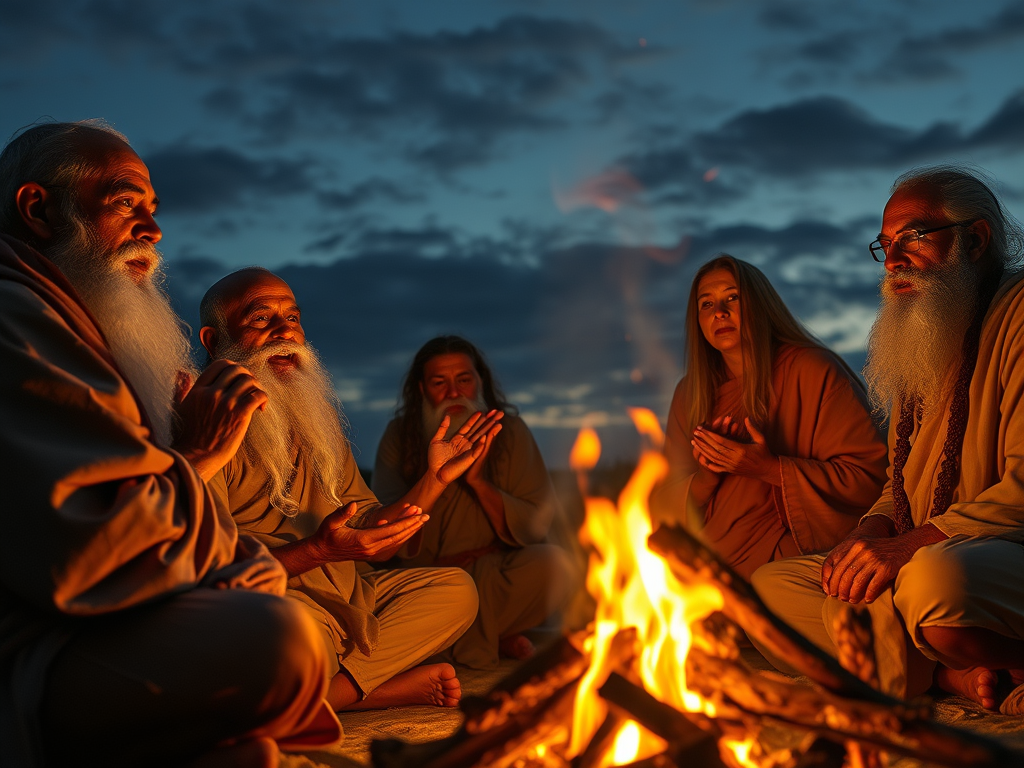
There is a way of conceiving spirituality that separates it from ordinary life, that makes it a reserved domain, a separate practice, something one does in a special place, at special moments, in special clothing, with people specially trained for it. This conception, which is that of most institutional religions, is fundamentally foreign to what the Rig Veda describes. In the civilisation of the 7 Rivers, spirituality was not separated from daily life. It was its guiding thread, the invisible but omnipresent dimension that gave every gesture, every meal, every sunrise, every birth and every death their meaning and their place in a larger order.
The day began with Ushas. Not symbolically, not metaphorically: literally. The rising of the sun was a spiritual event before being a natural one, or rather it was both simultaneously and inseparably. The hymns to the Dawn are not poems written at a distance, by someone contemplating the break of day from their desk. They are texts that accompanied the dawn itself, recited aloud in the pink light of the morning, before the domestic fire that was rekindled to welcome the new day. The first prayer of the day was not an individual and silent undertaking. It was a communal act, rooted in the landscape, synchronised with the movement of the sun, connecting those who practised it to the same cosmic force that their ancestors had invoked for generations.
The domestic fire, Agni, was the centre of the daily spiritual life of every family. We mentioned it in the article on daily life, but it deserves to be examined here from the angle of daily spirituality with greater precision. Agni was not lit only to cook food and heat the house, even though these functions were real and important. He was kept alive as a continuous divine presence, as the guardian of the hearth in the most profound sense of the term. To extinguish him through negligence was a serious act, not because a rule forbade it, but because it meant interrupting the daily dialogue between the family and the cosmic force of which the fire was the visible manifestation.
The domestic puja, that daily ritual in which a few spoonfuls of clarified butter are poured into the fire while mantras are recited, was the most widespread and most fundamental spiritual practice of Vedic civilisation. Its simplicity must not conceal its depth. To pour ghee into the fire is to perform a miniature yajña, an offering without guaranteed return, an act of participation in the cycle of circulation of energy between the levels of reality. It is also, and above all, a way of beginning each day with an act that says something essential about one’s relationship to the world: before taking anything for oneself, one gives. Before thinking of one’s own needs and desires, one acknowledges something greater than oneself. It is a practice that, performed regularly, progressively transforms the way one inhabits one’s life.
The recitation of mantras accompanied the essential moments of the day. Not as a mechanical obligation, a prayer wheel turned mindlessly, but as a deliberate coming into resonance with forces that ordinary words cannot reach. Vedic mantras are not requests addressed to distant gods. They are tools for the transformation of consciousness, sonic formulas whose vibrational structure acts directly on the inner state of the one who recites them correctly. To recite a mantra in the morning before beginning one’s day is to calibrate one’s consciousness, to remind oneself of who one is and in what world one lives, before entering the flow of activities that tends to make one forget all of this.
The relationship to food was a dimension of daily spirituality that deserves attention. In the Vedic vision, eating is not a purely biological act. It is a participation in the cycle of life, a way of receiving what the earth, the rains, the sun and human labour have produced together. The formulas recited before and after the meal were not grace in the Christian sense, thanks addressed to a transcendent creator god. They were a recognition of the interconnection of all the forces that had conspired to place this food in this bowl, a way of eating in awareness rather than in automatism. To eat in awareness, for the Vedic Indians, was a spiritual act. Not because one had decided to make it spiritual, but because the reality of what one was doing, seen clearly, was spiritual.
The relationship to the body was another dimension of this integrated daily spirituality. Pranayama, the work on the breath, was probably practised from this period, even if the word yoga does not exist in the Rig Veda in the sense of a codified discipline. The seals from Mohenjo-daro depicting figures in meditation posture are there to remind us that these practices existed before their names were even fixed. To become aware of one’s breath, to regulate it, to use it to modify one’s state of consciousness: this is a practice that requires no temple, no priest, no ceremony. It is available at any moment, in any place, to whoever knows how to use it. And in a civilisation where soma was not permanently available but only during the great public sacrifices, pranayama was probably the daily means of access to the expanded states of consciousness that soma allowed one to reach more quickly during the ceremonies.
The passages of life — birth, marriage, death — were naturally enveloped in a spiritual dimension. But this dimension was not separated from the rest. It was not a veneer of sacredness applied to fundamentally profane events. It was the explicit recognition of a reality that was present throughout all of life: that every birth is a manifestation of Brahman taking a new form, that every marriage is a union of complementary forces participating together in the cosmic cycle, that every death is a return, a dissolution of a particular form back into the infinite from which it came. The tenth mandala, with its nuptial and funerary hymns, is the most direct document of this sacralisation of life’s passages, even if in the older mandalas this dimension was probably lived in a still more immediate and less codified way.
There is something profoundly different about Vedic daily spirituality compared to what later religious traditions have proposed, and this difference deserves to be named clearly. It was not a spirituality of effort, of imposed discipline, of guilt and redemption. Nor was it a spirituality of refuge, a way of escaping from ordinary reality to find peace in a protected space. It was a spirituality of presence, a way of inhabiting ordinary reality with an attention and an awareness that revealed it for what it truly was: a continuous manifestation of Brahman, sacred in each of its aspects, accessible in each of its moments, visible to whoever had learned to look with the eyes that soma and the sacrifice opened.
The loss of this integrated daily spirituality is one of the most profound losses that the disappearance of soma and the collapse of the civilisation of the 7 Rivers caused. What succeeded it, in the religious traditions that developed in the following centuries, is often beautiful, often deep, often of extraordinary philosophical and artistic richness. But it is no longer the same thing. It is a spirituality that knows it has lost something, that seeks to recover that something through discipline, devotion, philosophy, asceticism. The spirituality of the 7 Rivers was not seeking. It simply was.


Votre commentaire