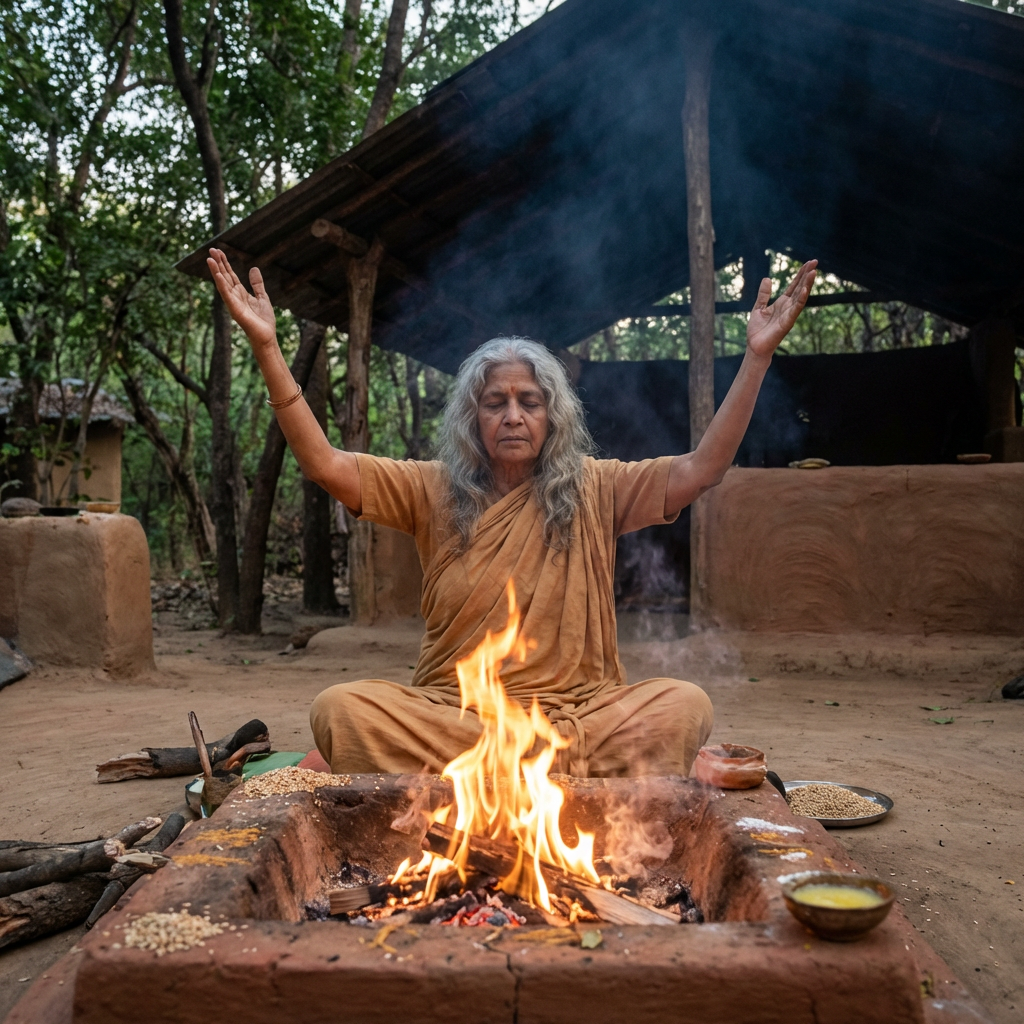
The Rig Veda has long been presented as a text by men, composed by men, for men. This reading is lazy, and it is inaccurate. The Vedic corpus itself, in its hymns, contains the voices of women who were not silent wives or ceremonial assistants, but seers in their own right, poets of the same calibre as their male counterparts. They are called the brahma-vādini, those who speak of brahman, of ultimate reality. Some twenty of them are named in the tradition, and their words have crossed the millennia with the same force as those of the male rishis whose names are better known.
The most celebrated is perhaps not in the Rig Veda itself, but in the Upanishads, those texts that are its philosophical continuation. Gārgī Vācaknavī belongs to that generation of thinkers who pushed Vedic inquiry to its most vertiginous limits. In the Bṛhadāraṇyaka Upaniṣad, she dares to publicly challenge Yājñavalkya, the greatest philosopher of her time, before an assembly of sages. She does not ask him beginner’s questions. She drives him toward the edge of the unspeakable, asking upon what everything that rests is itself resting, until he tells her that beyond a certain point, the question can no longer be asked without the head falling off. It is she who pressed the question all the way to that place. Not him. This detail says everything about the position these women occupied in the intellectual and spiritual life of that era.
Lopāmudrā is directly present in the Rig Veda itself. Hymn 179 of the first mandala is attributed to her, and it is a text of striking frankness. She is the wife of the rishi Agastya, an ascetic renowned for his extreme discipline and his indifference to worldly pleasures. Lopāmudrā speaks up to tell him, with an elegance that does not soften the firmness of what she says, that asceticism cannot do everything, that the body has its rights, that a complete life is not one that denies half of existence. She speaks of desire, of physical love, of the fullness that arises from union between beings, and she does so within the very framework of a sacred text, without this having seemed contradictory to those who preserved these hymns. The hymn is there, in the Rig Veda, untouched, for millennia. Lopāmudrā was not censored. She was transmitted.
There is in this fact something that invites us to entirely reconsider our image of this civilisation. A society that inscribes in its most sacred text the voice of a woman claiming the right to desire is not a society that reduced women to silence. It is a society that had a conception of wholeness different from the one that later centuries progressively imposed — a wholeness in which the feminine was not a concession made to human weakness, but an irreducible component of the cosmic order.
Viśvavārā, Śacī Paulomī, Surūpā, Romāśā — the names are less well known but the hymns exist. Viśvavārā composes hymns to Agni with a technical precision that speaks to deep training in the art of Vedic versification. She does not speak from the margins of the tradition — she speaks from its centre. Śacī Paulomī expresses herself on her own power, on the strength that comes to her from her nature and her choices, in terms that have nothing of the conventional humility one might expect from a feminine voice in an archaic religious text.
What strikes one, reading these hymns, is that these women do not speak of themselves as exceptions. They do not draw attention to their own audacity. They speak, simply, with the same natural authority as their male colleagues. It is in the later commentaries, in the glosses of subsequent centuries, that people began to be surprised, to minimise, to reinterpret these voices as symbolic or allegorical. The original text feels no such need. The woman-rishi is in the Rig Veda what she is in the life of the civilisation of the Seven Rivers: an ordinary reality.
The Sanskrit tradition has preserved the term strī-rishi to designate them, but one should not allow this technical term to obscure what it covers. These are not women who obtained an exceptional exemption from a general rule of exclusion. They are women who took part in a living transmission, who received the vision, the mantra, the inspiration that defines the rishi — and who in turn transmitted it. The chain of Vedic transmission passes through them as much as through the men.
What happened next? How did this civilisation, which placed Lopāmudrā and Gārgī in its founding texts, evolve toward the structures that India knew in later centuries, where women’s voices in sacred space became progressively restricted and then marginalised? The answer may lie in what I explore in my book on collapse: when a civilisation contracts under the pressure of catastrophe — droughts, migrations, wars, the disappearance of rivers — it is often toward control and hierarchy that it turns. The openness closes. What was living and plural solidifies into rules and exclusions.
The Rig Veda, for its part, preserves the trace of what existed before that contraction. These women’s voices are not an anomaly in the text — they are the text. And their presence, alongside those of Agni, Varuna, Indra, and Mitra, reminds us that the Vedic vision of the world was not a half-vision, but a whole one, in which every form of human consciousness had the right to turn toward the infinite and put into words what it had seen there.
 Le Rig Veda
Laisser un commentaire