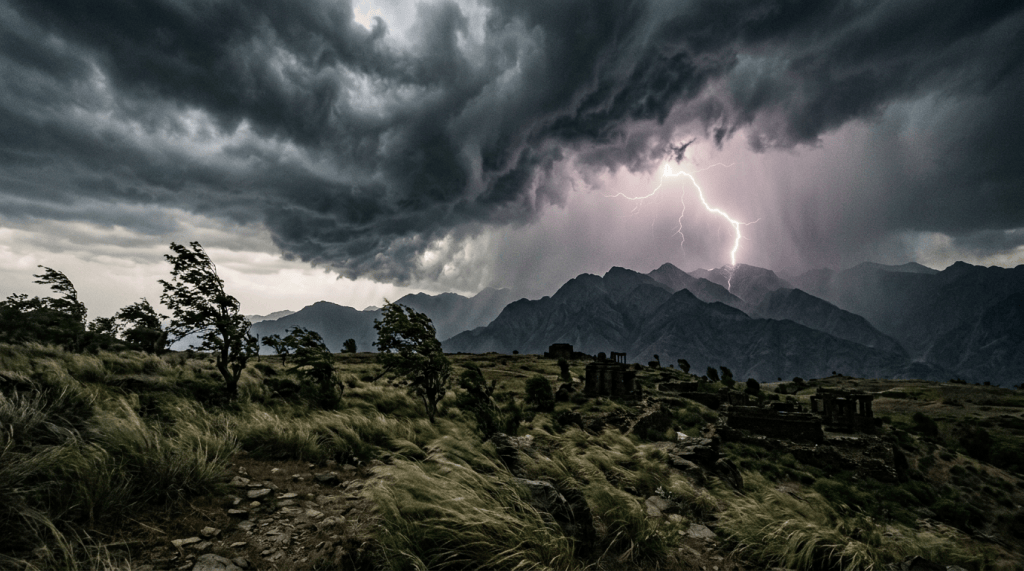
There is a troop in the Rig Veda that I am particularly fond of: the Maruts. Not solitary, majestic gods — a band, a squad, a group of inseparable brothers. They roar, they blaze, they make the earth tremble. And yet, behind the brilliance of the storm, there is something more subtle.
Who are the Maruts?
My Rig Veda text defines them simply at the outset: “The Maruts: those who cause death. The winds. They are the sons of Rudra, the companions of Indra. They are the gods of energy, the power of will and vital force.”
Three superimposed identities: they are the winds, they are the sons of the terrible god Rudra (the first name of Shiva), and they are the allies of Indra, the great warrior god of the storm and the thunderbolt. Their very name — those who cause death — says something of their nature: they are not simply the gentle winds of spring. They are the winds that break, that sweep away, that renew by destroying.
Hymn 1.37: the resplendent troop
Hymn 1.37 (To the Maruts, ṛṣi: kaṇva ghaura) is one of the most beautiful portraits of the troop:
“Celebrate the troop of the Maruts who come to you on a resplendent chariot, O Kaṇvas, it goes straight ahead. Those who are born blaze of themselves, with spotted antelopes, with spears, spears and ornaments. I hear those who speak like a whip cracking in their hands.”
And further: “Sons of Rudra, may the Union of your Force be continuously and swiftly destructive.”
They are described with ornaments, gleaming spears, spotted antelopes harnessed to their chariots. This is not a description of meteorological abstractions — it is a vision, a luminous and terrifying apparition, the moment when the storm rises on the horizon and the entire sky changes colour.
Sons of Rudra, born of Heaven
Hymn 1.64 (To the Maruts, ṛṣi: nodhas gautama) develops their birth and nature:
“They are born of Heaven, these sublime and vigorous children of Rudra, free of evil and divine, immaculate. They are pure as suns, warlike as storms of terrible form, falling as rain. The young Rudras remain forever young, they who have slain the Miser, have become irresistibly luminous, like mountains.”
As sons of Rudra, they inherit their father’s nature: the purifying destruction. Rudra in the Rig Veda is the one who destroys the darkness to make way for the Light. His sons do the same: their storm cleanses the sky, their rain fertilises the parched earth. Destruction is not an end — it is a means of renewal.
Companions of Indra, not his subordinates
The relationship between the Maruts and Indra is fascinating. They are not his servants — they are his companions, his allies, his peers in cosmic combat. Several hymns invoke them together: “May Indra and the Maruts be our protection” returns like a refrain.
But in hymn 1.85 the Maruts act on their own: “The Earth trembles like one who staggers as it hurries along the path. When they unite in Beauty. They play, roar loudly, armed with gleaming spears.”
What I take from this alliance is the complementarity: Indra is the single thunderbolt, the decisive blow; the Maruts are the multiple storm, the wind that comes from everywhere at once. One strikes, the others surround.
Vital energy in the form of the storm
In the symbolic reading I apply to the Rig Veda, the Maruts are not simply deified meteorological phenomena. They represent the forces of vital energy — what the Vedic definition calls “the power of will and vital force.” The storm is the perfect metaphor: an energy that builds, that rises, that breaks, that transforms everything in its path and leaves the air cleaner, the earth more fertile.
Hymn 1.38 says this simply: “Sons of Prishni, even if you may be mortal, make the one who celebrates you immortal.” The tumultuous troop can grant immortality — because their energy, well channelled, is that of life itself.
The Maruts and the coherence of civilisation
These gods of collective energy, acting together without a single chief but with a shared direction, make me think of the Seven Rivers civilisation. A society that covered a million square kilometres without a central king, with norms shared by all — like a storm that comes from everywhere at once, with no single wind more important than another. How does one measure and transmit a norm without central authority? This is precisely the question posed by the system of weights and measures of the Sapta Sindhu — which I discuss in [my article on saptasindhuveda.com].


Votre commentaire