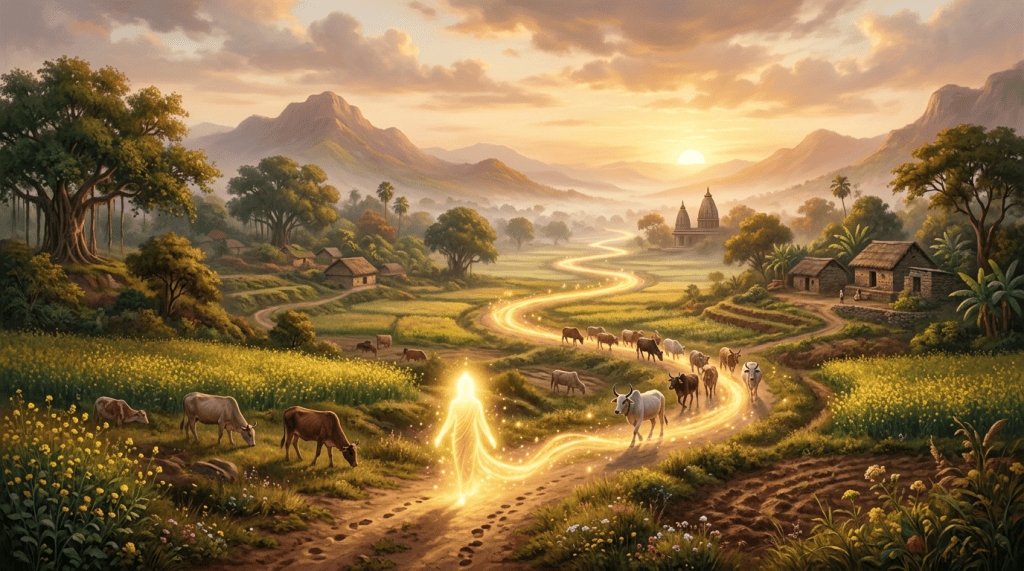
Some gods thunder, strike, illuminate. And then there is Pūṣan. No thunderbolt, no army, no triumphant hymns. Pūṣan is the god of the road — the ordinary road, the one you take at dawn with your herd, and the one you travel, just once, when you leave this world.
The meaning of the name
Pūṣan comes from the root puṣ — to nourish, to make prosper, to cause to grow. He is the one who makes the journey fruitful, who ensures that the road leads somewhere. His conveyance is unique in the entire Vedic pantheon: he does not drive a chariot pulled by horses like Indra or Sūrya, but one drawn by goats. He is not the god of speed — he is the god of patience and the road covered step by step.
Hymn 1.42: walk before us
Hymn 1.42 (To Pūṣan, ṛṣi: kaṇva ghaura) is one of the most direct texts in the Rig Veda. It says without detour what is asked of him:
“O Pūṣan, lead us safely across the road that blocks our liberation, Son. O God, walk before us, walk with us.”
And then: “Drive away from us the one who is evil — the wolf, the jealous one. Drive him from our path. Drive far away the one who lurks along the road, that thief. Lead him away from the path.”
This is not an abstract prayer. It is the prayer of someone who leaves at dawn, with their animals, on a road they do not know well, through a forest where wolves and thieves lurk. Pūṣan is the god of ordinary people on a journey.
The finder of lost herds
One of Pūṣan’s most concrete functions in the Rig Veda is to recover strayed animals. The ṛṣis ask him to bring back cows that have wandered into the forest, to recover what has been stolen, to put back on the right road what has gone astray. He is a practical god, rooted in the pastoral life of his time.
Hymn 2.40 pairs Pūṣan with Soma — the two divine herdsmen, “protectors of the entire Universe”: “Soma and Pūṣan, born of the Riches, born of Heaven, born of Earth, you, the two herdsmen, are the protectors of the entire Universe.”
This pairing is telling: Soma is inner ecstasy, Pūṣan is the outer world of paths and herds. One nourishes the soul, the other protects the body in movement.
The guide of the dead
Pūṣan also has a darker function: he is the one who accompanies the dead along the road to the beyond. In the Rig Veda, he is invoked in funeral rites to open the way, so that the deceased finds their road without getting lost in the darkness. The god of earthly paths is also the ferryman of souls.
This double function — guide of the living on the roads, guide of the dead toward the beyond — makes him one of the most human gods of the Rig Veda. He is not there for the great cosmic battles. He is there for the daily crossing.
Pūṣan and the silent order
What I take from Pūṣan is that he is the god of what works — of what connects, of what allows the circulation of people, animals, goods. The roads he guards are the flows of exchange that keep a civilisation alive.
This ideal of an order that permits free circulation without coercion brings me back to the Seven Rivers civilisation — a society that covered a million square kilometres without a central king, without an army, and yet with shared norms across the entire territory. How was such cohesion possible? One answer may lie in the bricks. I invite you to read [my article on the standardised brick of Mohenjo-daro on saptasindhuveda.com].


Votre commentaire