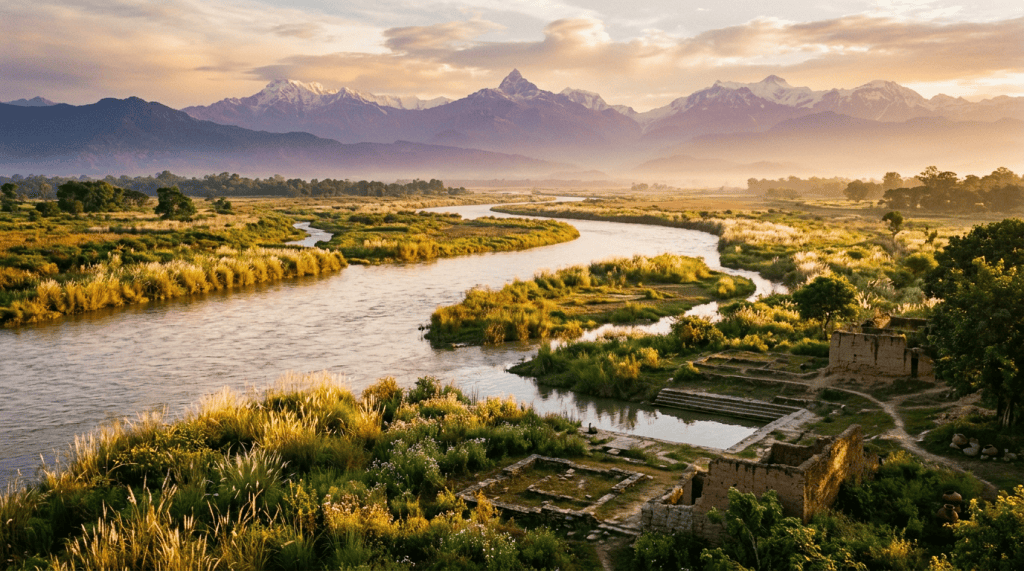
In the Rig Veda, rivers are everywhere. But only one of them was elevated to the rank of goddess — only one is invoked alongside Agni, Indra and Varuṇa. That river is Sarasvatī.
Her name means ‚like a lake.” The definition I give in my own work is more precise: Sarasvatī ‚illuminates all meditations; she is the flow of the divine word that illuminates all thoughts.” This is not a river celebrated for its volume. It is an inner force, a power of consciousness.
The greatest of rivers
Hymn 7.96.1 says: “I sing the divine word: she is the widest of rivers.” Hymn 7.95.1 adds: “She surges forth, billowing, refreshing, this Sarasvatī… She drives on like a swift chariot, surpassing the waters of all other rivers.”
These images describe a physical reality: the Sarasvatī was indeed, in Vedic times, an immense river — Himalayan headwaters, major tributaries, more than 1,500 km of flow. The greatest cities of the Seven Rivers Civilisation stood on her banks: Rakhigarhi, Banawali, Kalibangan, Ganweriwala — as I explore in the companion article on saptasindhuveda.com about the Sarasvatī / Ghaggar-Hakra.
The river and the word
What sets Sarasvatī apart is the explicit link between water and speech. The River is, in my symbolic lexicon, “the flow of speech, of illumination.” Vāc, the rightful word, is the one that reaches ṛta, Truth / Reality. Sarasvatī is the symbol of that aspiration. Hymn 1.164.49 declares: “…here is Sarasvatī, the primordial element.”
The only river that is also a goddess
Why her, and not the Ganges, not the Indus? Because it was on her banks that the Pūrus lived, from whom the Bharatas descended — the people who composed the Rig Veda. The river hymn (10.75.5) invokes her: “Join my praise, O Ganga, O Yamunā, O Sarasvatī…” And hymn 6.52.6: “Sarasvatī swells with the rivers.” She receives all other waters, integrates them — an image of consciousness enlarging itself by welcoming everything.
When the river runs dry
Two major earthquakes diverted her two principal tributaries. Deprived of her sources, the great river dried up around 1900 bce. The Rig Veda bears the mark of this catastrophe: in the tenth maṇḍala — the last to be added — the Drishadvatī is already dry. It is there that the varṇas appear, that the soma grows scarce.
Yet the goddess did not disappear. In later Hindu tradition, Sarasvatī became the deity of knowledge, music, the arts and speech — precisely what the Rig Veda already attributed to her. The river is gone; the goddess lives on.


Votre commentaire