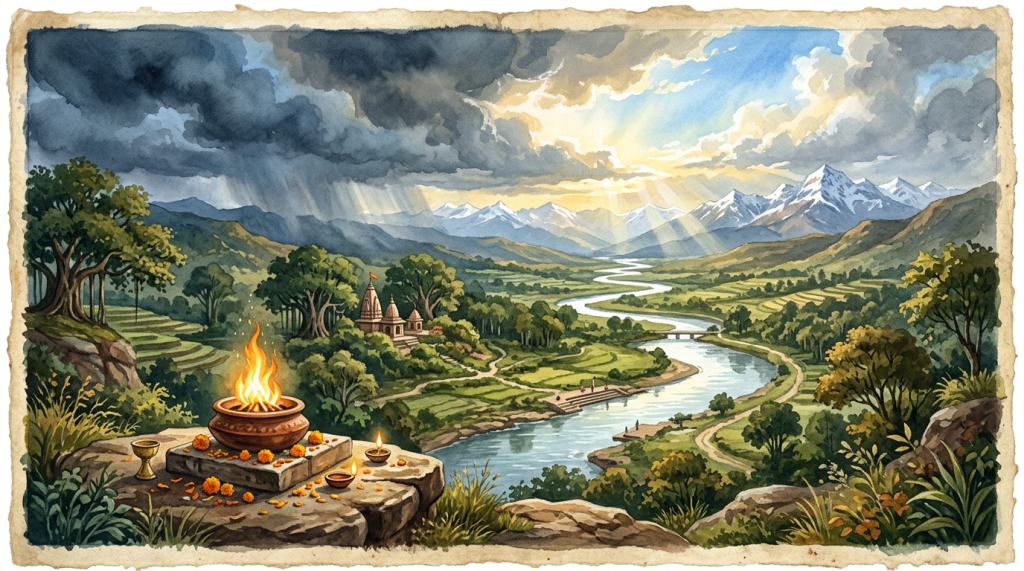
Dharma. This word has traveled through millennia and cultures, accumulating layers of meaning until it becomes almost elusive: moral duty, natural law, religion, life path, cosmic order. In Buddhism it designates the teaching of the Buddha himself. In contemporary Hinduism it structures a social ethic. But in the Rig Veda — the oldest text in the Indian tradition — this word still exists in its original nakedness, and it says something far more radical than all its later avatars.
In my reading glossary for the Rig Veda, I have retained this definition for the Rule: “the order of things. The cosmic order. The dharma.” But I prefer to pause on the word “Truth” — because this is how the term ṛta is most often rendered in translation, and it is ṛta that is everywhere in the hymns where we might expect dharma. These two notions coexist in the Vedic text, overlap, complement one another, and their relationship merits attention.
Ṛta is the Truth of what is — not a formulated truth, a proposition, a dogma, but the reality of the very structure of the universe. When a hymn says “With Truth, I cleanse the Earth and Heaven”, this is not a pious metaphor. It is the affirmation that Truth is an active, purifying, operative force. It acts in the world as water acts in the world: flowing where it must flow, washing what must be washed, nourishing what awaits nourishment.
Varuna is in the Rig Veda the guardian god par excellence of this ṛta. “O Divine Varuna, as the people do not follow your rules, each day, we violate them” says hymn 1.25 — and this formulation has a striking modernity. The human being, naturally, strays from the Rule. Not out of fundamental perversity, but because the ego pulls in its own directions, because fear and desire deflect the natural impulse. Varuna does not punish like a human judge: he observes, he maintains, he offers the possibility of return. “That you may show us compassion, we hold our thought unified, as a charioteer holds his Horses.” Varuna’s compassion is Truth itself made accessible to whoever sincerely seeks alignment with it. To deepen the sacrificial context in which this concept unfolds, I recommend reading my article on the ritual preparation of soma, which illuminates the context in which these hymns to Varuna were recited.
Agni, the god of sacred fire, is also profoundly associated with the Rule in the hymns. “O Agni, you were the first rishi, Angiras, god, benevolent friend of the gods; by your will are born the sages who act through knowledge and the Maruts with the brilliant lance. You strive for the Rule that permeates all of Humanity.” What I read here: the Rule is not external to the human being. It permeates them. It is in them as heat is in fire. Agni carries it, the rishis act within it, and this same inner fire “resides in every human being.” Vedic dharma is not a law imposed from above: it is a reality that seeks to express itself through every conscious being.
Most striking to me is this verse from Mandala 8: “Sing a great song for Indra, for the wise one, for the great one, for the one who created dharma.” Indra — the god of Force, Thunder, Soma — as the creator of dharma. Not a legislator who promulgates codes, but a force that, by shattering obstructions (demons, droughts, the fortresses of mental obscurity), allows the true structure of the real to appear. Vedic dharma is what remains when the obstacles are lifted. It is not constructed — it is revealed.
And in Mandala 7, Mitra and Varuna together: “O Guardians of truth, you who truly follow the dharma, you stand on your chariot in the highest Heaven. You thus favor this one, Mitra and Varuna. Make the honey-rich rain fall from Heaven.” The dharma here is not separate from fertility, rain, concrete life. The guardians of Truth make the rain fall. The cosmic dimension and the earthly dimension are one single reality. This is one of the most beautiful traits of Vedic thought: it does not separate the moral from the physical, the spiritual from the natural. The same order governs the clouds and human consciousness, the rivers and the sacrifice, the course of the Sun and the uprightness of the sage.
What I take from this exploration: dharma in the Rig Veda is not yet codified, standardized, institutionalized. It has not yet been transformed into a caste system, a code of social conduct, an instrument of religious power — all things that will come later, in other texts, in other times. Here it is alive, dynamic, cosmic. It is the name of the deep coherence of the real, and the invitation made to every human being to align with it not out of fear but out of recognition of what it is. The Ribhus, those divine craftsmen I discussed in my article on hymn 1.20, are a luminous example: they followed the dharma of their craft all the way to deification. And to understand how this same spirit of alignment with a deep reality manifests in the material civilization that preceded and accompanied these hymns, I invite you to read about the mysterious writing of the seals on my site dedicated to the 7 Rivers civilization.


Laisser un commentaire