Rig Veda · Maṇḍala X; Hymn 85
Rishi: Sūryā Sāvitrī
The Rig Veda is not merely a collection of sacrificial prayers. It is also the oldest literary text in human history to have captured in language the most universal of all experiences: love, marriage, the founding of a home. Hymn 10.85, known as the Sūryā Vivāha — the wedding of Sūryā — is its most vivid testimony.
This hymn of forty-seven stanzas accompanied the Vedic wedding ceremony. It is still recited today at Hindu marriages, three and a half thousand years later. But beneath the ritual formulas lies an entire cosmology, and beneath the cosmology, an invitation to an inner reading.
Sūryā, Daughter of the Sun
The central figure is Sūryā — not to be confused with Sūrya, the Sun itself. Sūryā is the daughter of the Sun, or more precisely « the sister of the Sun » as the poem’s dedication states, its feminine emanation, solar light as nuptial power.
Her father is Savitṛ — « The Impeller, » another aspect of the Sun, here the force of propulsion and creation. It is Savitṛ who arranges the marriage and « launches » Sūryā toward her husband, as the sun launches its rays. The verb used in stanza 13 — prāhiṇot, « he projected her » — shares the same root as sāvitrī, the gāyatrī formula recited at dawn.
Her husband is Soma — not simply the sacrificial plant or ritual drink, but Soma as lunar power, principle of immortality, master of the celestial waters.
The Celestial Procession
Stanza 1 sets the cosmic framework without ambiguity:
By truth the Earth was raised up. By the Sun the sky is supported. By reality the Ādityas stand in the sky. Soma is prepared.
This is not yet a human wedding. It is the ordering of the cosmos: Truth (ṛta) as the foundation of the Earth, the Sun as the support of Heaven, Soma as the substance of the gods. Everything that follows — the procession, the suitors, the giving of the bride — unfolds at this scale.
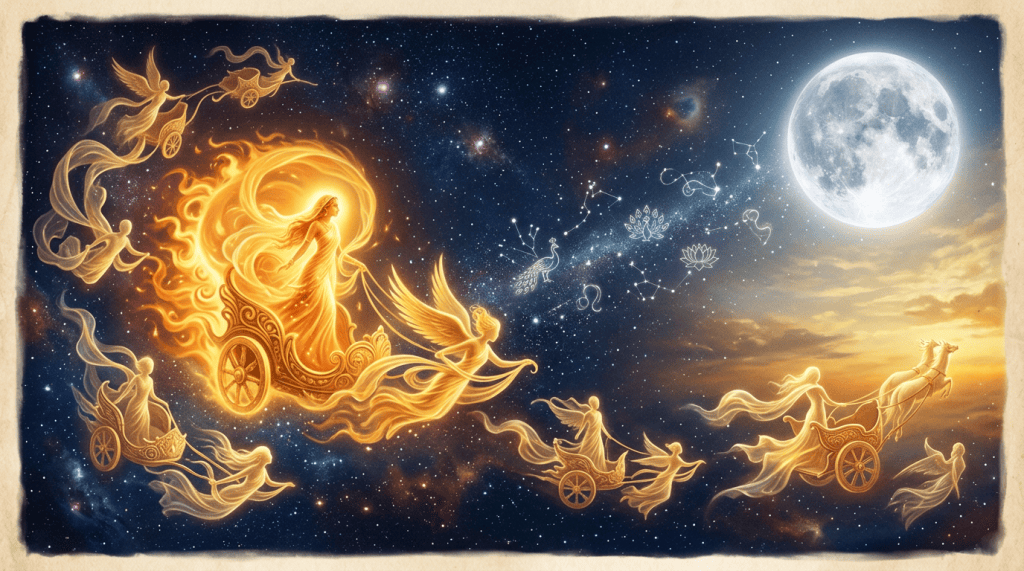
Sūryā’s suitors are the Aśvins, the Divine Twins, drivers of the Chariot of Dawn. The wedding chariot is described with a poetic precision that astonishes: the pillow is understanding (manas), the ointment is the eye (cakṣus), the two wheels are the two Lights.
The mind was her chariot, the sky was its canopy. The two shining ones were the two bullocks when Sūryā came home. (st. 10)
The Triple Reading of Stanza 3
The hymn contains one of the most striking warnings in the entire Rig Veda. Stanza 3:
He thinks he has drunk the soma when they have pressed the plant. But what the brahmin knows, no one actually drinks, that is certain.
This stanza overturns the ritual reading. The soma that is pressed, drunk, and offered is not the true soma. The true soma remains inaccessible to the ordinary mortal. Stanza 4 confirms: « No earthly being drinks you. »
The marriage of Sūryā and Soma is therefore also the marriage of conscious solar light and the principle of immortality — a union that is consummated in interiority, in direct knowing, and not in external ritual alone. Sūryā herself is the rishi of her own hymn: Sūryā Sāvitrī is named its author. The bride sings her own wedding.
Vishvavasu the Gandharva
Stanzas 21-22 introduce a strange figure: Vishvavasu, a gandharva — an intermediate being, celestial musician, guardian of soma. The Vedic tradition teaches that a young woman, before her wedding, first belongs to the gandharvas, then to the Sun, then to Fire (Agni), before being given to her human husband. Stanza 40 states it plainly:
Soma found you first. The highest gandharva found you. Agni is your third husband. He who is born of men is your fourth husband.
The sequence Soma → Gandharva → Agni → Man is a descent from the invisible to the visible, from the celestial to the terrestrial. The human wedding is the final stage of a cosmic process of « transmission » of light.
The Nuptial Blessing
The final stanzas (36-47) are of a striking beauty and humanity. The husband takes his bride’s hand:
I take your hand for happiness, so that with me, your husband, we may reach old age. Bhaga, Aryaman, Savitṛ, for the honored fullness, all the gods have given you to the householder. (st. 36)
The blessing asks for ten sons — and makes the husband the eleventh child of the family, for he too is born in this new union (st. 45). The in-laws are honoured with a remarkable equality: the bride is queen for her father-in-law, her mother-in-law, her sister-in-law, the whole family (st. 46).
And the final stanza gathers the waters, the winds, and the gods into a single gesture: may all blessings enter the heart of the new household.
The Double Reading
Like all the great hymns of the Rig Veda, the Wedding Hymn sustains a double reading:
Physical reading: A concrete nuptial hymn accompanying an actual ceremony, with its gestures (the taking of the hand, st. 36), its movements (the chariot, st. 10-12), its formulas for dismissing the gandharva (st. 21-22), its final blessings.
Inner reading: The wedding of luminous consciousness (Sūryā, daughter of the Sun) with the principle of immortality (Soma, the Moon, the waters of life). The union of masculine and feminine as cosmic principles. The « taking of the hand » as an act of knowledge: jnāna and bhakti united in the simplest of gestures.
This is why the hymn remains alive. It is not a three-thousand-year-old fossil. It is a description of what happens, in every marriage, both on Earth and in the inner sky.
To learn more about the civilisation that produced this hymn — its cities, its workshops, its trade networks — visit Sapta Sindhu — The Civilisation of the 7 Rivers and in particular the article Lapis Lazuli — from Badakhshan to the Workshops of Mohenjo-Daro: the precious stone that adorned the brides of the Indus.


Laisser un commentaire