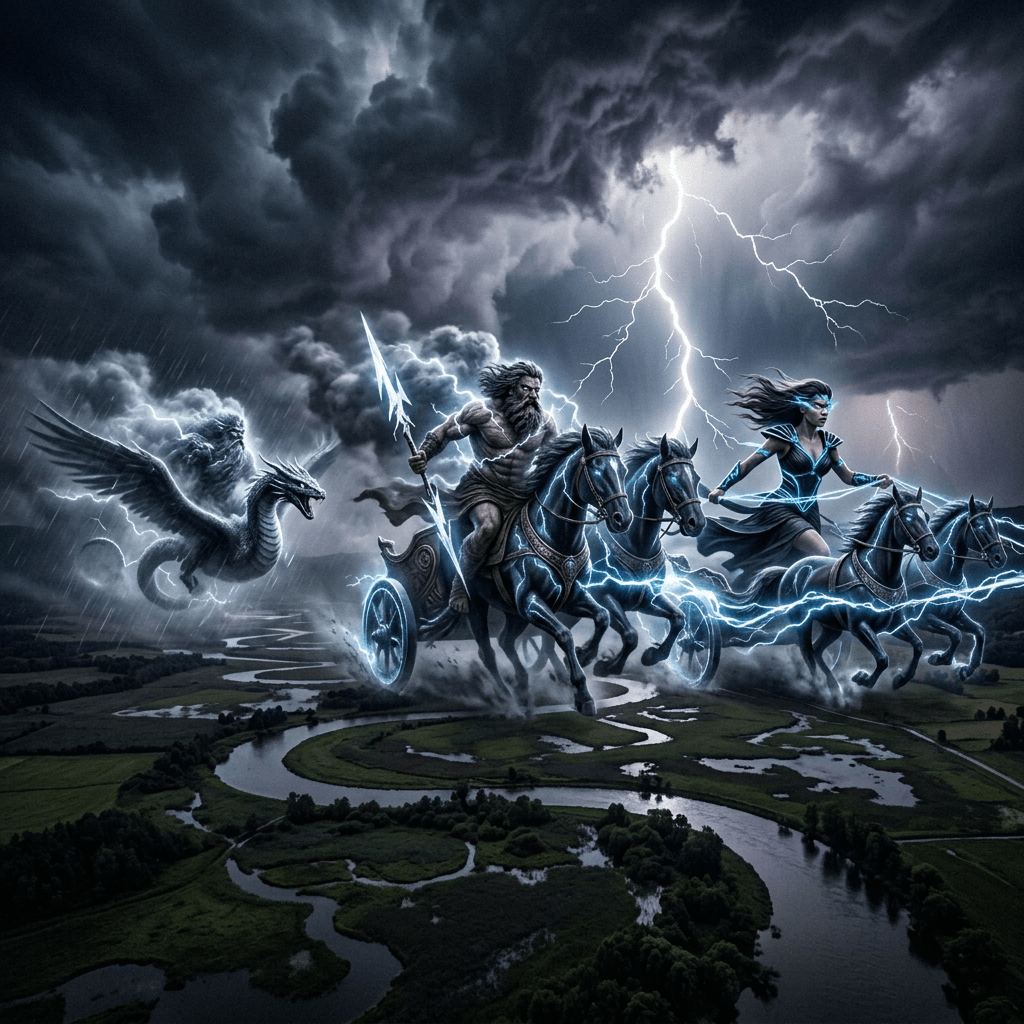
In the Vedic pantheon, the Maruts occupy a singular place. They are not a single god but a troop — a band of fierce, roaring, impetuous young gods who travel together on their blazing chariots and shake the world in their wake. Their name itself says it: « those who cause death » — the winds. But in the Rig Veda, they are far more than meteorological phenomena. They are wind energy deified — the force of the wind internalized, transformed into spiritual power.
In the glossary of The Civilization of the 7 Rivers, the definition is precise: the Maruts are the sons of Rudra, the companions of Indra, and they are the gods of energy, willpower and vital force.
The roaring troop
The Maruts appear in dozens of hymns of the Rig Veda, always as a group — never alone. Hymns 1.37, 1.38, 1.64, 1.85, 1.86 and 1.87 are entirely devoted to them in the first mandala alone. And the portrait that emerges is that of a collective, explosive energy, at once terrifying and beneficial.
Hymn 1.37, composed by the rishi Kaṇva Ghaura in Gāyatrī metre, describes them in my translation:
1.37.6 — Who is the strongest, O Heroes, of those who shake the Sky and the Earth? You shake them like garments.
1.37.7 — At your violent and furious approach, Man stands firm. Hills and mountains flee.
1.37.8 — Under your swift footsteps, the Earth trembles like a clan chief weakened by fear.
1.37.12 — Maruts, you have the Force, shake men, shake the mountains.
1.37.13 — When the Maruts travel, they speak together, everyone hears them.
This last verse is remarkably precise: when the Maruts pass, everyone hears them. The wind does not need to show itself. It makes itself heard. And it speaks — collectively, in chorus, in that roaring which is at once thunder and the voice of the gods.
Sons of Rudra, companions of Indra
The genealogy of the Maruts says something essential. They are the sons of Rudra — the cosmic force of the storm, of necessary destruction, of renewal through violence. And they are the permanent companions of Indra — the inner force that strikes resistance, that frees blocked waters, that opens paths.
This double filiation is a map of the Vedic psyche: the energy of the wind is at once destructive and liberating. It fells dead trees, scatters storm clouds, brings rain, renews the atmosphere. It is violence in the service of life.
Hymn 1.64, composed by the rishi Nodhas Gautama, describes them with extraordinary iconographic richness:
1.64.2 — They are born of the Sky, these sublime and vigorous children of Rudra, free from evil and divine, immaculate. They are pure as suns, warriors like storms of terrible form, falling in rain.
1.64.4 — With magnificent ornaments, they adorn themselves with golden chains on their chests and gather in Beauty. On their shoulders are the shining lances. They are born, together, by their inherent power, the Men of the Sky.
1.64.5 — Roaring, giving Force, destroying enemies, they created the winds, the lightning with their Forces. The divine agitated ones milk the udder of the Sky and make the surface of the Earth swell with the juice.
This last verse says everything: the Maruts milk the udder of the Sky — they extract rain from the clouds as one extracts milk. Wind energy and rain energy are one and the same force, in two of its manifestations.
1.64.6 — The generous Maruts make the Waters grow as liquid clarified butter makes knowledge grow in the Intermediate World. They bring, like the valiant Horse, the cloud which they milk like an udder and which flows.
1.64.11 — Those with golden wheels raise the Water and push it to an appropriate place like mountains. The Maruts of violent excitement, with shining lances, go their own way, joyful, intelligent, shaking what is fixed.
The Maruts and the Vedic double reading
In Vedic spirituality, no god is merely a natural phenomenon. The double reading is always present: the outer phenomenon and the corresponding inner force.
The outer Maruts are the winds — the storms that precede the monsoon, the gusts that scatter storm clouds, the tornados that sweep the plains of the Indus-Sarasvatī. But the inner Maruts are something more precise: vital energy, the prāṇa that circulates in the body, the willpower that shakes inner resistances, that « causes death » to obstacles to awakening.
Hymn 1.85 by Gotama Rāhūgaṇa specifies this inner dimension:
1.85.1 — Those who, like women walking with grace, perform wonderful actions, are incitators — these are the sons of Rudra. The Maruts have actively grown the Sky and the Earth, the Hero and the Agile ones become intoxicated in wisdom.
1.85.3 — When the Sons of Light, resplendent in their ornaments, put splendour on their magnificent bodies, they drive out the hypocrites and on their paths, the Light is freed.
1.85.10 — With vigorous Force, they pushed the well upward and split the Mountain. The Maruts, generous donors, in the intoxication of the soma, made me rejoice.
And in hymn 1.86:
1.86.9 — O You, power of Truth, make That manifest through your greatness. Pierce the Rākṣas with your Light.
1.86.10 — Hide the Darkness as secretly as possible, drive away all demons! Create the Light that we desire!
The Maruts drive away inner darkness — the obstacles to Light, the forces that block spiritual energy. They are the storm of awakening — violent, collective, irresistible.
What the Maruts reveal about the 7 Rivers civilization
A civilization established in the plains of northwestern India, between the Indus and the Sarasvatī, lived under the rule of monsoons and seasonal winds. Wind was not an incidental phenomenon — it was the force that preceded vital rain, that determined whether the year would be abundant or barren, that could destroy crops as easily as save them.
In this context, elevating the wind to the rank of collective divinity — a troop of fierce young gods, never alone, always in motion, always roaring — was not decorative metaphor. It was the recognition of a fundamental cosmic force, at once respected and invoked.
The troop of Maruts is also the image of a civilization that functioned collectively. Not a chief, not a king, not one dominant wind — but a troop, a group, a shared energy that advances together and speaks with one voice when it passes.
1.37.13 — When the Maruts travel, they speak together, everyone hears them.


Votre commentaire