There is in the Vedic tradition a concept that resists all definition — not because it is obscure or esoteric, but because its very nature renders every definition insufficient. This concept is Brahman. And understanding why it resists definition is already beginning to understand it.
Brahman is not a god. It is not a force among other forces. It is not an abstract principle that philosophers invented to account for existence. It is — according to the Vedic vision — reality itself. The only reality. The one of which everything else is only a temporary and partial expression.
What Brahman Is — According to the Introduction of the Rig Veda
In my work on the Rig Veda and the civilization of the 7 Rivers, I return constantly to an obvious truth that Western Indologists have often had difficulty integrating — the Vedic gods are not separate and independent beings who govern the world from a distant Olympus. They are deified natural forces, energies that govern the universe. And these forces are the same as those that govern the human being — because the human being is part of nature, not above it.
Each god is an aspect of Brahman. Agni — fire, light, illumination. Indra — the power of intellect and action. Varuna — the awareness of deep truth. Uṣas — the dawn of knowledge. All these gods, all these forces, all these energies — they are facets of the same diamond. Partial expressions of what, in totality, is Brahman.
The most precise definition that the Vedic tradition has given of Brahman is a Sanskrit formula: sat-cit-ananda. Existence, Consciousness, Bliss. Not three separate properties — a single reality seen from three different angles. What truly exists is consciousness. And this consciousness is bliss — not the passing pleasure of the senses, but a fullness that depends on nothing external.
Mâyâ — Why We Do Not See Brahman
If Brahman is ultimate reality, why do we not perceive it directly? Why do we live in a world of separation, conflict, and suffering — instead of perceiving in all things this unique and blissful reality?
The Vedic answer is Mâyâ. This word — often translated as illusion — deserves attention. Mâyâ is not the affirmation that the world does not exist. It is the recognition that our senses give us a partial and limited perception of what is.
Our eyes do not see infrared, ultraviolet, atoms. Our ears do not hear infrasound, ultrasound. Our intellect cannot directly grasp what exceeds its habitual categories. We perceive the world through filters — biological, cultural, psychological — that give us a partial image of reality.
And the most powerful of these filters is the ego. That psychological structure that experiences itself as separate from the rest, that places the « I » at the center of everything, that evaluates each situation in terms of what it brings or takes from this fictional entity called « me. » The ego is the primary producer of Mâyâ — it creates the illusion of separation where there is fundamentally unity.
Brahman does not reveal itself to the ego. It reveals itself when the ego falls silent.
The Soma — The Direct Path
This is where the civilization of the 7 Rivers contributes something unique in the history of human thought. It did not merely conceptualize Brahman — it developed a method for accessing it directly.
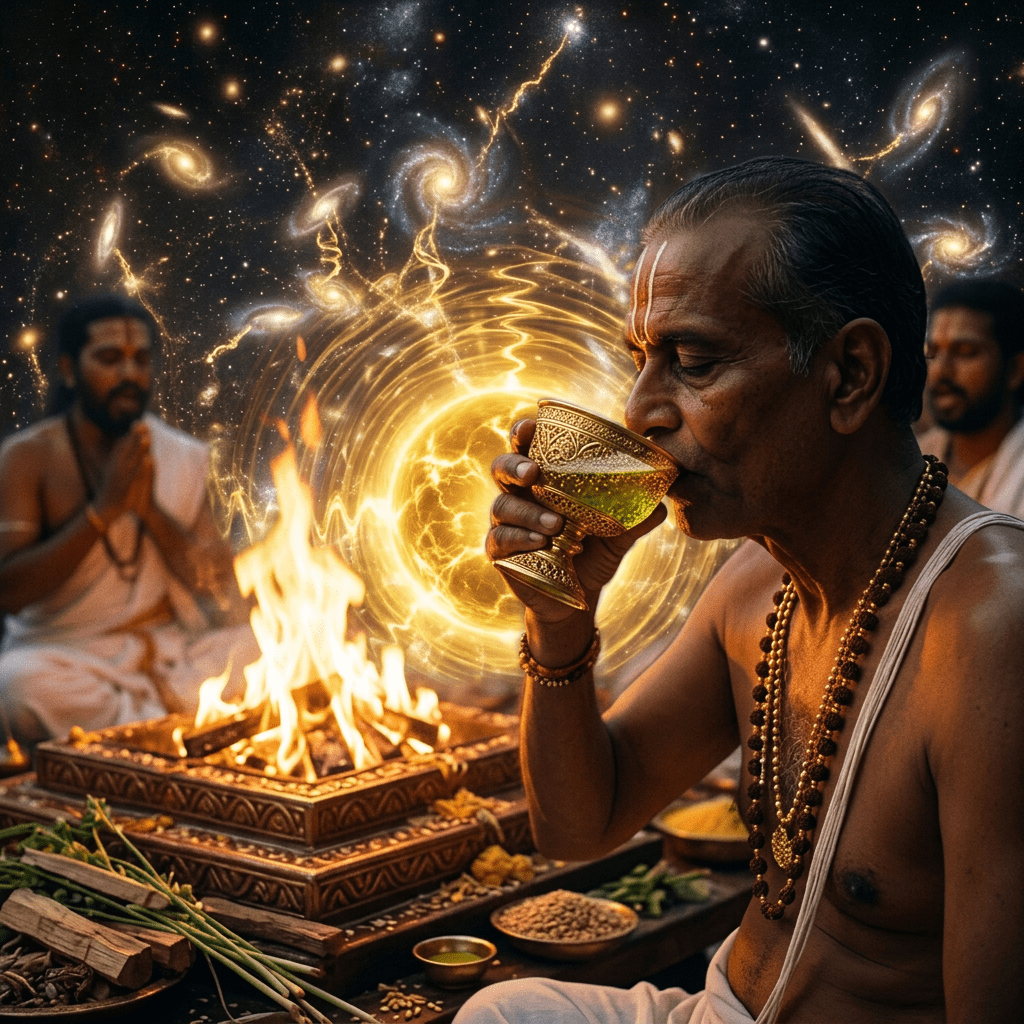
This method is the Soma. The sacred drink to which the ninth Mandala of the Rig Veda is entirely devoted — this unique Mandala in the entire text, dedicated to a single divinity, which says by itself the central importance of Soma in this civilization.
As I explain in my introduction to the Rig Veda, Soma very probably contained a tryptamine — of the same family as the dimethyltryptamine that our brain produces naturally. And its effects, as the rishis describe them in the hymns, correspond precisely to what contemporary research observes with psychedelic substances — expansion of consciousness, dissolution of the ego, feeling of unity with the cosmos, experience of transcendence.
« We have drunk the soma. We have become immortal. We have entered the Light, we have found the gods there. » (Rig Veda 8.48.3, translation Hervé Le Bévillon)
This is not poetic metaphor. It is an account of a lived experience. An experience in which the habitual filters of perception — and first among them the ego — temporarily dissolve, and what appears is Brahman. Reality as it is, without the distortions of Mâyâ.
This is why I insist, in my work on ṛta, on translating this term not as « cosmic order » — which makes it something abstract and external — but as Truth or Reality. The directly perceived reality, without filter. The one that can only be understood by living it.
The Gods as Inner Forces
Another fundamental aspect of the Vedic vision of Brahman that my work on the Rig Veda illuminates — the gods are not external to the human being. They are internal.
When a rishi invokes Agni — the sacred fire — he is not calling an external entity. He is activating within himself the force of light, of transformation, of illumination. When he invokes Indra — the power of lightning — he mobilizes his own mental and spiritual energy. When he invokes Varuna — the guardian of truth — he opens himself to the deep consciousness that sees beyond appearances.
The gods are aspects of Brahman. And since the human being is himself an expression of Brahman — since his consciousness is a spark of the universal Consciousness — these divine forces are also human forces.
This is what the Vedic sacrifice says in its spiritual reading — not a magical ritual to attract the favors of capricious gods, but an inner practice to activate within oneself forces that sleep there.
Brahman and Ego — The Heart of the Matter
What connects the Vedic vision of Brahman to the crisis we are living today is direct and unambiguous.
Our civilization has organized its collective life around the ego — individual and collective. Accumulation, domination, competition, unlimited consumption — these are expressions of the unregulated ego, of that psychological structure that experiences itself as separate and always wants more.
The civilization of the 7 Rivers had found — through Soma and through sacrifice — a mechanism for regulating the ego. Its leaders regularly drank a substance that temporarily dissolved their egotic boundaries, that gave them the direct experience of unity, that made impossible — during this experience and in the time that followed — wanting to dominate, accumulate, exploit.
Archaeology confirms it. Fifteen centuries without trace of organized warfare, without palaces for the powerful, without slavery, without excessive accumulation. A civilization that lasted longer than any that preceded or followed it.
Brahman is not merely a philosophical concept. It is the key to understanding a civilization that succeeded in something ours is incapable of — lasting, without destroying.
What Brahman Tells Us Today
The question that Brahman poses to our era is not metaphysical. It is practical.
If fundamental reality is unity — if the separation we experience between ourselves, and between ourselves and nature, is Mâyâ, a partial and distorted perception — then the destructions we inflict on the natural world and on other human beings are acts of self-mutilation. We are destroying what we are part of.
And if the ego — that structure that experiences itself as separate and always wants more — is the primary source of this destruction, then the most urgent question of our era is not technological or economic. It is the question the rishis were asking six thousand years ago: how to regulate the ego? How to create the conditions in which human beings — and especially those who exercise power — can access a consciousness that transcends their particular interest?
Brahman is not an answer. It is a question — the most important one there is.
And it is perhaps for this reason that the rishis who asked it still deserve to be read.


Laisser un commentaire