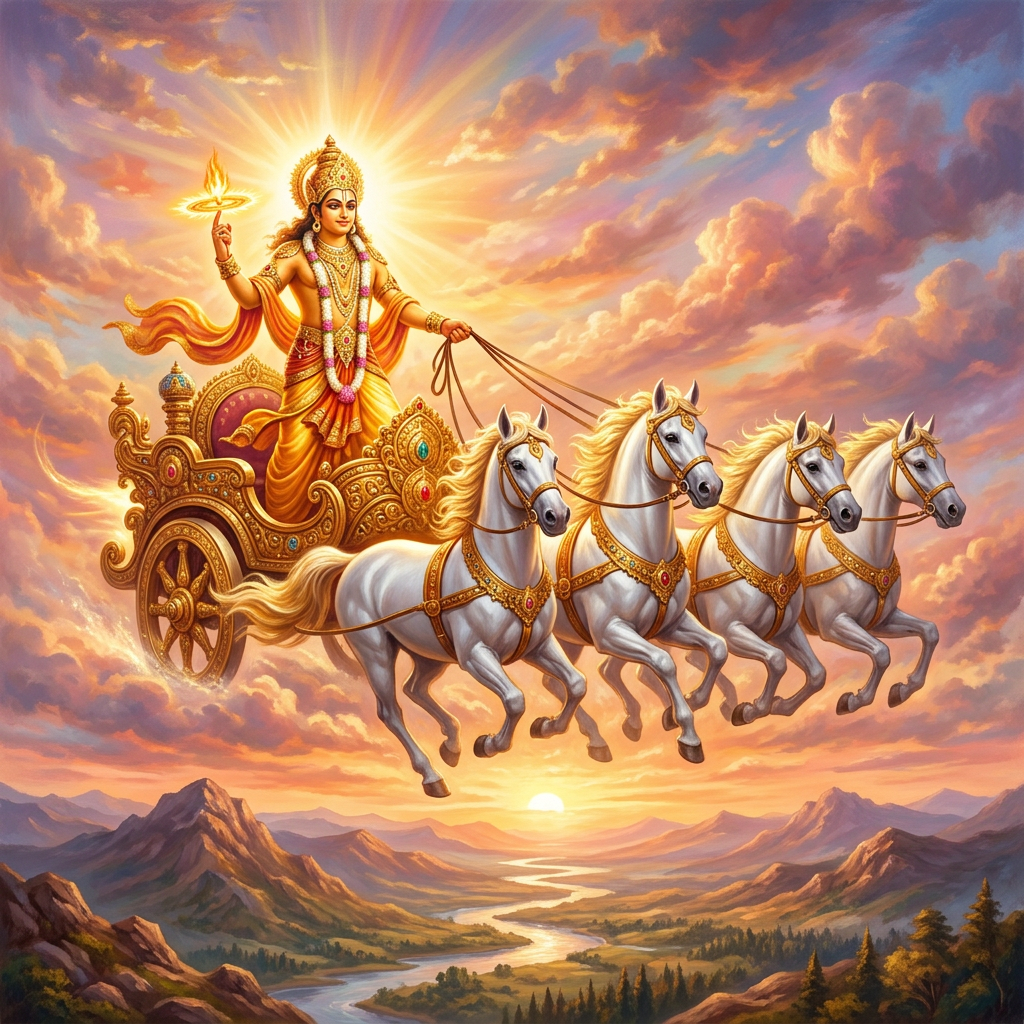
There is in the Rig Veda a presence that runs through all the hymns — visible or invisible, named directly or evoked through metaphor. The sun. Not simply as a physical star, as an astronomical object that rises and sets — but as a fundamental cosmological force, as a principle of knowledge, as the source of all life and all light.
Solar symbolism in the Vedic pantheon is both simple in its fundamental intuition and of extraordinary richness in its developments. Understanding how the rishis thought about the sun is understanding something essential about their vision of the world — and about the heritage they have transmitted to us.
Sūrya — The Sun as God
The first and most direct of the Vedic solar gods is Sūrya — the sun itself, personified and divinized. In the hymns dedicated to him, Sūrya is described with remarkable precision and beauty.
He crosses the sky on his chariot drawn by seven horses — the seven rays of light, the seven colors of the spectrum, the seven notes of the cosmic scale. He sees everything that happens on earth and in the sky — he is the universal witness, the one who illuminates and reveals, before whom nothing can remain hidden.
He is the physician of the gods — his light heals, purifies, dissolves the obscurities that cause illness. He is the one who gives life to plants, animals, humans — without him, everything goes out.
In my translation of the Rig Veda, what strikes in the hymns to Sūrya is their observational precision. The rishis observed the sun with extraordinary attention — its movements, its effects on the living world, its relationship with the moon and stars. Their poetry is a poetry of exact observation transfigured by spiritual vision.
Savitṛ — The Sun as Impulse
Distinct from Sūrya while being intimately related to him, Savitṛ is the sun as impulsive force — the one that sets in motion, that stimulates, that gives impetus.
Savitṛ is the god of the Gāyatrī Mantra — perhaps the most recited mantra in the entire Vedic and Hindu tradition. This mantra, which I have studied at length in my work on the Rig Veda, says something essential about the Vedic vision of the sun:
« Tat savitur vareṇyam bhargo devasya dhīmahi dhiyo yo naḥ pracodayāt »
« We meditate on the splendor of Savitṛ, the divine god — may he illuminate our intelligences. »
The sun is not merely a physical light — it is an inner light, a force that illuminates intelligence, that enables knowledge, that dissolves ignorance as the morning light dissolves the darkness of night.
This equation between solar light and the light of knowledge is one of the deepest intuitions of the Rig Veda — and one of the most fertile in the entire history of human thought.
Mitra and Varuṇa — The Solar Couple
Among the Adityas — those gods sons of Aditi who form the heart of the Vedic solar pantheon — two occupy a particularly important place: Mitra and Varuṇa.
Mitra is the sun of day — the visible, clear, benevolent light that presides over contracts and alliances. His very name means the friend, the ally — the one with whom one has made a pact and who will honor it.
Varuṇa is more complex — he embodies a nocturnal and cosmic dimension of the solar. He is the sun that shines in the invisible, that sees in darkness, that maintains cosmic order even when physical light is absent. He is the god of deep truth, of immanent justice, of that force which maintains the universe in order even when everything seems chaotic.
In the hymns, Mitra and Varuṇa are often invoked together — as the two faces of a single reality, visible light and invisible light, diurnal knowledge and nocturnal wisdom.
Uṣas — The Dawn as Prefiguration
One cannot speak of solar symbolism in the Rig Veda without evoking Uṣas — the Dawn. She is not the sun itself, but its prefiguration, its announcement, the light that precedes the light.
In the hymns to Uṣas — among the most beautiful in all the Rig Veda — the dawn is a young woman who slowly unveils herself, who parts the darkness with a grace that resembles no violence. She is the gentle transition between night and day, between unconsciousness and consciousness, between ignorance and knowledge.
The symbolism is transparent — knowledge does not burst suddenly into darkness. It arrives like the dawn — gradually, gently, chasing away the shadows little by little without combating them.
Viṣṇu — The Sun that Traverses
Viṣṇu — who will become in later Hinduism one of the major divinities — appears in the Rig Veda as a solar divinity of a particular type. He is the one who traverses space in three strides — an image of the sun’s course marking morning, noon, and evening.
These three strides of Viṣṇu — on the earth, in the intermediate space, in the sky — constitute a complete solar cosmology. They say that the sun is not merely a local phenomenon, that it structures all of space in its three dimensions, that it is the measure of all things.
What Solar Symbolism Says About the Vedic Vision
Taken together, this constellation of solar divinities says something fundamental about the worldview of the Vedic rishis.
The sun is not one god among others. It is the organizing principle of the cosmos — that in relation to which everything situates itself, that which gives their meaning to days and nights, to seasons and cycles, to life and death.
And in this solar cosmos, physical light and the light of knowledge are the same thing. To approach the sun is to approach truth. To be illuminated by Savitṛ is to see clearly — not only the outer world, but one’s own nature and the nature of reality.
This vision — that knowledge is a form of light, that ignorance is a form of darkness, that the spiritual quest is a journey toward the sun — has crossed the millennia. It is found in Plato’s myth of the cave. In the solar symbols of Gothic cathedrals. In the mystical traditions of all the great religions.
It comes perhaps, in part, from these hymns composed six thousand years ago in the civilization of the 7 Rivers — by men and women who watched the sun rise over the plains irrigated by the Sarasvatî and saw in that light the same thing as in the light that kindles in the mind when truth reveals itself.


Votre commentaire