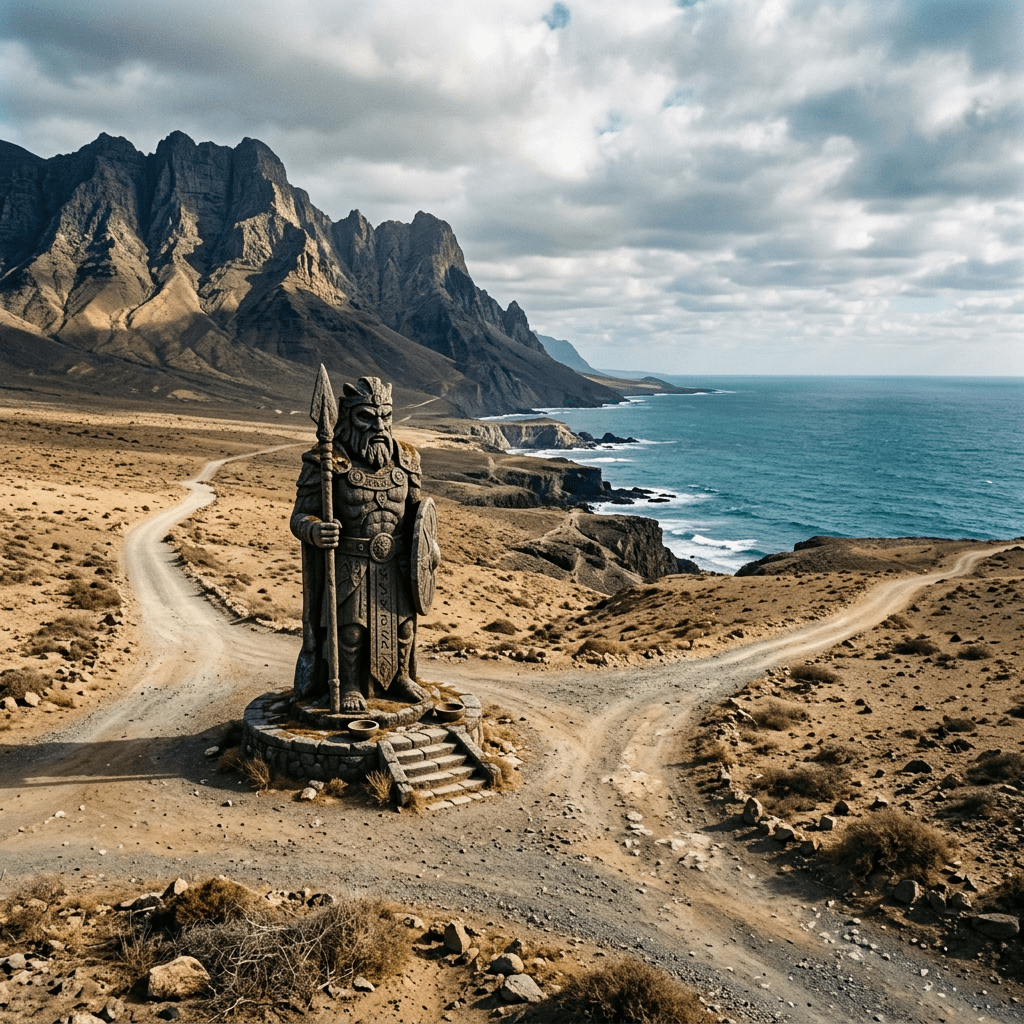
There is in the Rig Veda an Aditya — one of those solar gods, sons of Aditi — whose name and function are particularly striking in the context of our era. Aryaman. The guardian of paths, the protector of travelers, the god of alliances and bonds between communities.
His very name says something essential — « aryaman » in Sanskrit designates one who is a friend, a traveling companion, someone with whom one shares the road. The root « arya » — so tragically diverted by the racist ideologies of the twentieth century — originally meant in the Vedic context not a race or a superior people, but a moral quality — nobility of behavior, hospitality, respect for the bonds that unite human beings with one another.
Aryaman is the god of this nobility in relationships. And in a world where forced migrations are reaching historical records, where borders are closing, where hospitality has become an explosive political issue — he has something urgent to tell us.
What Aryaman Embodies in the Hymns
In the hymns of the Rig Veda, Aryaman is invoked for several functions that hold together and complement each other.
He is the guardian of paths — the one who protects travelers on the roads, who wards off the dangers of travel, who ensures that those who journey will arrive at their destination. In a world where roads were dangerous, where travelers were vulnerable, this protection had immediate practical value.
He is the god of marriage and alliances — the one who presides over unions between families and communities. Vedic marriage was not merely a private matter — it was a political act, an alliance between two groups, a way of weaving bonds that surpassed the individual. Aryaman guaranteed the solidity of these bonds.
He is the guardian of customs and ways — « panthah » in the hymns designates both physical paths and ritual ways, the customs that structure social life. Aryaman ensures that these ways remain practicable, that the rules enabling coexistence are respected.
This triple function — protecting travelers, weaving bonds between communities, maintaining the ways that allow coexistence — is a remarkably precise description of what our world needs in the face of the migration crisis.
The Migration Crisis — What It Really Is
The « migration crisis » our media and politicians speak of is often presented as an invasion — masses of people arriving from outside and threatening the order and culture of receiving countries.
This presentation is both factually partial and profoundly misleading.
It is factually partially accurate — international migrations are at a record level. In 2023, the number of forcibly displaced people in the world exceeded 110 million — refugees, asylum seekers, internal displaced persons. A figure never reached since the Second World War.
But it is profoundly misleading about causes and responsibilities. These migrations do not fall from the sky. They have documented causes — the wars that wealthy countries have fueled or provoked. The climate disruption that wealthy countries have primarily caused and which renders entire regions uninhabitable. The economic policies imposed by international financial institutions controlled by wealthy countries that have destroyed local agricultures and economies. The global inequalities — themselves largely produced by economic relations between North and South — that make migration a survival necessity for millions of people.
In other words — the countries that complain most about migrations are often those that have contributed most to creating the conditions that produce them.
What Aryaman Teaches Us About Hospitality
In the Vedic tradition, hospitality is not a generous option granted when one feels like it. It is a fundamental moral obligation — one of the practices that define nobility of behavior, arya.
The Atharva Veda — Vedic text complementary to the Rig Veda — formulates this obligation clearly: the guest who arrives is a god. To refuse them is to refuse the divine. To welcome them is to participate in the cosmic order.
This vision of hospitality as sacred obligation is not specific to the Vedic tradition. It is found in virtually all cultures of the world — in the Abrahamic tradition where Abraham welcomes strangers, in the Greek tradition where Zeus himself can appear in the guise of a stranger, in African and Native American traditions where hospitality is a fundamental value.
This is not a coincidence. It is the universal recognition that mobility is a condition of human life — that we have all been, at one moment or another in our individual or collective history, strangers on a territory that was not our own. And that the way we treat strangers is a mirror of who we are.
Blocked Paths — and Their Consequences
Aryaman is the guardian of paths. When paths are blocked — when borders close, when migration routes become deadly, when receiving countries erect physical and administrative walls — it is not movement that stops. It is death that arrives.
The Mediterranean has become the deadliest maritime border in the world. Thousands of people die each year attempting to cross it — not because the crossing is impossible, but because legal and safe routes have been closed, forcing migrants to take dangerous paths managed by traffickers.
This is not a natural tragedy. It is the result of deliberate political choices — by countries that have decided that the death of thousands of people is an acceptable price to deter migrations.
Aryaman, the guardian of paths, is outraged.
Migration as a Reality of Human History
There is a fact that anti-migration discourse systematically obscures — humanity has always migrated. It populated the entire planet through migrations. All current populations are the result of successive migrations — some voluntary, some forced, all transformative.
The Indus civilization — the 7 Rivers of which the Rig Veda speaks — was itself the product of migrations and population mixtures. Recent DNA analyses of Harappan skeletons show a genetically diverse population — the result of millennia of movements, encounters, mixtures.
France — the country that struggles most with the question of national identity in the face of migrations — is itself the product of twenty centuries of successive migrations. Gauls, Romans, Franks, Visigoths, Normans, Huguenots, Poles, Italians, Spaniards, Portuguese, North Africans, Sub-Saharan Africans — each wave contributed to what we call today French culture and identity.
Aryaman — the god of paths and alliances — knows what the identitarians forget. Cultures are not pure and immutable essences. They are living processes, in constant movement, transforming themselves at each encounter.
What Aryaman Asks of Us
Aryaman does not ask us to ignore the practical realities of migrations — the challenges of integration, the pressures on public services, the legitimate questions about the pace and modalities of reception. These realities are real and deserve to be seriously addressed.
He asks something more fundamental — to treat people who migrate as people. Not as a « wave, » not as an « invasion, » not as a « threat » — but as human beings who have histories, families, skills, dreams, and who generally move not by choice but by necessity.
He asks us to face squarely the collective responsibilities of wealthy countries in producing the conditions that force these migrations — and to assume these responsibilities rather than fleeing them by closing borders.
And he reminds us that alliances between peoples — that cultural mixtures, that encounters between differences — have always been sources of richness and renewal. That societies that open to the world transform themselves — sometimes painfully, always durably.
In a world that is collapsing — in a world where climate migrations will intensify massively in the coming decades — learning to open paths rather than block them is not a generous utopia.
It is a survival necessity.
Aryaman guards the paths. It is for us to decide whether they are passages or traps.


Votre commentaire