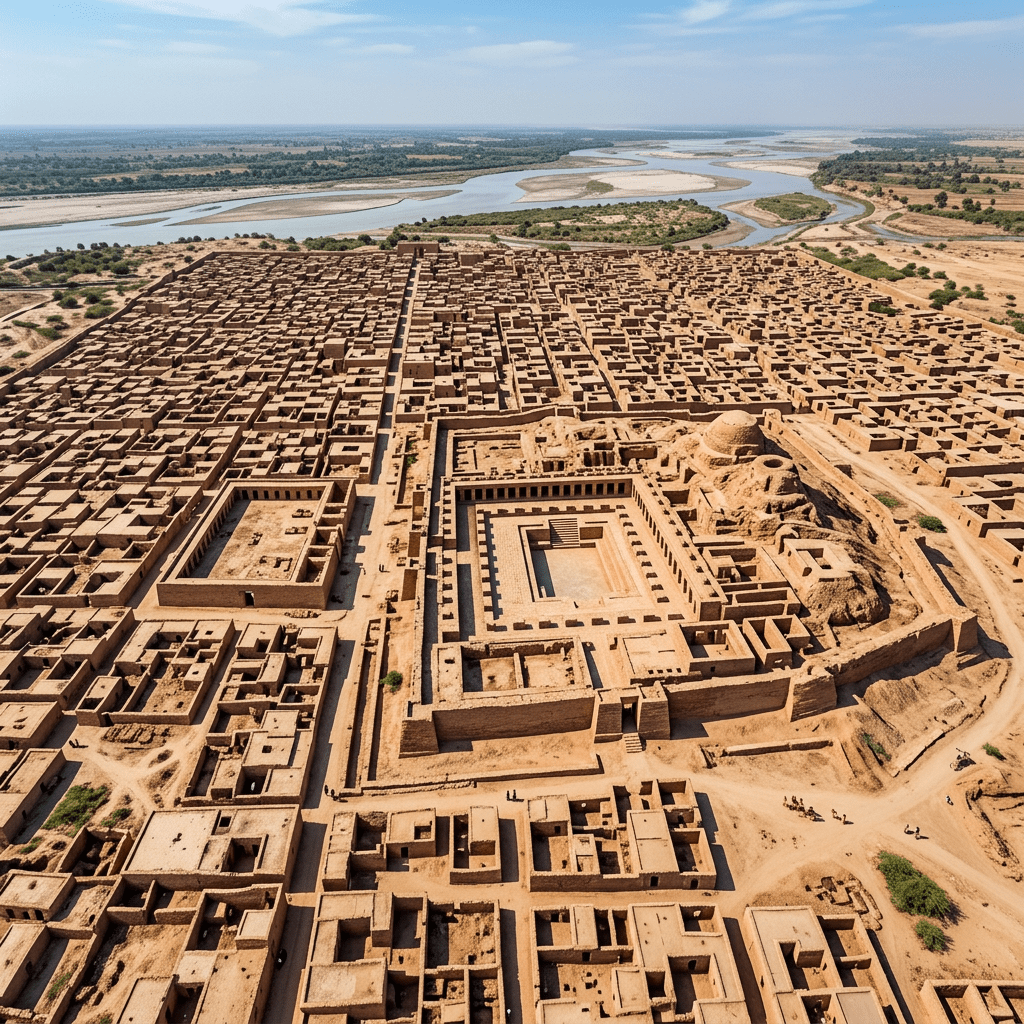
There is at Mohenjo-Daro a structure that has fascinated archaeologists since its discovery in the 1920s. At the heart of the citadel — on the upper part of the city, where the most important buildings are located — a large rectangular basin, carefully constructed in fired bricks, waterproofed with bitumen, supplied with water and equipped with a sophisticated drainage system.
Archaeologists called it the Great Bath. And for a century, they have debated what it really was.
What the Great Bath Tells Us Architecturally
The dimensions of the Great Bath are impressive for the period — approximately 12 meters long, 7 meters wide, 2.4 meters deep. Its builders did not skimp on technique — two layers of carefully laid bricks, a bitumen coating for waterproofing, stairs at each end allowing descent into the water, adjacent rooms that seem to have served as changing rooms or preparation halls.
This level of technical sophistication is not trivial. Building a perfectly watertight basin 4,500 years ago required considerable technical mastery and collective organization of labor. Someone — or an institution — decided that this structure deserved this investment.
And its location is equally significant. The Great Bath is not in the ordinary residential quarters. It is in the citadel — the upper part of the city, the part that seems to have housed governance structures, large grain reserves, major public buildings. It is at the heart of power — or of the sacred, if indeed the two were distinct in this civilization.
Ritual Purification — What the Vedic Tradition Illuminates
In my study of the civilization of the 7 Rivers and its relationship with the hymns of the Rig Veda, one thing strikes — the central importance of ritual purity in Vedic practice. Water is not merely a utilitarian physical element. It is a purifying force — capable of washing not only bodily dirt, but ritual impurity, the defilement that accumulates in ordinary life and renders one unfit for contact with the divine.
The hymns to Apas — the waters — in the Rig Veda describe them as active divine forces, purifying, healing. « O waters, carry away all that is evil in me » — this invocation says something essential about the Vedic relationship to water. It is not passive. It acts. It transforms.
The tradition of purification by immersion — which will become in Hinduism the practice of the sacred bath in rivers, of which the Ganges is today the best-known symbol — plunges its roots in this Vedic vision of water as an active purifying force.
The Great Bath of Mohenjo-Daro fits naturally into this vision. If the civilization of the 7 Rivers shared with the Vedic tradition this conception of purifying water — and everything suggests that it did — then the Great Bath was not simply a hygienic installation. It was a space of collective ritual purification. A place where members of the community came to purify themselves before important ceremonies, before participating in the rites that maintained cosmic order.
Public Hygiene — A Sophistication Without Equivalent
But the Great Bath cannot be understood independently of the rest of Mohenjo-Daro’s hydraulic system — which is itself remarkable.
The Indus civilization had developed a water supply and sanitation system that would not be found in Europe until the Roman period — and even then, not everywhere or with the same generality. Every house in Mohenjo-Daro had access to a well. Every house had a bathroom connected to a covered sewer network that ran beneath the streets. Wastewater was evacuated outside the city in an organized fashion.
This is not a technical curiosity. It is a vision — a vision of what urban life should be. A vision that places collective health, cleanliness, access to water for all at the rank of fundamental priorities.
This vision contrasts strikingly with what is observed in the other great civilizations of the period. In Babylon, in Memphis, in Mesopotamian and Egyptian cities, sanitation systems are rudimentary or nonexistent. Common pits, waste in the streets, contaminated water — this is the urban norm of the era.
The civilization of the 7 Rivers had made a different choice. It had invested in collective health infrastructures rather than in monuments to the glory of the powerful. It had considered that access to clean water and sanitation was not a luxury reserved for elites — but a basic condition of urban life for everyone.
The Great Bath as Social Space
Beyond its ritual function and technical sophistication, the Great Bath was probably a social space — a gathering place, a meeting place, a place for maintaining community bonds.
In societies where public baths have played an important role — Roman thermae, hammams of the Islamic tradition, Japanese sentō — they have always fulfilled this social function. People met at the baths. They talked. They debated. They conducted business. They maintained the bonds that structured the community.
The Great Bath of Mohenjo-Daro was perhaps this place — where ritual purification and social interaction overlapped, where the body was cleansed and social bonds strengthened in the same space and in the same gesture.
What the Great Bath Tells Us About the Civilization of the 7 Rivers
In my book on the civilization of the 7 Rivers, I return often to this question — what had this civilization understood that we have forgotten? The Great Bath is one of the most concrete answers.
It had understood that hygiene is a collective matter — that the health of one member of the community affects the health of all, and that sanitary infrastructures deserve considerable collective investment.
It had understood that body and spirit are inseparable — that physical purification and ritual purification are two faces of the same gesture, that caring for the body is also caring for the soul and for the bond with the divine.
It had understood that collective spaces — baths, granaries, public squares — are the heart of urban life, the place where the community meets, recognizes itself, sustains itself.
These lessons are of burning relevance in a world where public services are privatized, where access to clean water remains a luxury for billions of people, where collective spaces disappear in favor of private spaces.
The Great Bath of Mohenjo-Daro, built 4,500 years ago, poses a simple and disturbing question — an ancient civilization had understood the importance of public hygiene and collective purification. Why do we have such difficulty applying it to our own era?


Votre commentaire