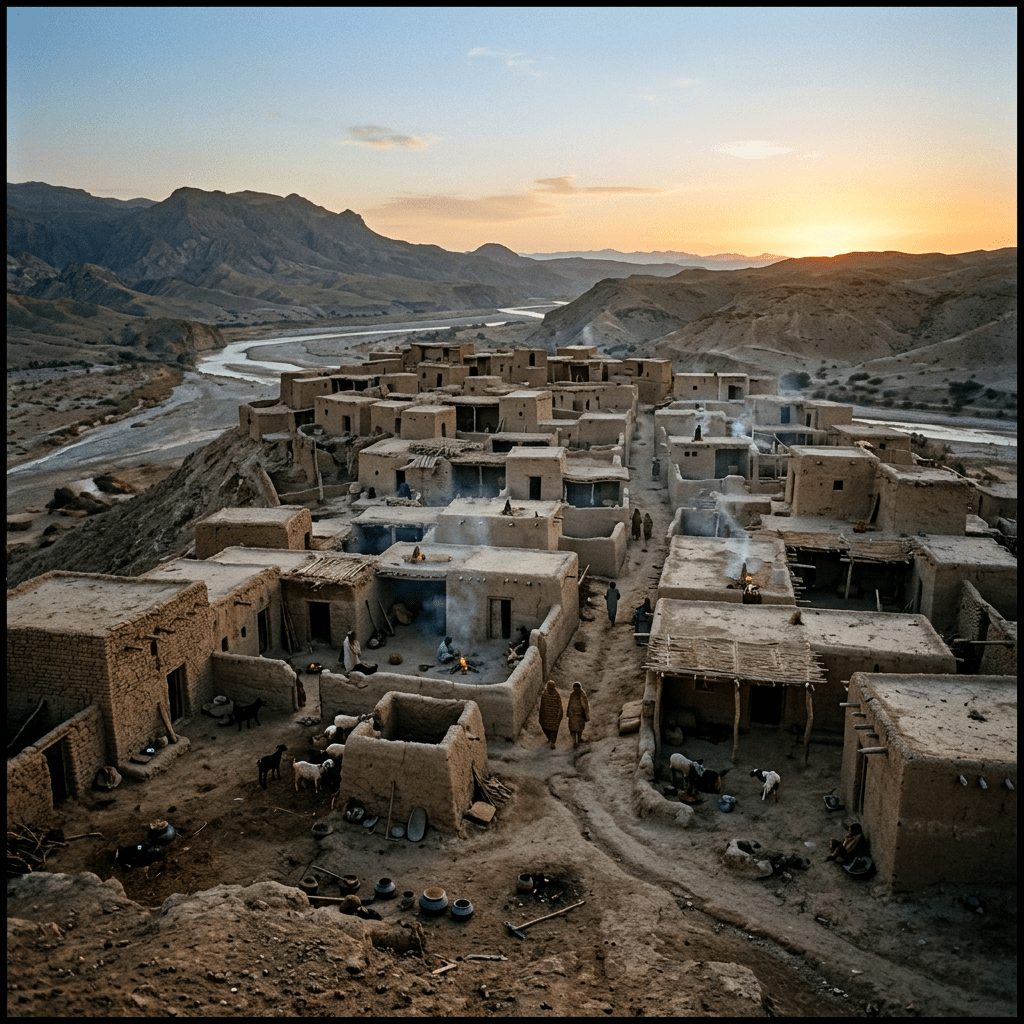
There are archaeological discoveries that silently change our understanding of human history — without making front pages, without provoking the debates they deserve. Mehrgarh is one of them.
This site located in present-day Pakistan, at the foot of the Balochistan mountains, was excavated from 1974 by a Franco-Pakistani team of archaeologists led by Jean-François Jarrige. What they found overturned established chronologies — a continuous human occupation going back to 7000 BCE, perhaps earlier, with levels of social, agricultural, and artisanal organization that nobody expected at this period and in this region.
Mehrgarh was not the first city in the strict sense. Jericho is older — occupied since 9000 BCE. And recent discoveries in Anatolia — notably the site of Çatalhöyük and even older sites — show that organized human settlements have deep and multiple roots. But Mehrgarh was something particular — the first city for which we have evidence of such complete, such effective, such durable organization, in the region that would become the cradle of the Indus civilization.
What Mehrgarh Was
Mehrgarh was not a temporary encampment or a primitive village. It was an organized community that lasted — with remarkable continuity — for more than five millennia. From approximately 7000 to 2500 BCE, this site evolved, transformed itself, weathered crises and renewals, without ever losing the thread of its continuity.
The earliest layers already show established agriculture — wheat, barley, cotton — and the raising of cattle, sheep, and goats. These are not hunter-gatherers fumbling their way forward. These are farmers who master their techniques, who store their harvests, who manage their herds with a sophistication that the excavations clearly reveal.
The collective granaries are one of the most striking elements of the earliest layers. Not individual reserves — collective storage structures, communally managed, that allowed the community to survive bad years without famine striking. A form of collective insurance inscribed in brick — which says something essential about the social organization of this community.
Craftspeople were present from the earliest occupations — potters, weavers, workers in copper and lapis lazuli. The jewelry found at Mehrgarh testifies to a developed aesthetic sense and long-distance trade — the lapis lazuli comes from Afghanistan, certain shells come from the Arabian Sea, hundreds of kilometers away.
What Makes Mehrgarh Unique
What distinguishes Mehrgarh from other ancient sites is its continuity and its evolution. This is not a city that arose, flourished, and disappeared. It is a community that grew, that learned, that transmitted its knowledge from generation to generation for millennia.
The excavations revealed something remarkable — dental practice dating to 7000 BCE. Human teeth with traces of drilling — cavities treated with flint tools. These are the oldest evidence of dentistry in the world. A practical, effective medicine, transmitted in a community that took care of its members.
The funerary practices reveal another dimension. The dead were buried with offerings — food, tools, jewelry. This care given to the deceased testifies to a spiritual life, a reflection on death and the beyond, a continuity between the living and the dead that structures the community through time.
And the animal representations — figurines of bulls, rams — suggesting a symbolic and perhaps ritual connection with domesticated animals. A relationship to the living world that is not merely utilitarian.
The Link with the Indus Civilization
Mehrgarh is directly in the lineage leading to the Indus civilization — that great civilization of the 7 Rivers of which we have often spoken, which flourished between 2600 and 1900 BCE in the plains of Pakistan and northwestern India.
The excavations show a clear cultural continuity — the same ceramic techniques, the same agricultural practices, the same decorative motifs evolve and transform from Mehrgarh to the great cities of Mohenjo-Daro and Harappa. Mehrgarh is not a distant, disconnected ancestor — it is the direct cradle of one of the greatest civilizations of Antiquity.
What was built at Mehrgarh over five millennia — agricultural techniques, artisanal know-how, collective storage practices, exchange networks, social structures — all of this provided the foundations on which the Indus civilization was able to flourish.
What Mehrgarh Teaches Us
The first lesson is a lesson in humility. Our vision of human history is still very partial. Sites like Mehrgarh — and there are probably many not yet excavated or even discovered — show that social complexity, technical sophistication, and collective organization are far older and far more widespread than we thought.
Humanity did not begin by being primitive to progressively become sophisticated. It developed forms of sophistication very early, in very diverse contexts, often without connection to one another. Complexity is an emergent property of human communities — it appears as soon as conditions permit.
The second lesson is a lesson in resilience. Mehrgarh lasted five millennia. Not by remaining identical to itself — by changing, adapting, weathering crises and transformations. This durability is not accidental. It rests on structures that have proven themselves — collective storage, diversification of activities, long-distance exchanges that reduce dependence on a single local environment.
The third lesson is a lesson about what truly matters. At Mehrgarh, people invested in collective granaries, in medical care, in funerary practices, in exchanges with other communities. Not in monuments to the glory of the powerful. Not in armies of conquest. In what allowed the community to live, to heal, to survive bad years, to maintain connection with the dead and with the living.
It is a lesson that our era has difficulty hearing — but which it may need more than ever.


Votre commentaire