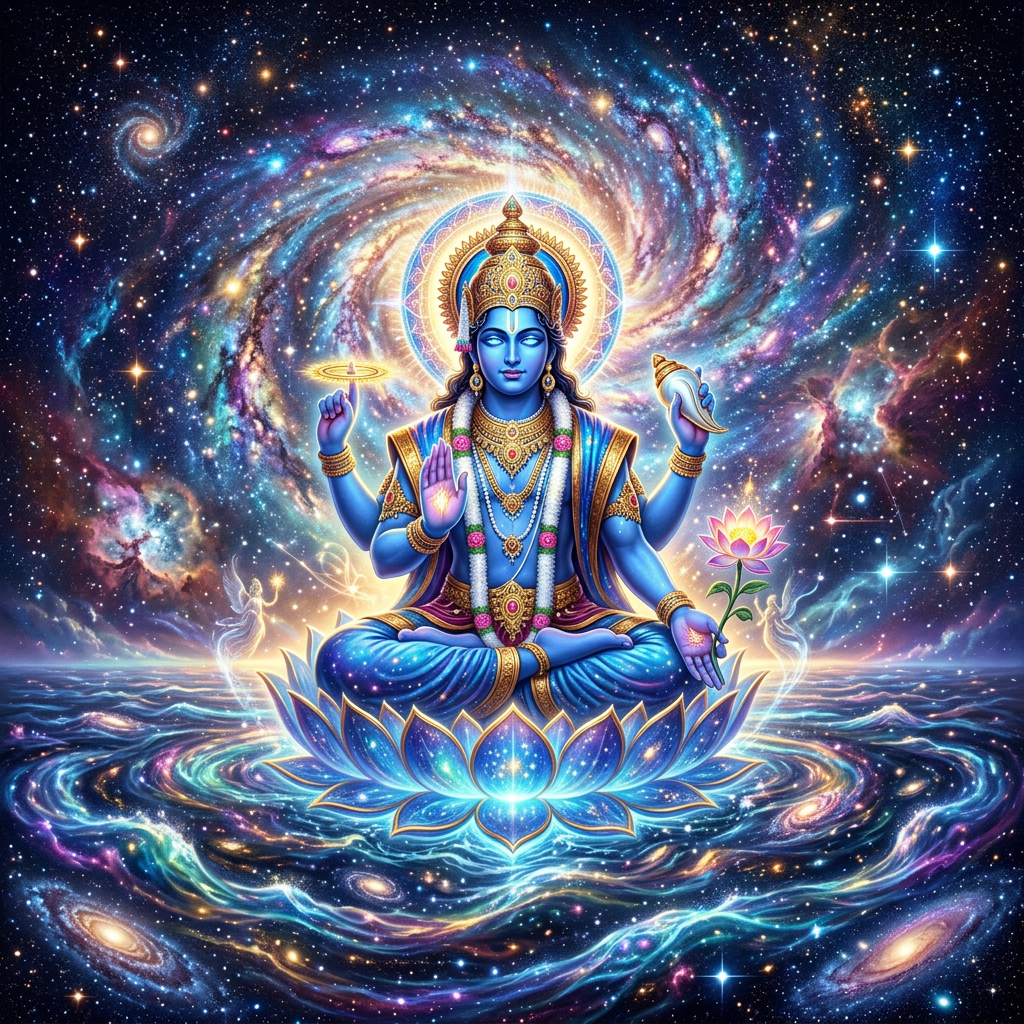
In the vast Vedic pantheon, Vishnu holds a singular place. Where Brahma creates and Shiva destroys and transforms, Vishnu preserves. He is the guardian of cosmic order — the dharma — that fundamental harmony which allows the universe to continue existing and functioning.
This preserving function is not passive. Vishnu is not a motionless guardian contemplating the world from a celestial throne. He intervenes — through his avatars, his successive incarnations in the world of men — whenever the cosmic balance is threatened. Ten principal avatars are traditionally recognized: Matsya the fish, Kurma the tortoise, Varaha the boar, Narasimha the man-lion, Vamana the dwarf, Parashurama, Rama, Krishna, Buddha, and Kalki who will come at the end of time.
What is striking, when we examine these avatars through the lens of our era, is their deep connection to living beings and to ecosystems.
Matsya — the first avatar — is a fish. Vishnu takes the form of a fish to save Manu, the first man, from the universal flood, and to recover the Vedas — the sacred knowledge — swallowed by the primordial waters. The ocean, aquatic life, the water cycle — from his very first incarnation, Vishnu is associated with the fundamental elements of life on Earth.
Kurma — the tortoise — is perhaps the ecologically richest avatar in symbolism. Vishnu takes the form of a gigantic tortoise to serve as the pivot for the churning of the cosmic ocean — that cosmic episode where gods and demons unite to extract amrita, the nectar of immortality, from the depths of the primordial ocean. The tortoise bears the world on its back — a powerful image of the Earth as a living being, of the ocean as the source of all life, of the necessity of a stable foundation for existence to be possible.
Varaha — the boar — is perhaps the avatar whose ecological significance is most direct. Vishnu takes the form of a gigantic boar to plunge into the cosmic waters and save the Earth — personified as Bhudevi, the Earth goddess — who has been dragged into the depths by the demon Hiranyaksha. Vishnu defeats the demon, frees the Earth and brings her back to the surface — restoring her to her rightful place in the cosmic order.
In this image — a god who plunges into the depths to save the Earth from a demon who has torn her from her natural place — some contemporary ecologists have seen a striking metaphor for our current situation. We are Hiranyaksha — the force that tears the Earth from her natural balance, that drags her into the depths of exploitation and destruction. And we need the preserving force of Vishnu — not as a miraculous divine intervention, but as an inner principle, as a collective commitment to restore what has been destroyed.
The dharma that Vishnu preserves is not merely a moral or social order. It is a natural order — the balance of ecosystems, the cycle of seasons, the regulation of species, the fertility of soils and waters. In the Vedic vision, violating this natural order is a transgression as grave — more grave perhaps — than violating a social or moral order.
The Hindu tradition has developed, from this vision, practices of nature protection that have survived through the centuries. The sacred forests — the dev vans or orans — protected around Hindu temples for millennia, are today recognized by ecologists as reservoirs of remarkable biodiversity. Species of plants and animals that have disappeared elsewhere survive in these forests protected by their sacred character.
The sacred rivers — the Ganges, the Yamuna, the Sarasvati — were for centuries objects of veneration that protected them. The sacredness of these waterways was a form of ecological protection long before the concept of environment existed. This is the painful paradox of our era — the Ganges, the most sacred river of Hinduism, is also one of the most polluted rivers in the world. Declared sacredness was not enough against the pressure of industrialization and overpopulation.
But the principle remains valid — and perhaps more urgent than ever. Treating nature as sacred, recognizing in it a value that transcends its economic utility, including it in the circle of what deserves protection and respect — this is precisely what our societies need in order to stop destroying it.
Vishnu the preserver is not a deity of the past. He is a figure of the future — the future where human beings will have chosen to preserve rather than exploit, to maintain balance rather than break it, to recognize their belonging to the natural order rather than claiming to dominate it.
This choice is ours. At every moment.


Votre commentaire